
Many New Yorkers pay attention to food safety grades at their favorite restaurants— but did you know that supermarkets and delis get grades too?
Like restaurants, every food store and deli is required to have a Notice of Inspection with a letter grade A, B or C posted near the entry. But whereas restaurants prominently display signs with large blue letter grades, supermarket inspection notices are usually in regular-size print and not as easily visible to customers.
In a review of store inspection data, the Bronx Times found that the majority of Bronx food businesses received an A in their most recent inspection. A list of the most recent inspection grades showed about six times as many passing than failing scores.
However, in many instances, the A came after a slew of serious violations that put customers at risk. Some businesses operating today were found to have committed egregious food safety violations.
Most notably, one bodega in Mott Haven racked up more than 80 violations, the most in the borough— and the infractions are so egregious that the state is suing to shut it down.
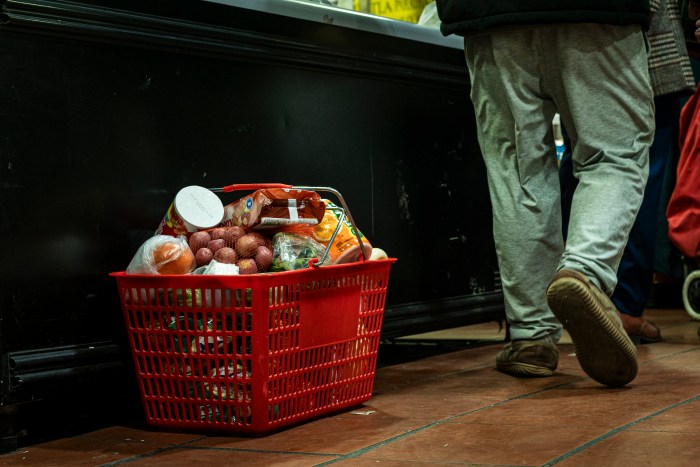 A full cart doesn’t always mean safe food— many Bronx supermarkets earn an “A” grade only after correcting serious violations that shoppers never see. Photo by Jonathan Portee
How bodegas, supermarkets and delis are graded
For each inspection, the New York State Department of Agriculture and Markets uses a grading system implemented in 2024 to align with the restaurant grades New Yorkers are accustomed to.
At grocery stores and delis, the grading system is as follows:
A: No critical deficiencies were found. The food safety program in place is working.
B: Although critical deficiencies were found, they were corrected at time of inspection. There is room for continuous improvement.
C: Critical deficiencies were found but were not or could not be corrected. There is a need for immediate corrective action.
This system functions as pass-fail, because critical deficiencies in the B and C categories can lead to serious food-borne illness. Records show that inspectors typically return to failing businesses every 1-3 months until a passing score is achieved.
The most common violations are evidence of insects, rodents, birds or cats; improper cleaning or sanitation of equipment, surfaces and utensils; inadequate staff handwashing facilities; and foods stored at unsafe temperatures.
The department conducts more than 20,000 inspections each year at not only supermarkets but also manufacturing and processing plants, beverage plants, warehouses, wholesalers, food salvage dealers, bodegas, delis, gas stations and convenience stores.
Businesses are usually inspected once per year, but the department can conduct additional inspections based on customer complaints, which can be filed online.
The state also has the power to issue food recalls. For instance, it issued a recent recall for two varieties of Genesis Bakery breads sold throughout the metropolitan area after they were found during routine inspection to contain soy without the allergen being declared on the label.
If someone with a soy allergy ate the product, they could have died— and yet this violation was only discovered by chance after the state sent samples to the lab.
“The Department is proud of the number of inspections conducted, food samples collected and analyzed at our Food Lab, consumer complaints investigated, and product labeling that is verified for thousands of products, from fish to baked goods. This work has led to hundreds of recalls and the subsequent removal of contaminated food from the food supply,” said a department spokesperson in an email statement.
When stores have repeated critical violations, the state can move to close them, but a spokesperson said that corrective action is always attempted first.
The food safety system that keeps customers safe relies upon consistent monitoring. The department told the Bronx Times that its staffing has increased in recent years— in contrast to the city’s Department of Health and Mental Hygiene, where staffing shortages have resulted in fewer restaurant inspections, as reported by Crain’s and City & State.
The department in charge of retail inspections has recently added a “significant number” of staff, according to a spokesperson’s email.
“From on-farm visits to inspections of our retail food stores, the Department works hard every day to monitor the foods and beverages consumers buy. As part of that, our Food Safety and Inspection team works with New York’s retail food stores to educate these businesses about food safety best practices and ensure compliance with the state’s food safety regulations.”
But many food safety problems are not obvious to customers, and being a safe shopper goes far beyond checking expiration dates.
‘Safe food handling practices start at the grocery store and go all the way through enjoying the final leftovers,” said Bailey McWilliams, a U.S. Department of Agriculture spokesperson, in an email statement sent to the Bronx Times.
McWilliams shared some safe shopping tips, including:
When possible, buy cold items last
Make shopping trips quick, especially in hot weather. When it’s over 90 degrees, it can take only an hour for bacteria to multiply
Wash your hands after touching packages of raw meat
Put raw meat and poultry in a separate bag away from ready-to-eat foods
Wash your reusable bags to avoid contamination
Some of the gross violations found in Bronx supermarkets and delis
The Bronx Times analyzed all supermarket and deli inspection records from the past two years and found a stomach-churning array of violations, including:
Live and dead mice and droppings
Live and dead roaches, beetles, spiders, flies, birds and rats
Packaging showing gnaw marks, droppings or urine stains
Discolored, putrid-smelling and bulging packages
Meats, dairy and other perishable foods with internal temperature between 50 and 70 degrees (should be under 41)
Expired items
Unclean surfaces and equipment (deli slicer, cutting board, juicer)
Cat feces and litter boxes
Items stored directly on the floor
Employees keeping food and drinks in prep areas
Cross-contaminated items (raw shrimp touching cooked shrimp, raw beef dripping onto cabbage heads)
Rancid or moldy foods
Products containing banned ingredients
Home-processed items for sale
Meats and cheeses for sale on top of the display coolers instead of inside
Illegally imported or undocumented items
Missing thermometers in hot and cold storage
In a borough that can little afford to waste food, inspection records also showed more than 450 instances of unsafe products that had to be destroyed on the spot— totaling more than 33,778 pounds, according to a Bronx Times analysis.
Some of these hazardous items were in storage, but many were on display for customers to purchase. They included cooked and raw meats; cheeses, especially soft cheeses; prepared salads; ready-to-eat foods like empanadas, pudding and yogurt; juices; rice, flour and grains; pet food; food coloring and more.
Some notable examples of destroyed product:
La Parada Latina Food Corp., 3822 Third Ave. | Most recent grade: A in Feb. 2025
When inspected on Sept. 5, 2025, 990 pounds of raw chicken and pork were destroyed with an internal temperature of 72 to 78 degrees (should be below 41)
Sy Strawberry Farms and Grocery, 3402 Westchester Ave. | Most recent grade: A in Sept. 2024
When inspected on July 8, 2024, 1,800 pounds of yogurt, deli meat, cheese and other items were destroyed with an internal temperature of 58 to 72 degrees
Lola’s Deli and Grocery, 4008 Bronxwood Ave. | Most recent grade: A in Oct. 2025
When inspected on August 7, 2025, 60 containers of Gerber baby food were found “decomposed as evidenced by putrid odor and discoloration,” with expiration dates as far back as November 2023
Hernandez Deli Grocery, 774 East 149th St. | Most recent grade: C in Oct. 2025
When inspected on Sept. 18, 2024, 232 bags of rice totaling 646 pounds were found infested with grain beetles
The state sent the Bronx Times a list of the most recent inspection results for more than 1,400 businesses. We found the highest current failure rates in these zip codes:
10452 | 29 of 104 failed (28%) Highbridge/Mt. Eden
10453 | 13 of 50 failed (26%) Morris Heights
10454 | 13 of 45 failed (29%) Mott Haven/Port Morris
10457 | 12 of 45 failed (27%) Belmont, Tremont, Mt. Hope
10465 | 7 of 24 failed (29%) Throggs Neck, Country Club
Data confirmed April 7, but can change by the day with the addition of new inspections
Failing to pass?
The Bronx Times examined the records for a few supermarkets near me and found that the three closest options all received As on their most recent inspections— but their past records were less reassuring.
Shop Fair at 228 Brook Ave. had 20 violations in a single Jan. 2025 inspection— citing flies, unsafe temperatures of deli meats and cheeses and 60-80 mouse droppings found in the basement, among other issues— and then received an A in April.
Pioneer at 256 St. Ann’s Ave. racked up 15 violations on July 11, 2025, for live birds, flies and 50 pounds of packaged hot dogs and sausages that were discolored, bulging and had to be thrown out— but then received an A in September.
Pioneer at 250 Willis Ave., received an A in May 2025 after accumulating 33 violations in September 2024 and March 2025. The store was cited for having no thermometer in the walk-in freezer, yogurt for sale at temperatures more than 10 degrees too warm, 15 pounds of bulging meat packages that were destroyed on the spot, and hundreds of mouse droppings in storage and retail areas— along with a “freshly killed mouse.”
The company did not respond to a request for comment.
If a store goes from C to A, does that mean all is well?
According to the inspection department, that change likely “signifies that the store took the corrective actions needed to ensure the safety of their food supply for consumers, and that our food safety inspectors were diligent in their work to educate store owners on measures and actions needed to come into compliance.”
Improving the safety of any business takes effort from management and employees, and the Bronx Times spoke with one store operator committed to improving in ways both seen and unseen.
In a single October 2025 inspection, Golden Mango in Castle Hill racked up 25 C violations for a live bird inside the store, a dirty ice machine, salmon stored at an unsafe temperature, cutting boards embedded with residue and more.
But when inspectors returned on Feb. 3, 2026, no violations were found, according to state data. Managers who took over in April 2025 said they’ve worked hard to put the store on the right track.
Nicholas Kim, who identified himself to the Bronx Times as the company’s vice president, said taking over the store was “a big process.”
“The store was…it was neglected for a little bit for a period of time before us,” he said. “But that’s just not fair to the community in terms of the quality, in terms of the pricing, in terms of the freshness that they’re getting with, especially with the meat and produce.”
Now, he said he’s most proud of their international offerings and specialty items, which set the store apart from others and have received positive customer feedback. For example, the store carries rice sourced from Haiti and Thailand, olives, sardines, vanilla extract and other items that can be hard to find in the Bronx.
Kim said the main difference is that he walks the store daily, “making sure that the quality of any item in the store is up to the standard of where I believe it should be.”
South Bronx deli open despite 85 food safety violations
When it comes to food safety violations, state records show that the worst Bronx offender is Willis Grocery and Deli Corp at 408 East 138th St. in Mott Haven, which had more than 85 violations across six inspections between 2024 and 2026.
The business is currently facing a lawsuit from the state Department of Agriculture and Markets, seeking to shut it down.
Contact information for the deli’s attorney was not yet available, and the Bronx Times was unable to locate the owner’s contact information.
The lawsuit in the Albany County Supreme Court states that the deli has had “repeated and ongoing findings of critical deficiencies requiring immediate correction” and is a threat to public health and welfare.
In a report submitted to the court, two state inspectors who visited on Jan 31, 2025, noted “severe insanitary conditions” at the store, including 80-100 live cockroaches in multiple locations, a cat in the basement, “brownish grime” built up in the ice machine, cigarette butts in the deli preparation area, soiled floors and equipment and more.
In addition, the store was cited for selling prepared items such as cappuccinos and sandwiches without the required license.
A Bronx Times staff member who visited on April 2 was stopped from taking photos in the store and said the shelves displayed chips, soft drinks, energy drinks, Hostess snack cakes, candy, cigarettes and similar items. He also reported the grill was visibly dirty and that a person was sleeping on the floor in a corner.
Though the store remains open today as the case moves through the court system, it appears many locals have already gotten the message not to buy food there.
A shopper named Dee, who spoke to the Bronx Times after using the deli’s ATM, said she was not surprised to learn that the Willis Grocery and Deli had the most violations in the borough.
“That’s probably why people don’t shop in there,” she said. “This store is okay, but they don’t carry half the stuff that you want. So nobody really goes in their store unless you want a cigarette or beer, or something like that. You know, this store’s not as good as you would think it is.”