
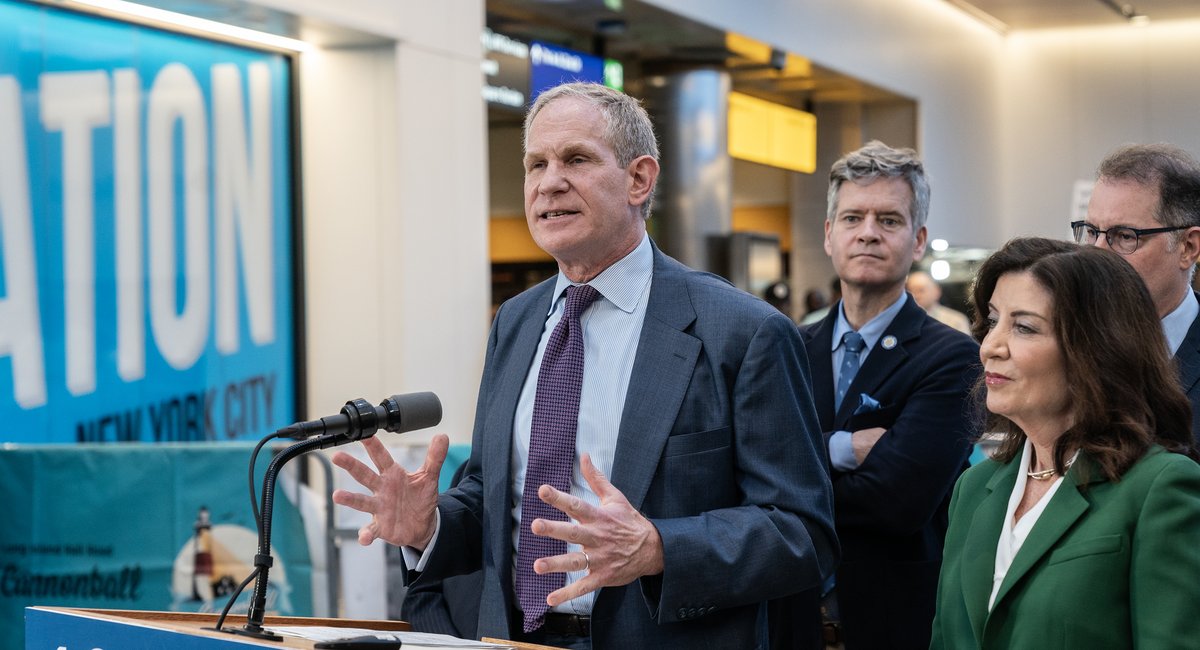
This column originally appeared in On The Way, a weekly newsletter covering everything you need to know about NYC-area transportation.
Sign up to get the full version, which includes answers to reader questions, trivia, service changes and more, in your inbox every Thursday.
The feds are charging ahead with President Donald Trump’s push to rebuild Penn Station, but the MTA — which is the train hub’s biggest tenant — has so far declined to join the cause.
Two weeks ago, Amtrak announced that NJ Transit had signed on as a “key partner” in the transformation effort. That means the Garden State agency will have a seat at the table as the Trump administration picks a “master developer” to rebuild Penn. A decision is expected in May.
Amtrak, the federally run national railroad, owns the station, but the MTA for years led a charge to redevelop the facility. The New York agency runs the Long Island Rail Road and six subway lines through Penn — and plans to add Metro-North service to the station once it completes its ongoing Penn Access project.
MTA Chair Janno Lieber had commissioned plans in 2022 to redesign the station by combining its several levels into one contiguous room. He also planned to build a new entrance on Eighth Avenue and reconstruct the taxiway next to Madison Square Garden in order to bring natural light into the dingy train hall. Lieber convinced NJ Transit and Amtrak to sign an agreement to participate in the redesign.
But Lieber’s plans stalled, and last year Trump swooped in and took control of the project.
Now, Lieber has picked up his ball and gone home.
Speaking at the Citizen’s Budget Commission breakfast in January, Andy Byford — a special adviser to Amtrak now leading the redesign effort — said he offered both the MTA and NJ Transit “full voting rights” in the design competition. Only the latter accepted.
“We invited the MTA to have a seat at that same table,” Byford said.
Amtrak and the federal transportation department said that the MTA remains involved in the project and regularly meets with Byford’s team, but did not say whether it would officially join as a partner.
There’s no love lost between Byford and Lieber. Byford resigned as NYC Transit president in 2020 after then-Gov. Andrew Cuomo stripped his oversight of construction projects and gave them to Lieber, who was head of the MTA’s construction department at the time.
MTA Chair Janno Lieber spent more than $500 million to build a new entrance and upgrade the 33rd Street corridor at Penn Station.
MTA
MTA and New York state officials said they’ve already improved the northern half of Penn Station used by the LIRR. Lieber spent more than $500 million over the last decade to add a new entrance on Seventh Avenue and reconstruct the corridor along 33rd Street that runs next to the LIRR tracks. Cuomo also opened Moynihan Train Hall in 2021, which serves LIRR and Amtrak riders — but does not connect to NJ Transit’s platforms.
According to an information packet Amtrak sent to prospective bidders to redesign Penn Station in October, the feds have no plans to redo Lieber and Cuomo’s work. Both the 33rd Street corridor and Moynihan Train Hall were specifically highlighted in the packet as sections of the station “not contemplated for inclusion” in the overall redesign.
“LIRR riders overwhelmingly like our new 33rd Street corridor, and our lease gives us the legal standing to protect the entire customer experience there,” MTA spokesperson Mitch Schwartz wrote in a statement. “No matter what the federal government’s process yields, we’ll be at the table to fight for their rights.”
Tom Wright, president of the Regional Plan Association, said the MTA still has leverage in the project because the agency has a lease in the station.
He noted NJ Transit has more to gain from the reconstruction. New Jersey riders rely on Penn Station’s most cramped and outdated parts, including the notorious “pit” where riders crowd while waiting to find out which track their train is departing from before scurrying down to the platforms.
“[NJ Transit] signed up for being a partner with Amtrak and the review of the teams and helping fund part of that, whereas the MTA has a lease that they would like to use as the basis of their negotiations and participation in it,” Wright said. “They think that that protects their rights, but they’re going to have to come to the table as part of this process.”
Mitchell Moss, an urban planning professor at NYU who used to run its Rudin Center for Transportation, speculated that by not signing on as a partner to Trump’s plan, Lieber was buying time until a new president was in the White House.
“This is a 20-year project,” said Moss. “By the time they figure out the legal arrangement for this, Trump will be out of office.”
NYC transportation news this week
Flatbush Avenue construction. City officials are asking drivers to avoid the northern section of Flatbush Avenue between Grand Army Plaza and Livingston Street as the area undergoes a bus-friendly redesign.
A looming railroad worker strike. LIRR workers are preparing to strike next month as negotiations with the MTA over pay increases have stalled.
From Brooklyn to Hollywood. What do “The Taking of Pelham 123,” “The Warriors” and “Coming to America” have in common? They all have scenes filmed in the Hoyt-Schermerhorn subway station. You can hear about why the Brooklyn station was a good place to shoot these films in this NYC Now episode.
New York City’s new “Deliverista Hub.” It just opened. The unused newsstand near City Hall was converted into a respite space for delivery workers to charge e-bikes, get free tune-ups and even legal advice.
Earth Day 2026. Get ready for the return of New York City’s car-free Earth Day on April 25, when dozens of streets across the five boroughs will transform into public pedestrian plazas.
Curious Commuter
Have a question for us? Use this form to submit yours and we may answer it in a future newsletter!
Question from Louis in Manhattan
Are the “fare required” signs on MTA buses a result of Mayor Zohran Mamdani’s campaign proposal to make buses free?
Answer
No. Those digital messages on the city’s fleet of buses date back to 2020, when state officials suspended fare collection for six months in the middle of the COVID-19 pandemic. The MTA opted to make the fare free to protect bus drivers from getting sick by requiring passengers to board through the rear door. After that six-month period, the transit agency brought fares back to the buses and began displaying the “fare required” messages, which officials said was necessary because many people didn’t realize they had to keep paying.
Louis’ question comes as New York Post reporter Craig McCarthy posed a similar query on social media, wondering if the digital signs on the buses were prompted by the mayor’s campaign pledge to make all the city’s buses free. But in reality, New Yorkers have been seeing those messages for nearly six years.