
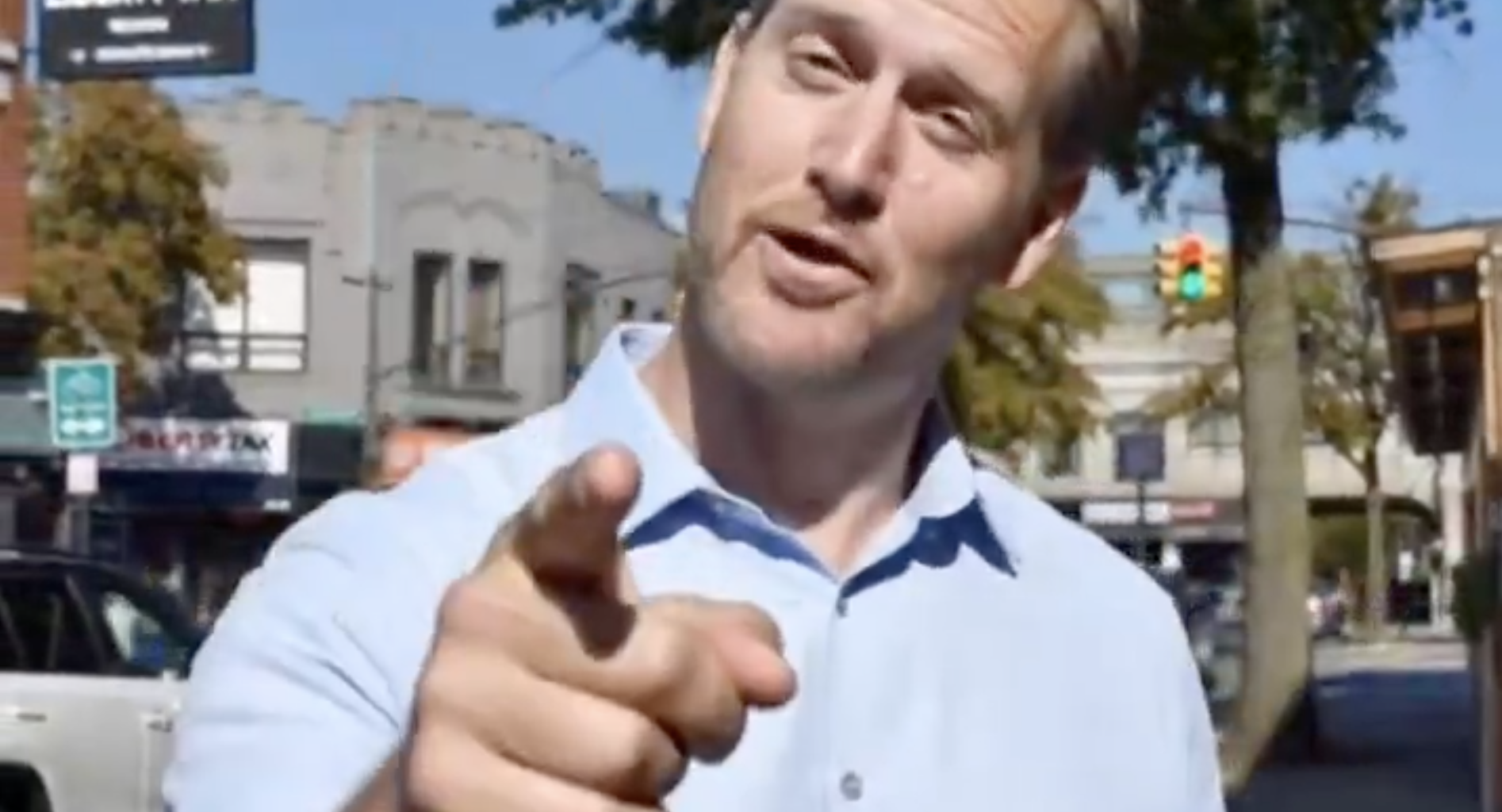
Hevesi declined an interview with the Eagle on Friday, and said he is not seeking any kind of legal relief at this time for the AI video.
“This video says more about who Mr. Rinaldi is more than it does about who I am,” Hevesi said in a statement to the Eagle.
In a text exchange, Rinaldi said that AI, which he has used often in his political campaigns, is an “artistic tool” he uses to present and articulate his ideas.
“AI, like any artistic tool, can be used to visualize ideas, but it doesn’t change the public record or the facts behind what someone has said or done,” he said. “The First Amendment doesn’t die with AI.”
However, there are laws on the books that explicitly restrict this use of AI.
“This video is a perfect example of why we passed this law,” said Queens State Senator Kristen Gonzalez, who sponsored legislation that created the state’s first AI regulations in political campaigning. “There’s no disclaimer. It does not seem to be complete parity or satire, and we want campaigns to have the ability to bring this to court and litigate this.”
“When we say, ‘We should be using AI in a positive way,’ this ad is certainly not what we have in mind,” she added.
Hochul wants the state to go further and outright ban campaigns from using AI images of people, like opposing candidates, without their consent, in the 90 days leading up to an election.
“Now is the time to take action and protect our democracy or risk a slippery slope,” the governor said in January. “We’re leading the nation in setting strong and sensible standards for AI use in elections, protecting voters across the state.”
Gonzalez said she is open to having a discussion about an all-out AI ban, as Hochul proposed, but would first like to strengthen existing laws.
“I think it does make sense to come back to the table and negotiate a stronger version of this bill,” she said. “Whether or not that is an all out ban, I think is something that is still an active discussion.”
She added the State Senate would like to bring up AI policy after the passage of the state’s budget, which is still under negotiation and currently behind schedule.
Rinaldi is running against Hevesi for the State Assembly as a Democrat after running several previous races for Congress and the City Council as a Republican.
He has used AI to campaign going back to last year, when he challenged City Councilmember Lynn Schulman.
During that campaign, he fabricated news headlines flaunting fake endorsements and created AI videos of Queens locals claiming to support his campaign and criticize Schulman.
“I can’t answer how far he will go,” Schulman told the Eagle on Friday. “When he ran against me, he decided that his best path to victory was by lying about me and creating fake news through the use of AI, because he did similar things to divide our community.”
“It doesn’t surprise me that he’s engaged in this type of deceit against Assemblymember Hevesi,” she said.
Besides the recent video of Hevesi, Rinaldi’s social media accounts have continued to post AI-created videos of local Queens residents talking about their support for him. He has also posted campaign videos depicting an AI version of himself.
His website includes AI-generated videos and images of him campaigning and speaking about campaign issues.
Rinaldi’s isn’t the only political campaign that has been called out for its AI usage.
Both former Governor Andrew Cuomo and former Mayor Eric Adams were criticized for their use of AI during last year’s mayoral election, and Queens Council candidate Ruben Wills appeared to use undisclosed AI images on his campaign website.
Gonzalez said that the Rinaldi video and other recent examples are exactly why the state should come back to the table and strengthen its laws governing AI use in politics.
“With the development of artificial intelligence and how rapidly it’s evolving, we’re seeing new pieces of media on a scale and the quality we’ve never seen before that are incredibly convincing and could deeply influence our elections,” she said. “If we want to actually protect our democracy from this misinformation, we have to pass clear guardrails on the usage of deepfakes in elections.”