
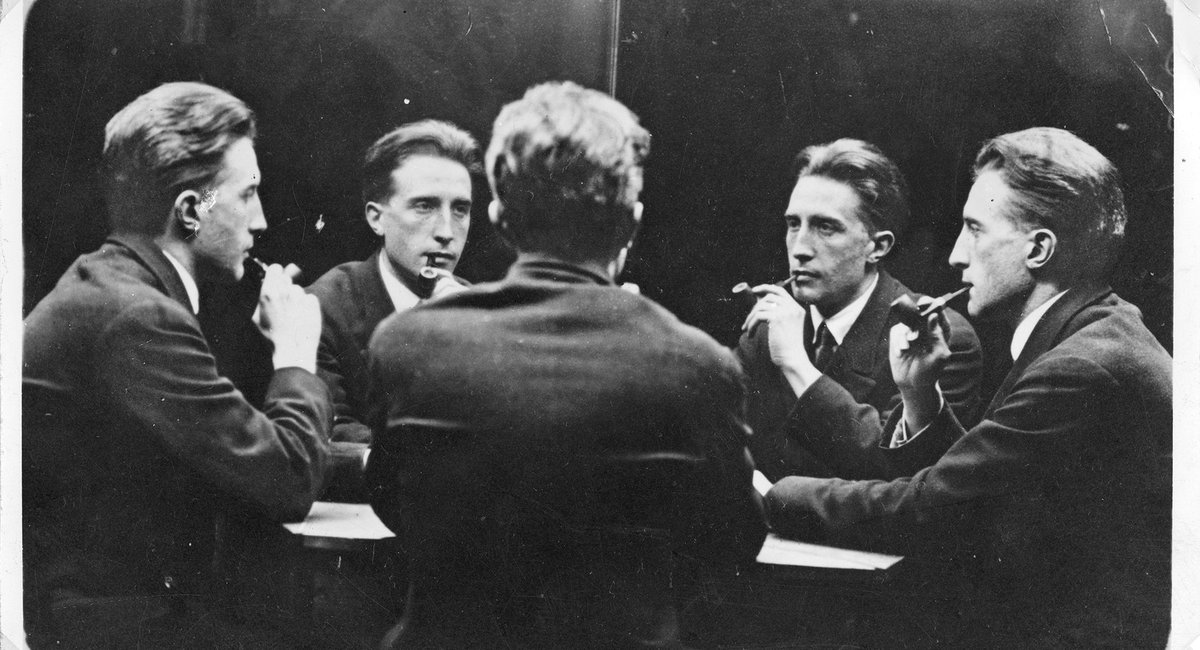
Dada lovers, rejoice!
A sprawling retrospective spanning six decades of Marcel Duchamp’s career opens to the public at the Museum of Modern Art this Sunday.
It’s the first major Duchamp survey held in North America in more than 50 years. The exhibition includes more than 290 works and 100 items of ephemera by the French-American conceptual artist sourced from more than 26 institutions and 29 private collections and galleries. Indeed, all of Duchamp’s greatest hits are here – “Nude Descending a Staircase, No. 2,” “The Bride Stripped Bare By Her Bachelors, Even,” “LHOOQ,” “Étant donnés,” and all four remakes of his famous urinal, “Fountain” (the original was lost soon after it first appeared in 1917).
The show is organized chronologically from 1900 to 1968, and begins with Duchamp’s early drawings, cartoons and paintings before moving into the patron saint of surrealism’s legendarily unconventional work.
One section offers an impressive collection of Duchamp’s readymades, or mass-produced, everyday objects the artist presented as sculptures — a feat he described in 1961 as “the most important single idea to come out of my work.”
A number of these objects have been lost to time, but MoMA has gathered together many still in existence: The replica urinals, as well as a galvanized black iron bottlerack; a snow shovel, hung from the ceiling; a bicycle wheel; a paned window.
The central gallery features the most extensive presentation of Duchamp’s “Box In A Valise” work to date. These “portable museums” offer miniature, meticulously reproduced worlds containing replicas of Duchamp’s work.
Another section includes his experiments with optical illusions and motorized discs, a number of which are covered in spirals and simple illustrations and revolve hypnotically in glass cases.
“Contemporary artworks often prompt viewers to ask, ‘Why is this art?’ It is virtually impossible to answer this question without referring to the work of Duchamp,” said Ann Temkin, exhibition co-organizer and MoMA chief curator of painting and sculpture, in notes on the exhibit. “More than any other modern artist, Duchamp challenged and transformed the very definition of an artwork.”
Co-organizer and MoMA Chief Curator at Large Michelle Kuo added that the “exhibition will foreground the ways in which Duchamp upended conventional oppositions between hand and machine, original and copy, intention and chance, and matter and idea.”
The show is open through Aug. 22.