
Apr 09, 2026
By Queens University Communications
Queens University of Charlotte prides itself on its connection to local businesses and its ability to propel students into the workforce. This is immediately evident in the Knight School of Communication, where a collaboration between the school and a local nonprofit has student names appearing on media bylines in several publications across Charlotte.
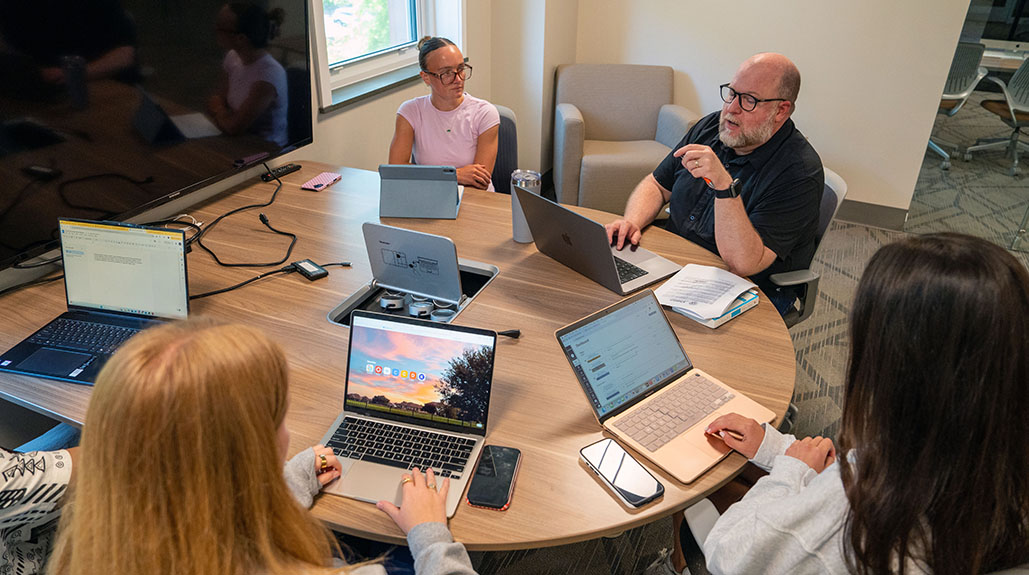
Chris Rudisill teaches news writing and reporting at Queens, helping students learn to write in AP style, interview sources, and tell a cohesive story. He is also the director of the Charlotte Journalism Collaborative (CJC), a conglomerate of six local newsrooms, the Charlotte Mecklenburg Library, the Charlotte Urban Institute, and the Knight School.
“At its core, we are here to serve residents of Charlotte,” said Rudisill. “The CJC formed around the idea that we could do more together than any of us could do alone.”
It takes on a solutions-focused approach to its reporting and encourages its media partners to do the same, meaning it doesn’t just identify issues affecting the greater Charlotte community but, in a departure from traditional “hard news,” also proposes paths forward to begin addressing them.
This fosters a unique angle on stories that often sees the media working directly with residents to create more lines of dialogue, host forums, and spread their message together.
“It’s why we’re not just made up of local media outlets,” said Rudisill. “It’s why the library is part of the Collaborative as well, and why universities are partnered with our Collaborative.”
The Queens News Service Finds New Wings
Technically, Queens has always been a partner with the CJC, joining as a founding sponsor in 2019, but Rudisill found an opportunity to elevate the cooperation to new levels when he moved their main office into the Knight School in the summer of 2024.
The Knight School suggested Rudisill collaborate with its Queens News Service, an initiative where students create content for local media partners. It’s a mutually beneficial undertaking, the student receives guidance from professionals and publishes their own content to help build a portfolio after graduation, while the publication receives cost-efficient freelance support to pursue local stories.
“Those students are doing work that adds to the breadth of news and information that’s coming out in our community,” said Rudisill. “They’re able to graduate with published stories that are shared among our CJC media partners and widely published across the Charlotte region.”
Students pursue a variety of topics, typically with a solutions-based angle in mind. The News Service was successful before Rudisill arrived, notably sending a team to cover the 2024 Summer Olympics in Paris through an initiative set up with the John Belk International Program. But the Collaborative has helped it reach new heights.
“I think by bringing CJC onto campus it further cemented that commitment to local news and local media, and by doing so it gives our students a huge opportunity to get in front of local media outlets, get internships, get real-life opportunities to grow, and potentially job placement when they graduate,” said Rudisill.
Notable stories to come out of the CJC’s collaboration with the Queens News Service include mental health and how it affects college athletes, the debut of the locally-produced opera performance ‘Sweeney Todd’, and a study on whether Charlotte is going to be at increased risk for wildfires in the coming years.
Rudisill sees stories like those as essential to being a service to the Charlotte community, an ethos for both Queens and the CJC. It’s why he feels the partnership between the two is a natural fit.
“The connection was always there,” he said, “the two were always tied close together, but I think moving our office [to Queens] just makes all of this more cohesive and visible.”
Looking Ahead
As students at Queens wind down their spring semester, Rudisill is busy finding more ways for the Queens News Service and CJC to grow together.
The City Bureau Documenters program, which trains residents on how to be local watchdogs at government and agency meetings, will be expanding to Charlotte later in the year, hosted by the CJC and housed in the Knight School. Rudisill is excited about the opportunities this will bring his students.
“It’s a great opportunity for students in other programs that study local government or civic engagement or civic education,” he said. “It’s a paid opportunity as well, which is always nice. They’ll get the training and then they can sign up to do Documenters sites and learn how to cover local meetings and get engaged.”
It’s not just Knight School students who will be able to partake. Documenters is a public program, free to join for any Queens student or resident of Charlotte.
The CJC will also be hosting the 2026 Local News Impact Summit on May 21 on Queens’ campus. This will be the summit’s fifth year, but the first time it’s taking place at Queens. The CJC website describes the summit as a way to bring together “journalists, community leaders, nonprofits, and residents for a day of conversation, connection, and action.”
The focus of this year’s summit will be the CJC’s Shifting Ground project, an exploration of how day-to-day life in Charlotte is being impacted by changing federal funding priorities, especially as it extends to nonprofit organizations trying to assist residents who are most in need. A pillar of journalism centers around providing a voice to the people. The CJC is able to put that mission to use at Queens, where the two take their service-oriented approach to the Charlotte community and work together to mold students into the next generation of storytellers.