
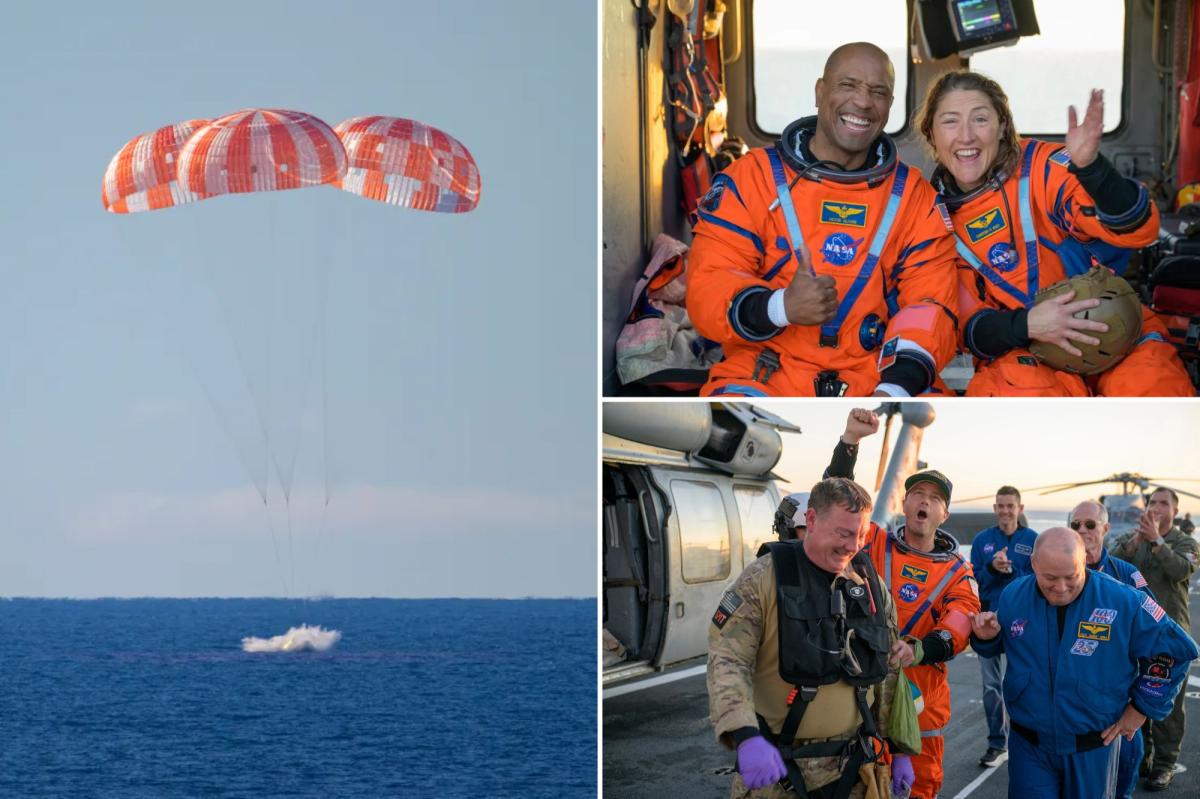
Artemis II spectacularly splashed down in the Pacific Ocean on Friday evening — concluding mankind’s historic return to the moon and completing the first steps toward walking on the lunar surface again.
The capsule perfectly plunked down in the Pacific Ocean off the coast of San Diego precisely at 8:07 p.m. ET, with the dangerous reentry going off without a hitch as giant orange and white parachutes slowed the zooming capsule for a gentle splashdown at 19 mph.
The crew — Cmdr. Reid Wiseman, pilot Victor Glover, and mission specialists Jeremy Hansen and Christina Koch — are all in “excellent shape,” NASA said, calling their landing a “perfect bullseye” that was less than a mile from their target.
The Orion crew module, carrying the four-person crew of the Artemis II, splashes down in the Pacific Ocean on April 10, 2026. NASA via Getty Images
NASA astronaut Victor Glover arrives on the deck of the USS John P. Murtha after returning to Earth on April 10, 2026. NASA/AFP via Getty Images
“Yesterday, flight director Jeff Radigan said we had less than a degree of an angle to hit after a quarter of a million miles to the moon. And their team hit it,” said NASA Associate Administrator Amit Kshatriya. “That is not luck — that is 1,000 people doing their job.”
Artemis II’s peak velocity hit a staggering 24,664 mph — not quite enough to break Apollo 10’s record for fastest reentry in 1967 at 24,791 mph — but impressive in and of itself.
Recovery crews immediately descended on the scorched, gumdrop-shaped craft by boat and helicopter to secure it — after it endured estimated temperatures half as hot as the sun on its way through the atmosphere — and began the extradition process.
Artemis II’s crew were safely out of the capsule and onto a boat — donning their bright orange jumpsuits — more than 90 minutes later.
NASA astronauts Victor Glover and Christina Koch pose for a photo on a Navy MH-60 Seahawk after returning to Earth on April 11, 2026. NASA/AFP via Getty Images
Artemis II commander Reid Wiseman and Canadian Space Agency astronaut Jeremy Hansen talk with NASA Flight Surgeon Richard Scheuring on the deck of the USS John P. Murtha on April 10, 2026. NASA/AFP via Getty Images
They were then whisked over to the nearby USS John P. Murtha — a Navy amphibious dock ship — to undergo a post-mission medical evaluation before being flown back to NASA headquarters in Houston, Texas. Each astronaut walked across the ship’s deck even though wheelchairs were available to them.
“I’m still at a loss for words,” said NASA Administrator Jared Isaacman while perched on Murtha.
“I mean, you know, like the childhood Jared right now, can’t believe what I just saw. I mean, almost been waiting my whole lifetime to see this, and then as NASA administrator, i just couldn’t be more proud of the entire workforce, the years, the effort, the late nights, all that contributed to this incredible moment.”
Recovery units secure the Artemis II crew capsule after it returned to Earth on April 10, 2026. via REUTERS
Artemis II’s crew were safely out of the capsule and onto a boat — donning their bright orange jumpsuits — more than 90 minutes after splashdown. AP
The crew’s faithful Orion capsule — no longer shiny chrome but blackened from the heat of reentry — was scooped up into the USS Murtha’s well deck so it can be rigorously studied to improve future flights. Divers also took pictures of the capsule’s heat shield as it floated in the Pacific.
“Congratulations to the Great and Very Talented Crew of Artemis II,” President Trump posted on Truth Social. “The entire trip was spectacular, the landing was perfect and, as President of the United States, I could not be more proud! I look forward to seeing you all at the White House soon. We’ll be doing it again and then, next step, Mars!”
The crew’s faithful Orion capsule was no longer shiny chrome but blackened from the heat of reentry. via REUTERS
The successful mission now sets the stage for 2028’s Artemis IV mission to land humans on the moon. NASA
This stunning picture shows a solar eclipse taken from Artemis II as it passed behind the moon Monday. AP
A fastboat passes by the Artemis II crew capsule, which floats in the Pacific Ocean following splashdown. via REUTERS
Bars and ballparks — including Citi Field in Queens — across the nation carried the live stream of Artemis II’s return to terra firma, with crowds breaking out into triumphant chants of “USA! USA!” as the crew splashed down.
The mission’s success concludes a nine-day epic journey into outerspace that brought the crew further from the Earth than any humans had ever gone before — with the capsule soaring 252,756 miles from Earth on Monday, breaking the 248,655-mile record set by Apollo 13 nearly 56 years ago to the date in 1970.
It was the first time humans had seen the moon up close since Apollo 17 left it in 1972, with the Artemis II crew flying about 685,000 miles in a massive figure-eight around the satellite and back to Earth.
Crew members are extracted from the Artemis II capsule by recovery personnel in the Pacific Ocean in this screengrab from a livestream video after the Artemis II crew’s flyby of the Moon, April 10, 2026. NASA
The Earth is a tiny sliver of light compared to the moon when Artemis II makes its flyby of the lunar surface. AP
The astronauts saw swaths of the far side of the moon during the mission that were never before seen by human eyes and sent back stunning photos of the lunar surface, with the crescent Earth peering out over its cratered horizon.
They were just over 4,000 miles from the lunar surface during their flyby, with the moon appearing about the size of a basketball held at arm’s length to the crew peering out the cabin windows.
“Y’all, we did it!” said Lori Glaze, Deputy Associate Administrator of NASA Exploration Systems Development. “We sent four amazing people to the moon and safely returned them to Earth for the first time in more than 50 years. To the generation that now knows what we’re capable of, welcome to our moonshot.”
A helicopter transports Artemis II members after they landed in the Pacific Ocean. NASA
Nearly the entire flight was also broadcast live, with the whole world being invited to tune in and watch the crew as the astronauts floated about the cabin going about their duties at zero gravity.
One of the most emotional moments of the entire flight came as the crew began their lunar flyby and named a bright crater — located on the shadow line between the near and far side of the moon — after Cmdr. Wiseman’s late wife Carroll.
The whole crew was seen breaking down in tears and then floating together for an embrace during the dedication.
Astronauts Koch, Glover and Hensen also made history on the flight: Koch became the first woman to fly to the moon, Glover became the first person who wasn’t white, and the Canadian Hensen became the first non-American to see the moon up close.
But the crew’s greatest legacy will involve the future of manned space travel.
Artemis II launched from Cape Canaveral, Fla., on April 1 and then splashed down off California on April 10. REUTERS
Artemis II’s crew was comprised of (from left) specialist Jeremy Hensen, pilot Victor Glover, Cmdr. Reid Wiseman and specialist Christina Koch. Getty Images
The success of Artemis II set the stage for 2028’s Artemis IV mission to land humans on the lunar surface again, while NASA has predicted missions to Mars for the 2030s.
The only step currently scheduled ahead of the moon landing is 2027’s Artemis III, which will remain in Earth’s orbit and test out the rendezvous procedures and flight capabilities of the new lunar landers.
Once humans are back on the moon, NASA is planning to build long-term bases, which will be used to help launch manned rockets to Mars.
If Artemis II failed, those efforts could have been derailed indefinitely.