
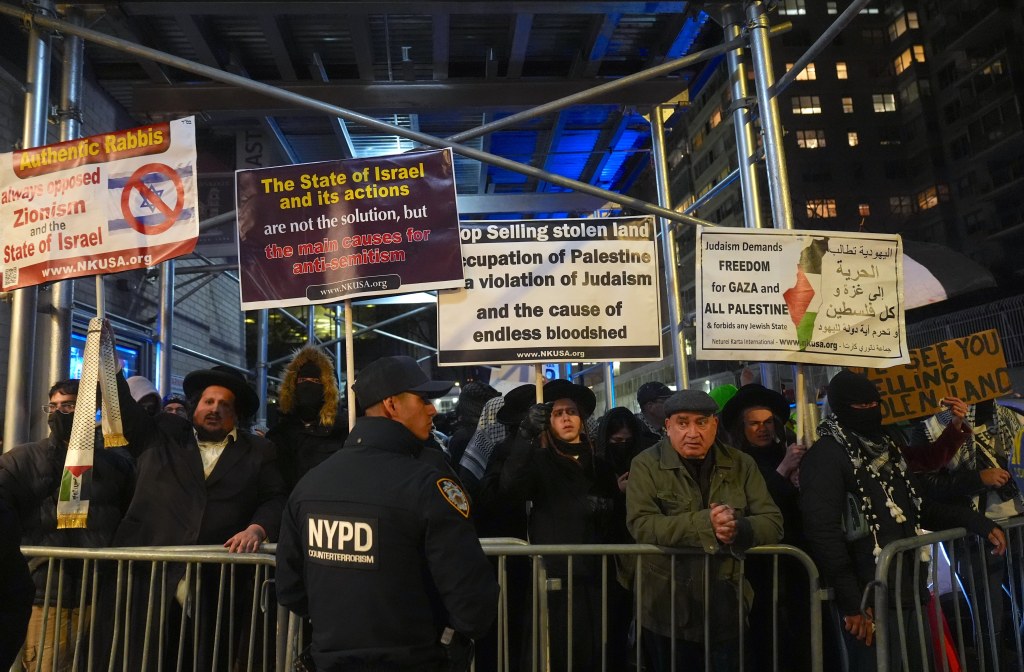
The New York City Council overwhelmingly passed last month a bill that would allow police to create security perimeters for protests around houses of worship. Now the state Legislature should follow suit by passing Gov. Hochul’s buffer-zone proposal as part of the state budget.
The need for action is urgent. For too many Jewish New Yorkers, even entering a house of worship no longer feels safe. It can mean walking past shouting crowds, being singled out, and feeling exposed simply for showing up. That kind of harassment has a real impact. It deters participation. It changes behavior. Over time, it sends a message about who belongs — and who does not.
In New York City alone — home to 1 million Jews — the largest Jewish population in the world outside Israel — antisemitic hate crimes accounted for 57% of all reported hate crimes in 2025. Nationally, the picture is just as stark.
According to American Jewish Committee’s State of Antisemitism in America 2025 Report, 91% of American Jews say they feel less safe due to violent attacks in the past year — including the burning of a Jewish governor’s home, the firebombing of Jews in Boulder, Colo., and the murders of two Israeli embassy staffers in Washington, D.C. Fifty-five percent have changed their behavior out of fear of antisemitism, and nearly one-third have been personally targeted by antisemitism in the past year.
While Jews are the most targeted religious group in FBI hate crime data, establishing buffer zones is about something more fundamental: the ability of any person, of any faith, to practice their religion and participate in communal life freely and without fear. Safe access to houses of worship — spaces for gathering and connection — should not be controversial. Protesters using them as targets for harassment should be.
Hochul’s plan to create buffer zones around houses of worship treats this moment with the seriousness it demands. It goes beyond existing approaches that focus primarily on physical obstruction, addressing harassment which could rise to the level of de facto obstruction.
The goal is straightforward: no one should be harassed or threatened when entering a house of worship. Existing laws address obstruction and trespassing. The gap is harassment — following, blocking, targeted intimidation — directed at people as they enter and leave these spaces.
Any policy in this space must be carefully crafted to respect First Amendment protections. The governor’s proposal reflects that balance.
Narrowly tailored with a focus on conduct intended to harass or interfere with access, it is designed to address real-world harm while remaining consistent with established constitutional standards. That balance is not only appropriate, it is necessary if protections are to be both effective and durable.
What is at stake is how New York responds to this moment — and what that response signals moving forward. When harassment at the threshold of a house of worship is tolerated or dismissed, it sets a precedent that normalizes the targeting of communities in spaces where they gather. Clear, enforceable boundaries matter — not to limit expression, but to ensure that expression does not come at the expense of safety.
New Yorkers should not have to choose between their safety and their rights. We can — and must — protect both.
Bearak is assistant director of the American Jewish Committee regional office in New York.