
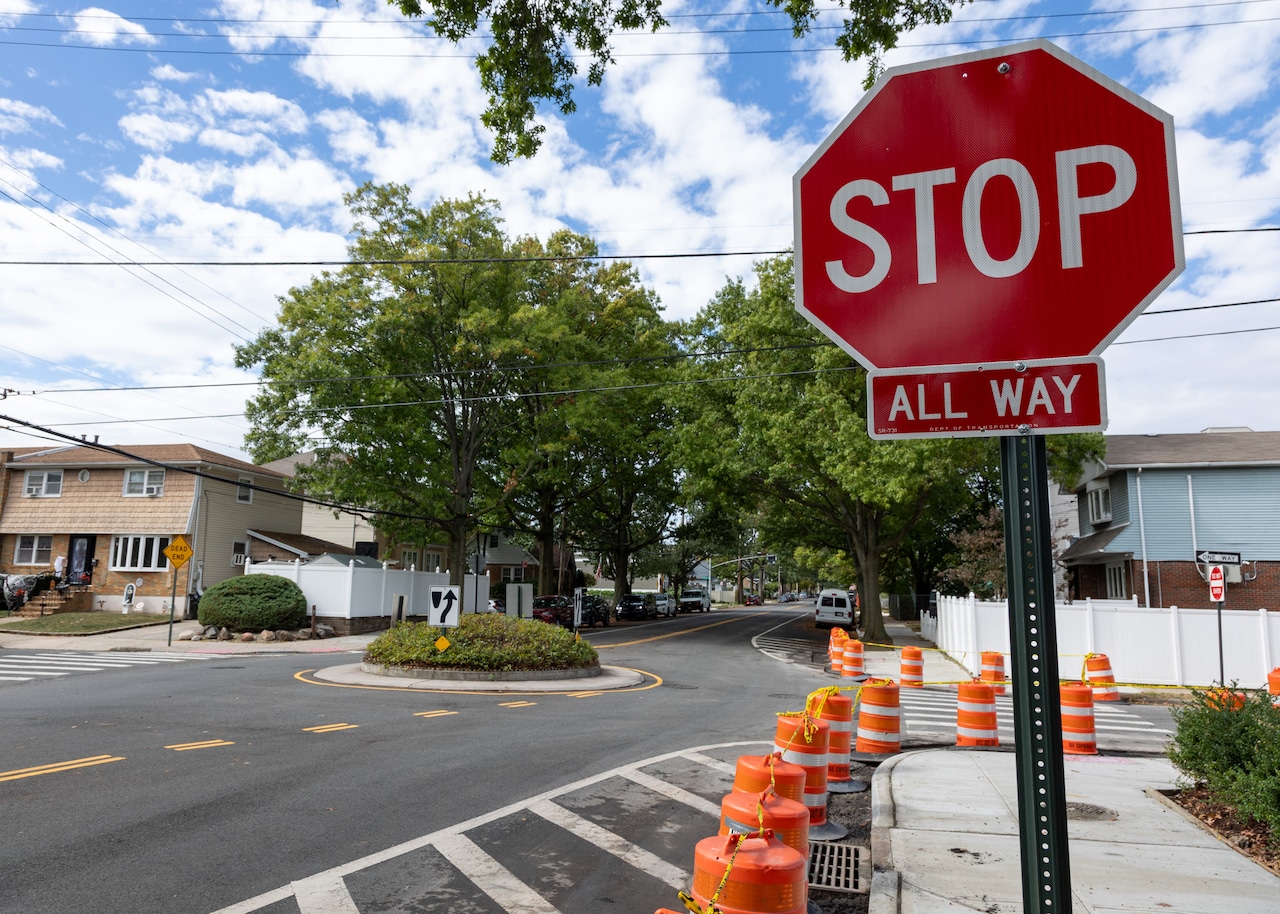
STATEN ISLAND, N.Y. — The New York City Department of Transportation recently installed a new set of all-way stop signs in Midland Beach, after denying the need for the signs years ago and installing traffic circles in the area instead.
Earlier this week, the New York City Department of Transportation installed a new set of all-way stop signs at Greeley Avenue and Freeborn Street.
Mere feet from one of the borough’s only traffic circles, the DOT previously said that the area didn’t meet the criteria to warrant an all-way stop, leaving some to question why the signs were installed now.
“For decades, we asked for stop signs. DOT came back and said it wasn’t warranted at Greeley Avenue,” said Sal Monforte of the Midland Beach Civic Association in a video posted to Facebook on Monday.
“We don’t understand why the stop sign was put in place and we have the circles,” Monforte continued.
When asked why the intersection now qualified for an all-way stop, a spokesperson for the DOT said the signs were added to support crosswalks that are being installed at Greeley and Freeborn Street.
Pedestrian traffic
According to the spokesperson, a nearby senior center has led to an increase in pedestrian traffic at Greeley Avenue and Freeborn Street in recent years.
The spokesperson explained that the agency studied the intersection for a crosswalk at the request of Councilmember David Carr.
During the study, the DOT noted that a number of seniors were crossing Greeley at Freeborn Avenue to get to the Happy Island Senior Center, so the agency approved the crosswalks.
The representative also said that no crosswalks are installed on wide, two-way roads without some sort of traffic control — like a stop sign— to accompany it.
“The opening of the Happy Island Senior Center and subsequent significant increase in pedestrian traffic helped inform our study and approval of Council Member Carr’s request for crosswalks at Freeborn Street,” the spokesperson said. “We will continue to work with elected officials and the community to add safety enhancements where appropriate.”
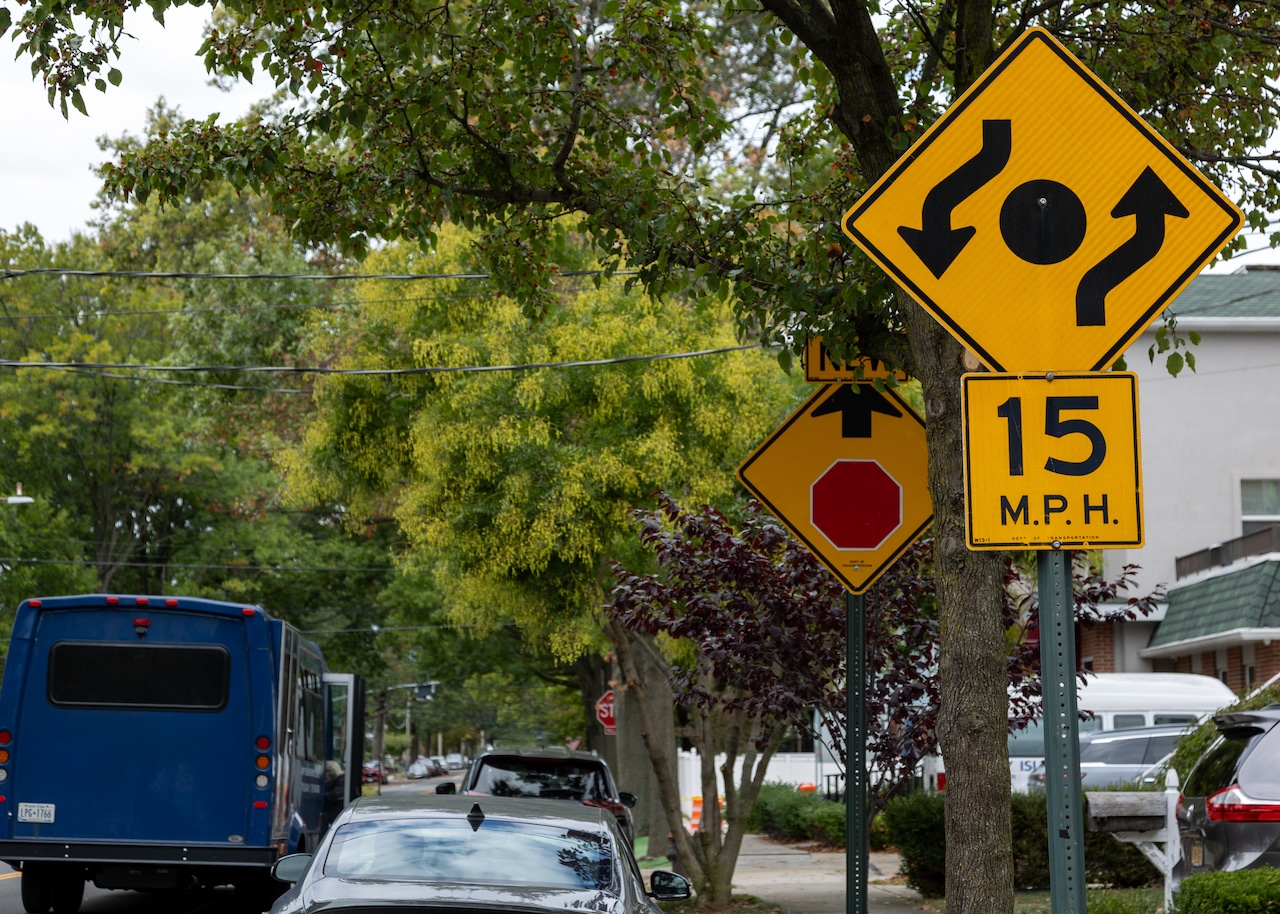 Road signs warn drivers of the newly installed all-way stop in Midland Beach. Wednesday, Oct. 9 2025(Advance/SILive.com | Mike Matteo)
When asked about the new stop signs at Greeley Avenue, Carr said that the DOT should “re-evaluate” the traffic circles, as the stop signs are proof “that the circles were a failure.”
“For almost three decades, the four councilmembers representing the Mid Island have been advocating for the installation of stop signs on Greeley Avenue. DOT always refused, and instead we ended up with these ridiculous traffic circles that no one ever wanted,” the Republican representing the Mid-Island said.
‘Proven’ to slow speeding
The DOT spokesperson said the Greeley Avenue traffic circles “are proven measures to slow speeds and turns, and to enhance safety on this corridor.”
As of Wednesday, only the traffic circle located at Greeley Avenue and Freeborn Street had received all-way stop signs.
The crosswalks had not yet been painted on the road near the intersection.
The other traffic circles on Greeley Avenue, located at the intersections of Colony Avenue, Moreland Street, and Oldfield Street, remained unchanged.
In November 2017, the city began construction of the four neighborhood traffic circles between Hylan Boulevard and Father Capodanno Boulevard.
Greeley Avenue was chosen as the location for the traffic circles due to excessive speeding from motorists using it as a cut-through to Father Capodanno Boulevard.
“Greeley Avenue has been an issue for us for decades. The fundamental issue is that it serves as a cut-through for South Shore residents, who come up Hylan Boulevard during their morning commute, and want to make their way down to Father Cap,” former DOT Borough Commissioner Tom Cocola told the Advance/SILive.com in 2017.
Controversial decision
The circles were initially met with mixed reviews throughout the community, with some residents questioning whether or not other treatments, like stop signs or traffic lights, would have been more practical.
At the time, the DOT said that the intersections had been studied multiple times for stop signs or traffic signals, but continuously failed to meet the federal criteria required for installation.
The agency didn’t want to add all-way stop signs because they are supposed to be used to determine who has the right-of-way, not to control speeding.
The DOT also noted at the time that unnecessary stop signs can cause rear-end crashes and add significant delays during busy hours.
As for speed bumps, the residential area and limited space between driveways made them a non-viable option, the agency previously said.
If you purchase a product or register for an account through a link on our site, we may receive compensation. By using this site, you consent to our User Agreement and agree that your clicks, interactions, and personal information may be collected, recorded, and/or stored by us and social media and other third-party partners in accordance with our Privacy Policy.