
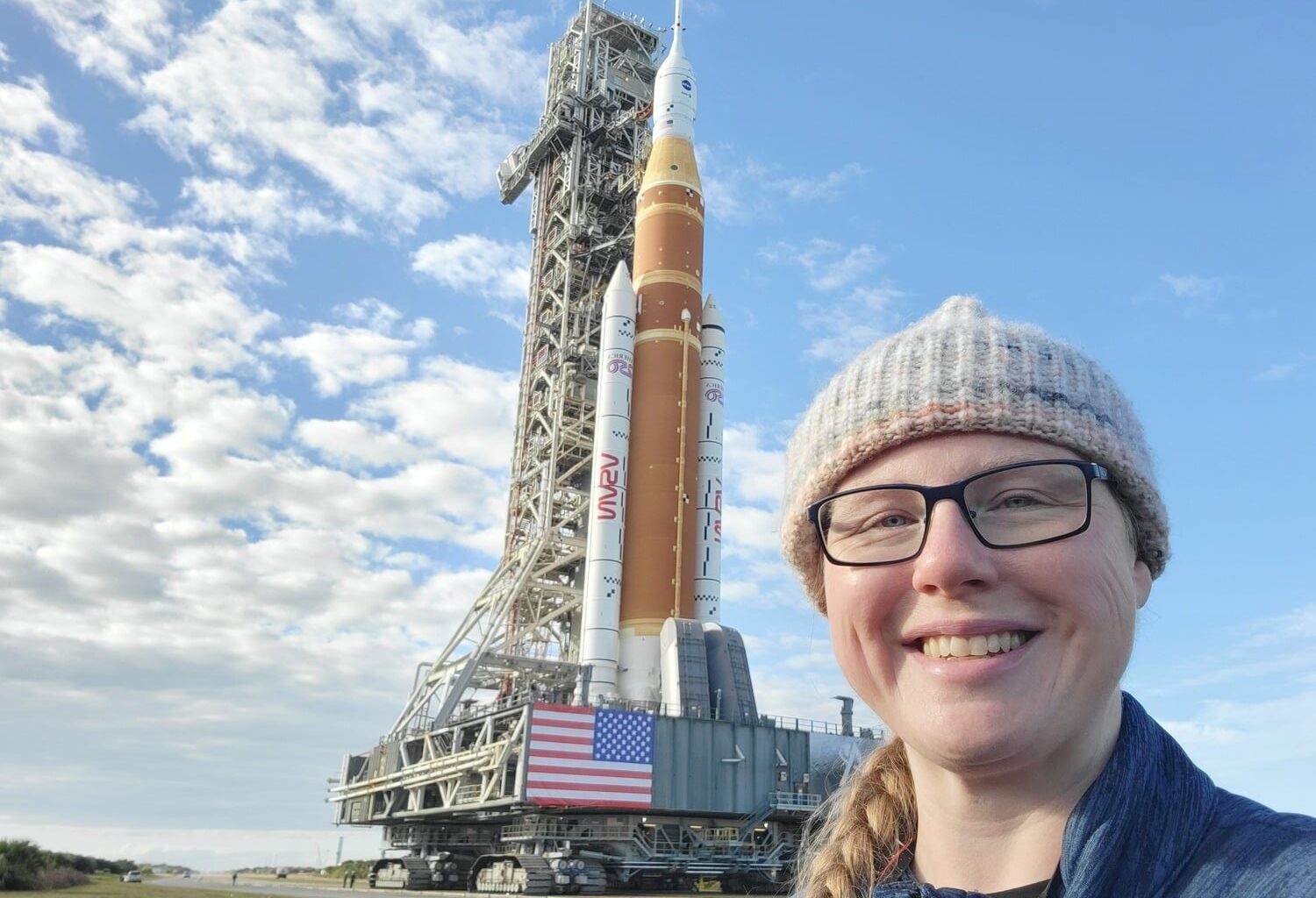
A woman from St. Lawrence County was an integral part of the team that launched Artemis II to the moon.

Jamie Szafran, a NASA software engineer and architect, before the Artemis II launch. Szafran grew up in Edwards in St. Lawrence County and went to SUNY Potsdam. Photo provided.
Jamie Szafran is a software engineer and architect on NASA’s Artemis missions. She went to Edwards-Knox High School and graduated from SUNY Potsdam as a triple major.
David SommersteinMeet the NASA Artemis engineer who’s from St. Lawrence County
She told David Sommerstein she started at the Crane School of Music. Their conversation has been lightly edited for clarity.
JAMIE SZAFRAN: I started at Crane as a clarinet music theory major and then added math, which I ended up taking as a minor, and then added computer science. And so that kind of led along this path.
But for the computer science major, for the Capstone project, I had to do an internship. I applied all over NASA and got one at the Kennedy Space Center. And that’s how I ended up here.
DAVID SOMMERSTEIN: So now you’re at NASA. What did you do related to the Artemis mission?
SZAFRAN: Well, so like I originally said with my title, I’m a software architect and a software engineer on the Spaceport Command and Control System. What that is is the software that we use for the processing and the assembly and the launch of the rocket and the Orion capsule for each of the Artemis missions.
Or, as I just explained to an elementary school class fairly recently, I write the programs on the computers that you see the people on TV with the headsets using to launch the rocket.

Jamie Szafran before the Artemis II launch. Photo provided
I was also very honored to be a member of the design center launch support team for both Artemis 1 and 2. That’s the group of subject matter experts who specialize in the launch control system itself, every aspect of it. We were there to advise and assist if any issues came up with the actual launch control software and advise the launch team on actions they could take.
SOMMERSTEIN: Give me a sense of what it was like for you, with such a personal stake, to be at the launch. What were you doing when the launch was happening?
SZAFRAN: So the entire lead up to the launch, we actually worked a couple of shifts from the start of the count into the launch. The terminal count shift, which is that last one that starts with us fueling the rocket and going through to launch, we were sitting on console, waiting to see if we’d be needed, watching the internal camera feeds. We had the public coverage on in the background quietly. We were working but also just kind of waiting.

Jamie Szafran at NASA in Houston, Photo provided
And then, we were really lucky because our team was not in the prime firing room, and there’s really nothing that we do for the last few minutes of launch. So we were released to go outside. So my team got to watch the launch from next to the launch control center building. And it was fantastic.
SOMMERSTEIN: Wow, what were you feeling?
SZAFRAN: You spend the entire three days of the count basically both equal parts nervous and excited. The last couple of minutes before the launch, we had the coverage on outside listening to the count. I think we held our breath for the entire several minutes we were outside.
And then the rocket lifts off the pad, and it was the most beautiful thing I had ever seen. It lit up the sky. This was daytime and it still lit up the sky brighter than the sun. There’s this brief moment, because of physics, the sound hasn’t hit you yet. All you see is this giant glowing rocket rising up into the sky. And then the sound hits you.
It’s the absolute loudest thing on the planet Earth. You just feel it. It reverberates. We’re just a handful of miles from the pad that it just reverberates through your body. And then you get it again because it bounces off the building.
It was the pinnacle of everything we’ve worked on. It was exciting in ways I can barely describe to you.
SOMMERSTEIN: Yeah, it really strikes you emotionally, just hearing you talk about it.
SZAFRAN: You know, everybody works long hours. We have occasional early mornings and late nights, challenging work. This is the pinnacle of that. It made it all worth it. You’re there with a couple dozen of your colleagues, and we’re laughing, and we’re crying, and we’re cheering, and everybody’s wordless. Nobody’s got a single thing to actually say. We’re just all cheering and thrilled. It was amazing.
SOMMERSTEIN: What has your work life been like during the mission, as Artemis has been going out to the moon and then back around, what have you been doing?
SZAFRAN: Bizarrely normal because we’re actually working forward. We’re coming up to a release of the first cut of the Artemis III software, and we’re working on the Artemis IV software and hardware modifications. So we’ve actually been working Artemis II, III, and IV at the same time.
What a lot of people don’t realize is that the software has to be done a couple of years in advance. And then we have testing to make sure it’s solid. And then we give it to the launch team and they train on it for months. So we’re actually working right now pretty hard on Artemis III and IV.
SOMMERSTEIN: There’s been some coverage and a lot on social media about a photo of mission control and how many women were in the room and how many women were working on this project. What has been like to work in this environment with so many women when across STEM, there’s still fewer women than men?
SZAFRAN: It is awesome. It’s a lot of fun. I do a lot of outreach and I tell people that I almost forget that it’s not this balanced in the real world, because I look at my team and my team leads are women. My supervisor and her deputy are both women. I’m a lead in my branch. The chief software architect on this project is a woman. And of course our launch director Charlie Blackwell Thompson is the Artemis launch director.
We actually took pictures a couple years in a row for Women’s History Month. We had all the women of launch control and we all got together. They went out on NASA’s social media comparing us with the Apollo 11 launch that had a single woman sitting there. So it’s gratifying to see how far we’ve come. And now I find it completely normal that we’re pretty well balanced here.
Special thanks to Carol Strom, Szafran’s choral director at Edwards-Know high school, for putting NCPR in touch with her.