
April 13, 2026

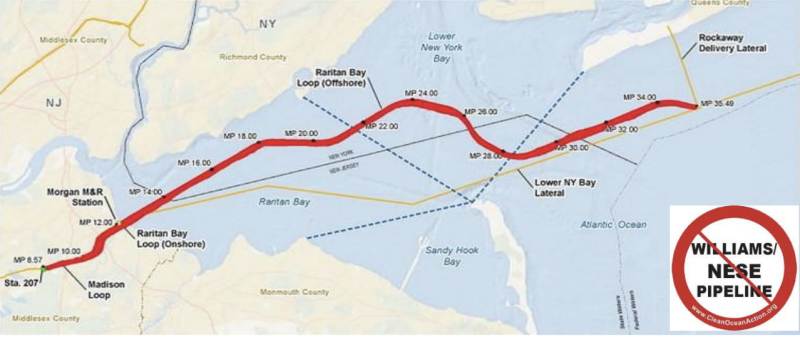
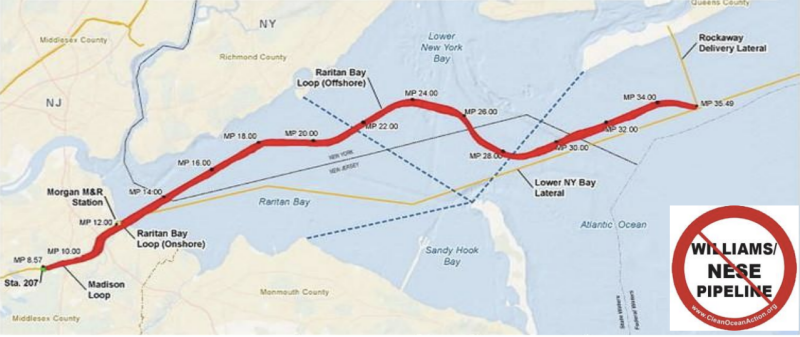 Environmental groups are opposing the proposed Northeast Supply Enhancement (NESE) Project, 26” diameter natural gas pipeline across the Raritan and Lower New York Bay, Clean Ocean Action image.
Environmental activists fighting a proposed natural gas pipeline across lower New York Bay are demanding New Jersey state officials deny a tidelands permit for parts of the 23.4-mile route.
Environmental activists fighting a proposed natural gas pipeline across lower New York Bay are demanding New Jersey state officials deny a tidelands permit for parts of the 23.4-mile route.
If approved, the Northeast Supply Enhancement (NESE) Project could provide a crucial link from inland natural gas producers in Pennsylvania to New York and New England. The impending fight echoes past years of controversy over dredging in the crowded New Jersey/New York estuary.
An April 1 New Jersey public meeting on the plan was abruptly cancelled 15 minutes before it started amid intense pressure from critics who contend dredging and construction could disturb contaminated sediments in the lower bay.
Opponents like the New Jersey group Clean Ocean Action are fighting gas distributor Williams, Tulsa, Okla., which originally ran into resistance over its Transco pipeline plan from New York and New Jersey state officials and opposition from environmental groups.
But the politics shifted abruptly in spring 2025, as the Trump administration moved against offshore wind power projects, then appeared to strike a deal with New York Gov. Kathy Hochul’s administration to ease its opposition to new natural gas transmission.
The Transco plan also needs approval from the New Jersey Tidelands Resource Council, a panel of 12 members appointed by the state governor working with the state Department of Environmental Protection staff. The council’s usual tasks include reviewing such routine developments as permitting marinas; Transco would need a “utility license” from the council while protecting state resources and water quality.
“It’s a very little-known entity, but it has a very important role,” said Cynthia Zipf, executive director of Clean Ocean Action. The pipeline route would affect some 9,500 acres of submerged New Jersey tidelands, raising questions about future disposal of dredged sediment, “and all that mud that’s going to be resuspended,” she said.
Since taking office in January, New Jersey Gov. Mikie Sherrill has continued to press for support for developing new, cleaner energy sources – despite the state’s previous offshore wind power ambitions foundering in the face of escalating costs and roadblocks from the Trump administration.
The meeting was canceled “to allow the new administration sufficient time to review” the Transco application, according to a spokesman for the New Jersey DEP. Meanwhile, on April 8, Sherrill signed state legislation to lift a 40-year-old, de facto moratorium on new nuclear power development, launching a new nuclear task force and potentially opening a path toward future expansion of the Salem nuclear complex on Upper Delaware Bay.
Sediment pollution in the New York Harbor estuary forced intensive remediation efforts starting in the 1990s to enable channel deepening projects to maintain the Port of New York and New Jersey’s primacy in U.S. shipping. Elevated levels of historic industrial pollutants, including dioxin and PCBs, led to new disposal practices – including an end to wholesale sediment disposal offshore – and dramatically increased costs.
The pipeline conflict comes a decade after the U.S. Army Corps of Engineers and U.S. Environmental Protection Agency (EPA) essentially declared victory over the harbor sediment pollution problem. The Main Navigation Channel Deepening Program started in 1989 as a $2.1 billion mega-project anticipated by the expansion of the Panama Canal and the bigger cargo vessels it would bring to U.S. ports.
It changed the way the Corps and the EPA deal with contaminated sediment from harbors. The prospect of business as usual – dumping dredge spoils at sea, tainted with decades of industrial pollution – triggered an uproar from the fishing and tourism industries and environmental groups that delayed deepening for years in the 1990s.
By 2016, 38 miles of federal channels were dredged to as deep as 50’. The final tally for public and private investment to prepare the New Jersey and New York ports for 21st century shipping totaled some $6 billion.
The harbor cleanup and better dredged material management yielded other economic and environmental benefits, ranging from a public park and golf course in Bayonne to a revived hard clam fishery that lands about 20.5 million lbs. annually at the J.T. White clam depuration plant at Highlands, N.J., said Zipf.
Now the prospect of dredging for a new pipeline could “take us back to the bad old days,” and public pressure has grown “very intense,” said Zipf, who says her group alone had lined up more than 50 commenters anticipating the April 1 hearing. “People who have been on the (tidelands) council a long time have never experienced this before.”
The NESE plan would include a compressor station in Franklin Township on New Jersey’s Raritan Bay shore, and 26″ diameter pipeline across the Raritan and Lower New York Bay, terminating at other pipeline connections off the Rockaways in New York. Williams won land use permits in November 2025.
Opponents suspect the high level of public interest in the project led to state officials postponing a hearing, said Zipf, adding, “we’re going to use the [extended] time to get the word out.”