
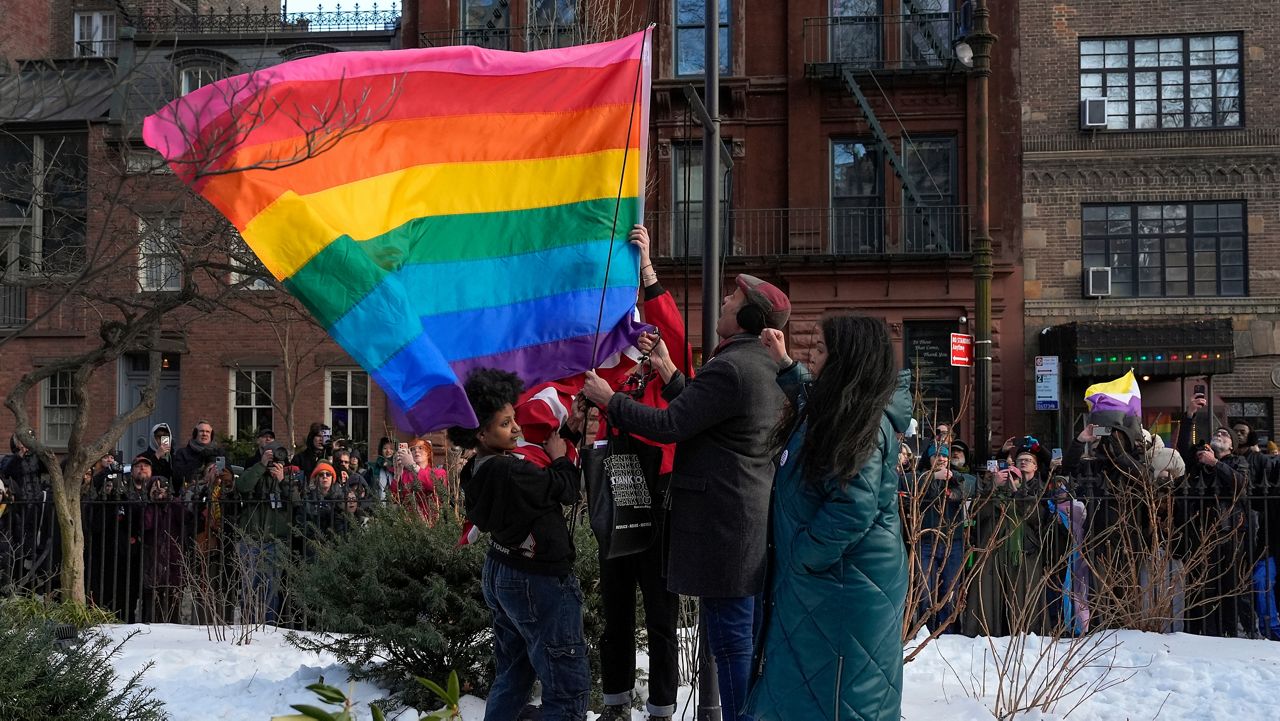
The Trump administration will allow the Pride flag to keep flying at the Stonewall National Monument as part of a settlement it reached with several activist groups.
The Greenwich Village monument’s flag was removed in February after the administration issued a directive barring non-authorized flags from being flown on National Park Service-managed flagpoles.
What You Need To Know
The Trump administration will allow the Pride flag to keep flying at the Stonewall National Monument as part of a settlement it reached with several activist groups
The Greenwich Village monument’s flag was removed in February after the administration issued a directive barring non-authorized flags from being flown on National Park Service-managed flagpoles
Activist groups quickly filed suit over the flag’s removal, and advocates held a rally to re-raise it. Since then, it has continued to fly in an unofficial capacity
The flag — one of several Pride banners flown at the 7.7-acre Stonewall monument — won’t be removed, except for “maintenance or other practical purposes,” lawyers for the government and the groups wrote in a joint court filing
Activist groups quickly filed suit over the flag’s removal, and advocates held a rally to re-raise it. Since then, it has continued to fly in an unofficial capacity.
The flag — one of several Pride banners flown at the 7.7-acre Stonewall monument — won’t be removed, except for “maintenance or other practical purposes,” lawyers for the government and the groups wrote in a joint court filing.
Under the agreement, within a week, the park service will hang three flags on the flagpole it maintains at the monument. The Pride flag will be positioned below the U.S. flag, in accordance with the U.S. flag code, and above the park service flag. Each will measure three feet by five feet.
The site also features a large Pride banner on a city-controlled flag pole and small rainbow flags on a fence surrounding the monument. Those have stayed up the whole time.
The Jan. 21 park service memo largely restricted the agency to displaying the U.S., Department of the Interior and POW/MIA flags, with exemptions that included providing “historical context.”
LGBTQ+ groups including the Gilbert Baker Foundation had argued the Pride flag at Stonewall fell into that category.
The park service insisted that the monument “remains committed to preserving and interpreting the history and significance of this site” through various exhibits and programs. But LGBTQ+ activists saw the flag’s removal as a targeted affront meant to diminish a site that is all about their fight for rights and visibility.
In a statement, Gilbert Baker Foundation president Charley Beal said the settlement was “a powerful victory for our community and for the legacy of Gilbert Baker, who created the Rainbow Flag.”
“Stonewall is sacred ground in the fight for LGBTQ+ liberation, and this resolution helps ensure that the Rainbow Flag will continue to fly there, where it belongs,” Beal said.
In her own statement, Gov. Kathy Hochul called the flag’s removal “an attempt to silence a movement.”
“But when New Yorkers stand together, we win,” she said.
A judge still has to sign off on the deal.
Then-President Barack Obama created the Stonewall monument in 2016. The monument centers on a tiny park across the street from the Stonewall Inn, the gay bar where a 1969 police raid sparked an uprising and helped catalyze the modern LGBTQ+ rights movement.
After Trump returned to office last year, he took aim at diversity, equity and inclusion initiatives and protections for transgender people. In one outcome of his policies, many references to transgender people were excised from the monument’s website and materials.
Trump’s administration similarly has put national parks, museums and landmarks under a messaging microscope, aiming to remove or alter materials that the government says are “divisive or partisan” or “inappropriately disparage Americans.”