
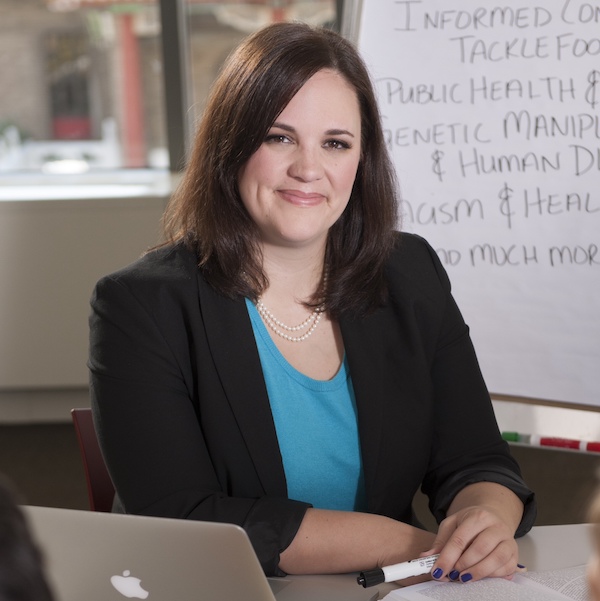
 Despite her earlier work with the Vatican on social justice issues, Meghan Clark says she was surprised when she learned of her appointment to the dicastery. “I did not know that I was being considered for this role,” she adds. (Photo: Courtesy of Meghan Clark)
JAMAICA — Meghan Clark opened her email last month and found correspondence from the Vatican that left her speechless.
While Clark, assistant chair of theology and religious studies at St. John’s University, received emails from the Vatican in the past because of her work with church officials on social justice issues, this email came a surprise for two reasons; 1) It contained a letter informing her that Pope Leo XIV had appointed her to the Dicastery for Promoting Integral Human Development, and 2) The letter was written in Latin.
Luckily for Clark, the email also contained an English translation.
Clark, who said she was “deeply honored and humbled” by her appointment, is one of 11 new members of the dicastery, including four Americans, whose appointments were announced March 30. Members serve five-year terms.
She joins fellow Americans Father Daniel Groody, vice president and associate provost for undergraduate education at the University of Notre Dame; Dylan Corbett, executive director of the Hope Border Institute in Texas; and Léocadie Wabo Lushombo, a professor of ethical theology at Santa Clara University in California, on the panel.
Established by Pope Francis in 2016, the dicastery is tasked with promoting the social justice teachings of the Catholic Church and its areas of concentration include immigration, the environment, and human rights.
For Clark, the appointment is a chance to continue working in areas that she has focused on in the past.
“My goal is to be of service to the people of God. What I hope I am able to do is the same thing I have done — to lift up the voices of those living, to use Pope Francis’ language, on the periphery so that not just their basic needs are met, but that they are heard and taken seriously,” said Clark, a parishioner of St. Rose of Lima Church in Rockaway Beach.
In 2022, she worked with the Dicastery on Human Development on a migration and refugee project, traveling around the U.S. to interview day laborers, migrants, and sex trafficking survivors as well as people who collect bottles and cans on the street.
Folks on the peripheries of society have a lot to teach us, Clark said. “It was in a conversation I had with a recycler from Brooklyn that I heard the best description of integral ecology,” she recalled.
Clark, who holds a Ph.D. in Theological Ethics from Boston University, worked as an advisor for the Holy See’s Mission to the United Nations and served as a consultant to the U.S. Conference of Catholic Bishops’ Committee on Domestic Justice and Human Development.
Promoting human dignity was engrained in her at an early age. She recalled growing up in Babylon, Long Island, “with a copy of the Catholic Worker newspaper on my grandparent’s coffee table and hearing discussions on what it meant to treat the poor with dignity.”
Her grandparents, John and Carol Clark, and her parents, Charles and Lisa Clark, had a profound influence on her life and her work, she said. The family regularly volunteered at food pantries and worked on social justice issues.
“I was brought up in a family where the expectation was modeled for me by my grandparents and parents and that was that our faith should touch every aspect of our lives. This isn’t something you do just on Sundays. You practice what you preach in a real sense,” she explained.