

How do teachers captivate their students? Here, in a feature we call How I Teach, we ask great educators how they approach their jobs.
Sign up for Chalkbeat’s free monthly newsletter How I Teach to get inspiration, news, and advice for — and from — educators.
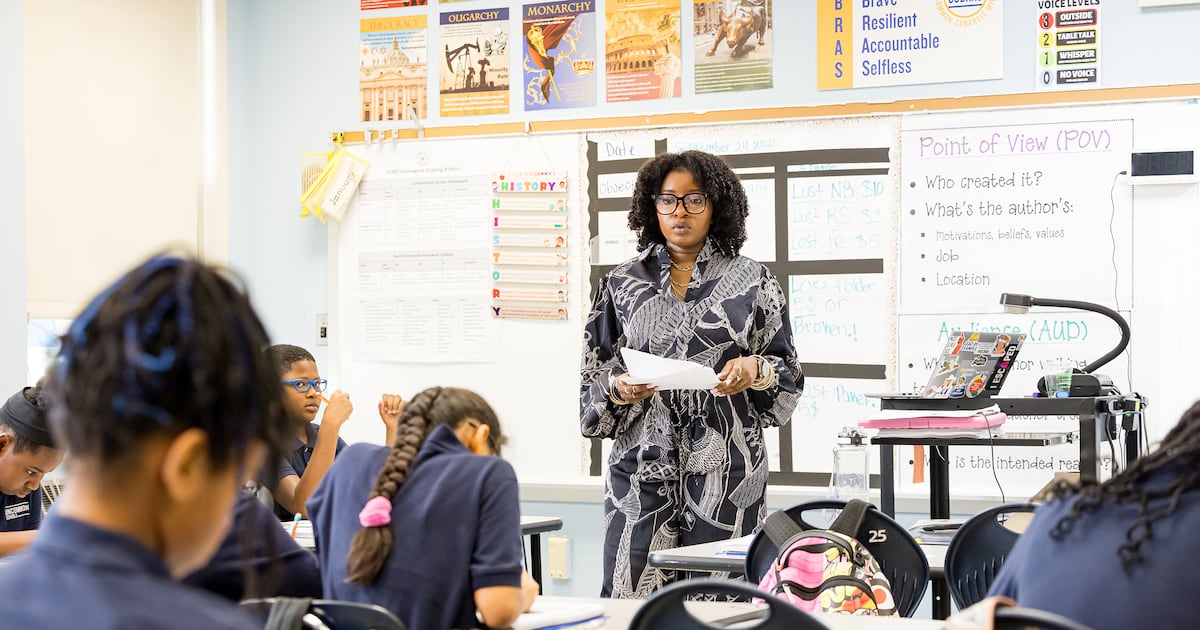
Fatimah Barrie knows the 30 sixth graders in her three history classes at Uncommon Canarsie Middle School really well. But she also prides herself on knowing the younger and older kids at the 5-8 school, which serves about 100 kids per grade.
“To me, that is joy,” Barrie said. “It is showing up every day as a whole school educator to pour into all students in the building, not just the ones on my roster.”
Barrie has been at Uncommon for eight years and serves as the school’s lead lesson planner, helping write the 5-8 curriculum, leading professional development, and mentoring new and returning educators. Barrie’s own educational journey was filled with highs and lows. She went from being expelled from high school — which she shares candidly with her students on the first day of school — to winning a 2025 Big Apple Award from the city’s Education Department, which recognizes 10 “exceptional teachers who go above and beyond to serve students and families.”
Barrie’s school, which is overwhelmingly Black, Latino, and economically disadvantaged, often outperforms its peers on standardized tests. About 63% of its students, for instance, passed last year’s Algebra 1 Regents exam, which was well above the average for students of similar backgrounds and also surpassed the state average.
But more importantly, Barrie said, her students have shown resilience and compassion in the face of loss. In 2023, a fatal fire claimed the lives of two students, Kelsee Miles (who would have been in sixth grade this year) and her sister Journee Milles (who would have graduated last year), along with their mother, Danielle Havens. Four of the girls’ cousins attend the school along with many of their friends. At last year’s eighth grade graduation, the school reserved a seat for Journee, had a gown for her, designed a cap in her memory, and presented her father with her diploma. The school plans to honor Kelsee in the same way, said Barrie, who is working on a more permanent memorial for the girls through funding from the Big Apple Awards fellowship.
“They’ve been through a lot,” Barrie said of her students, “but they continue to show up for each other in ways that mean a lot.”
This interview has been edited for length and clarity.
How and when did you decide to become a teacher?
Becoming a teacher was extremely unplanned. I was just about to graduate from City College of New York with my B.A. in Political Science and my B.A. in Black Studies, and the plan was to take a gap year interning at a law firm as I prepared for my LSATs.
A few weeks prior to graduation, I bumped into a former high school classmate who had recently relocated back to NYC and was starting her principal journey at Uncommon. She thought with my interests and concentrations in college, I’d be a great fit as a seventh grade history middle school teacher. I did not think I would get the job, but on Juneteenth of 2018, I was hired just two weeks post-graduation for a full-time history teaching position.
The plan was to teach for a year, study for my LSATs, and prepare for law school. However, I fell in love with teaching.
What’s your favorite lesson to teach and why?
This is such a hard question, I hope I can change it up. Since I have begun teaching, I’ve had the pleasure of teaching fifth, sixth, and eighth grade. My favorite grade to teach history is sixth grade not only because of their personalities but the content is foundational to scholars’ understanding of the United States. The essential questions of the year asks students to consider: Does a society’s culture shape their government or does a society’s government shape their culture?; What form of government best serves people?; What role do people play in their governments? Students start the year off learning about Ancient American Civilizations (Aztec, Maya, and Inca) and end the year learning about the formation of the United States.
And while I am sure my students would say their favorite lesson was when I dressed up as an English judge (and we put Columbus, his men, the King and Queen of Spain, the Tainos, and the system of empire on trial for the genocide of the Taino population), I was only able to do that because I had built genuine relationships with my students which not only resulted in strong classroom management but a comfortable learning environment.
Inspiration, advice, and best practices for the classroom — learn from teachers like you.
Across all of our bureaus, Chalkbeat reporters interview educators with interesting, effective approaches to teaching students and leading their schools. Get the best of How I Teach sent to your inbox for free every month.
What’s something happening in the community that affects what goes on inside your classroom or your school?
One thing that really impacts my classroom is how much my students are on social media and just constantly taking in information. They have opinions, they have thoughts, but a lot of times they haven’t been taught how to actually question what they’re seeing. They’ll say something confidently, but not always know where it’s coming from. So, I’ve had to be really intentional about slowing them down and teaching them how to think, not just respond.
Tell us more about the importance of joy in school. How do you bring joy into the classroom?
Middle school is often one of the most challenging parts of a student’s learning journey. I know it was for me. I attended three middle schools during my journey because of my behavior. When students get to middle school, they are navigating everything from hormonal changes to major shifts in academic expectations. They have a different teacher for each subject, move between classrooms every hour, and face increased rigor. Because of that, joy is not extra. It is essential. It becomes the heart of learning, especially in middle school.
I bring joy into the classroom by removing the strict power dynamic between adult and child, or teacher and student. My scholars know that my classroom and our school building are safe places. For some, joy may look performative in the classroom, like sing-a-longs, chants, and dance breaks. For me, joy is building relationships with them, not just teaching them. It is about students feeling seen, valued, and safe.
Tell us about your own experience with school and how it affects your work today.
I had the honor and privilege of growing up in the greatest and most influential neighborhood in the world, Harlem. Being from there, especially in the ‘90s, and attending schools in Harlem gave me a unique perspective on life, confidence in learning, and knowledge of Black and brown people.
In Harlem, I learned a lot through an inclusive education and learning about multiple perspectives. I always tell my peers and my mother that attending Child’s Memorial Christian Academy for Kindergarten and first grade gave me the tools I needed to excel academically in any setting. From second to eighth grade I attended public schools; including P.S. 166, FDA II, West Side Collaborative, and I.S. 164 Stitt. At a few of these schools (those not based in Harlem), instruction, especially regarding history, was often Eurocentric, which sometimes made it hard to see myself and my community reflected in what I was learning. At parent-teacher conferences I would often hear, “Fatimah is so bright, but she distracts her peers by constantly talking to them,” or “Fatimah challenged the lesson today by saying Christopher Columbus did not discover America.” It was a constant reminder that I was intelligent, but I was not necessarily a follower. I was a leader in some way, even if I did not always realize it.
Eighth grade brought me to one of the most challenging middle schools in New York City, where there was constant violence. I knew I needed a better environment. For high school, I attended the first and only boarding school for girls in New York City, Catherine McCauley Catholic Academy, where I developed independence and control over my studies. In true Fatimah fashion, I was later expelled and was given the opportunity to complete my high school journey at Frederick Douglass Academy I, earning a Regents diploma. While some may see that I attended seven different schools during my educational journey and assume the worst, however each school gave me an experience that led to this very moment in my life.
I would not change a single choice I made during my adolescent and teenage years as a student. I believe this is why I connect so well with middle school students.
I know firsthand what it feels like to make a mistake and not be given grace. I want them to know that not only do I understand what they are going through, but they can grow through it and truly excel.
Amy Zimmer is the bureau chief for Chalkbeat New York. Contact Amy atazimmer@chalkbeat.org.