
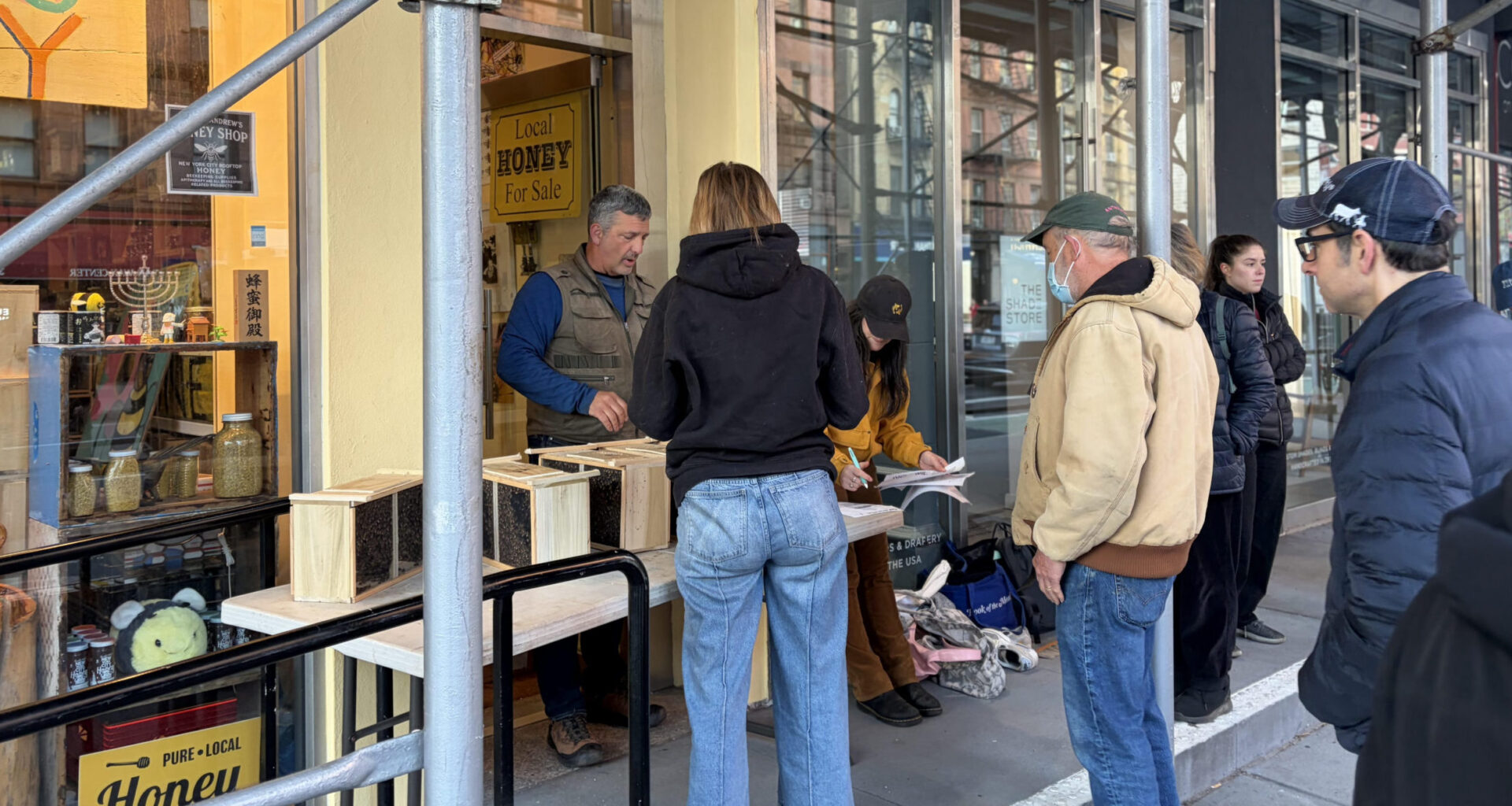
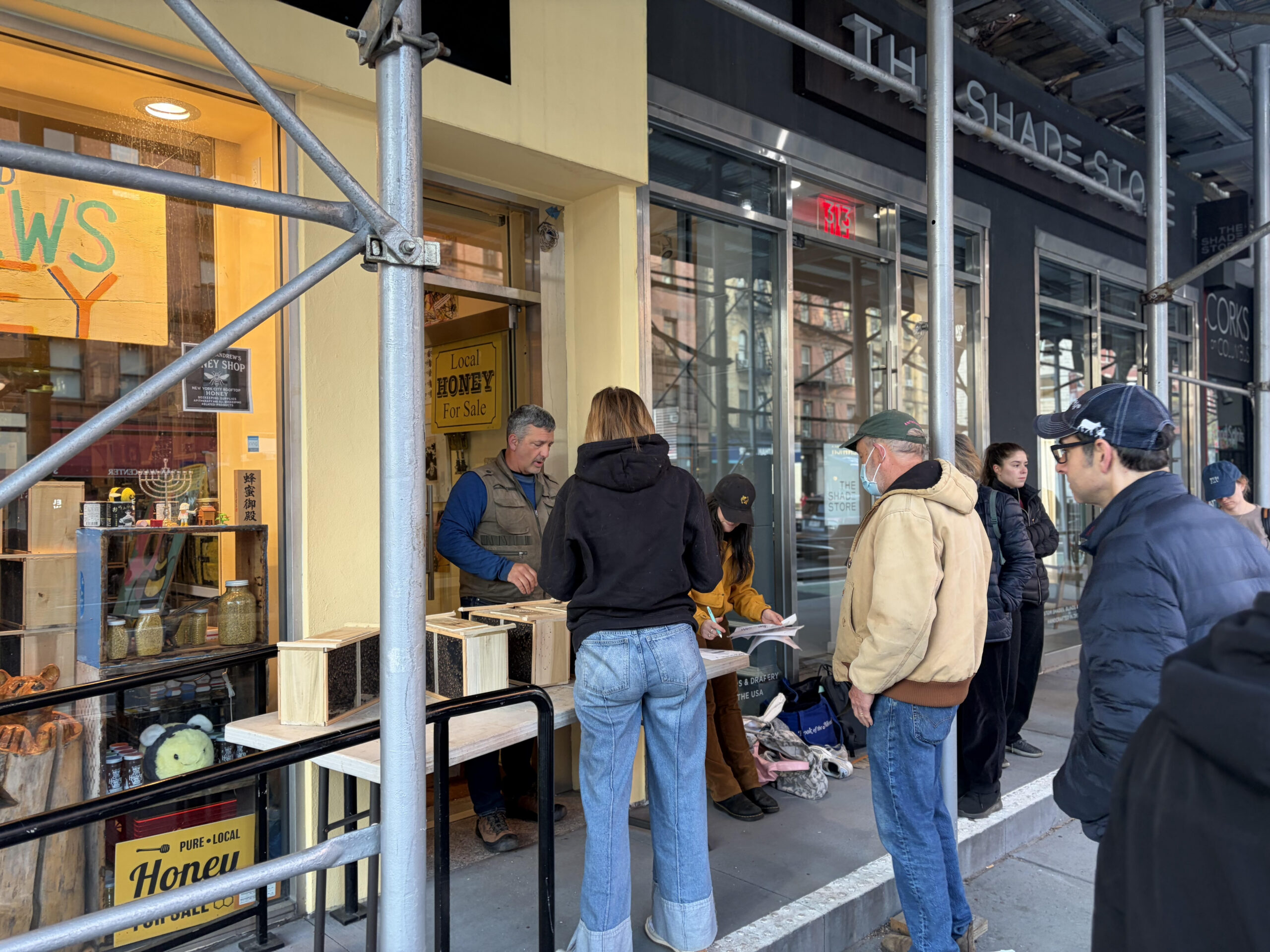
 Andrew Coté distributing bees outside his UWS shop, Andrew’s Honey, last Friday. Photos by Scott Etkin
By Scott Etkin
At just past 6:45 a.m. on a chilly Friday, Andrew Coté started unloading boxes of bees from the back of a white rental van parked on the Upper West Side.
Beekeeping apprentices, some dressed in protective bee suits, others in sweatpants or jeans, brushed stray bees from the outside of the boxes, and then brought the wooden containers into Andrew’s Honey on the corner of West 75th Street and Columbus Avenue.
The shop, which sells many types of local honey, was the site of this year’s distribution of live bees to dozens of beekeepers in the city. Coté has held this event – affectionately called “the running of the bees” – for the past 20 years in various locations, including Bryant Park and Columbus Circle.
A group of beekeepers and onlookers gathered around the store, taking photos and talking about their hives. Each box contained its own queen, though she was kept in a smaller, separate enclosure while the worker bees got used to her scent.
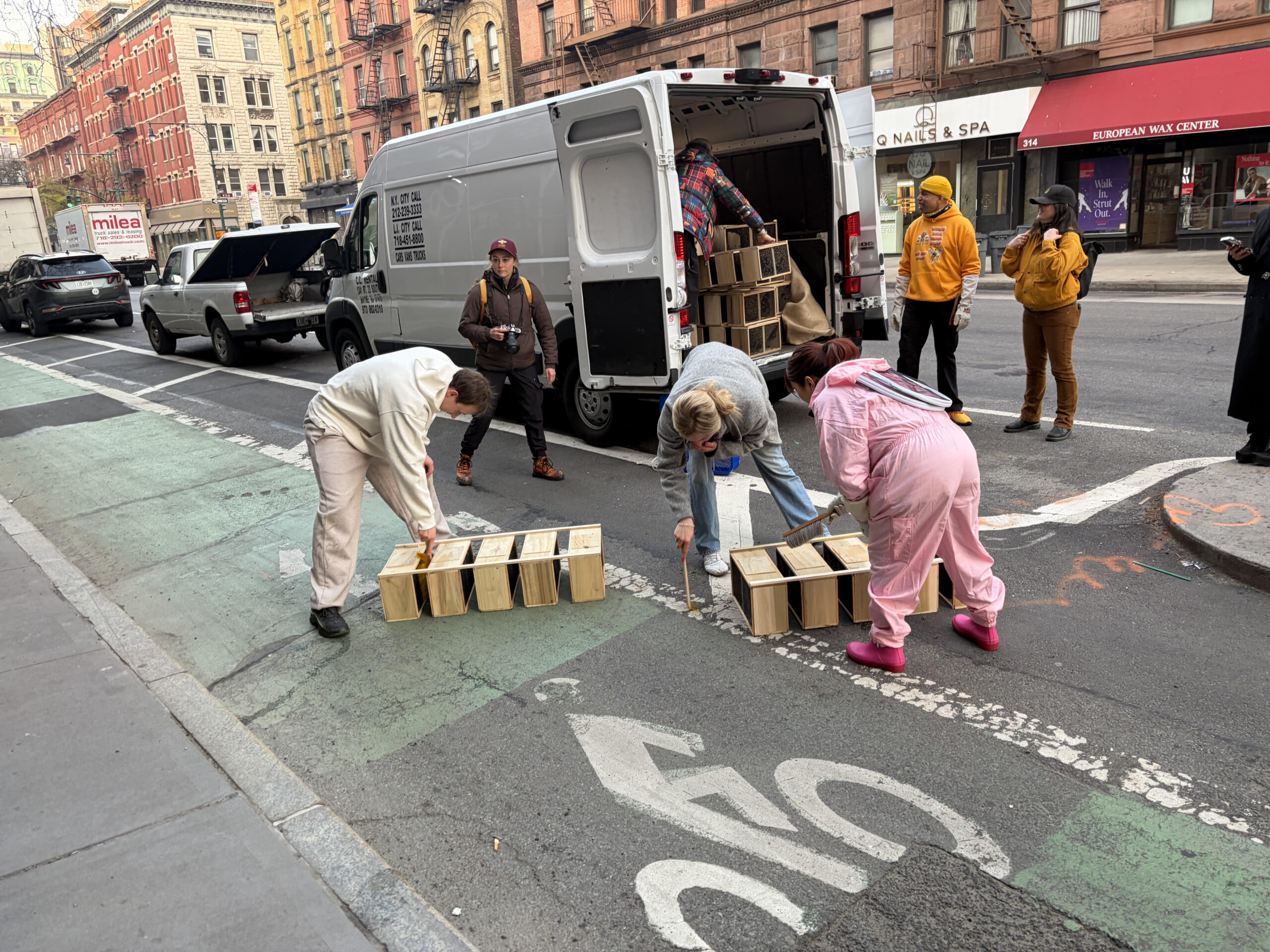 Getting the bee containers ready for distribution.
The containers of bees – “a shoe box of 12,000 flying, singing, venomous creatures,” in Coté’s colorful description – were attached together in groups of five. Conté used a reciprocating saw to separate the boxes from one another for distribution.
More than 60 people had signed up to collect a fresh bee colony. “I’m the only guy that I know of in New York City” who sells live bees, said Coté, a fourth-generation beekeeper and founder of the New York City Beekeepers Association.
Coté maintains hives on rooftops and outdoor spaces throughout New York City, including some at landmarks such as Madison Square Garden and the United Nations. But the bees distributed on Friday morning were bred in Georgia, where it’s warmer.
On a phone call with the Rag, Coté energetically explained that “bees are sold by weight, like cheese or cocaine.” A package of three pounds of bees, including a mated queen, is listed on Coté’s website for $210.
Pennie Morgan, director of Hephzibah House, a Christian guest house on West 75th Street, started keeping bees on the building’s roof last spring, with help from Coté’s team. She said that she has become “obsessed” with the bees.
The bees are relatively low-maintenance, she said. Someone from Coté’s team checks up on them around every six weeks, and their honey is harvested in the fall.
If you’re surprised that beekeeping is allowed in New York City, you’re not alone. Coté acknowledged that it catches people off guard to learn that the city legalized beekeeping in 2010 (hives have to be registered with the NYC Department of Health).
As you might expect from someone who spends his life around bees, he downplayed concerns. “People are allowed to reproduce humans, and have dogs, and drive cars, and all of those things are much more dangerous than honeybees,” he said.
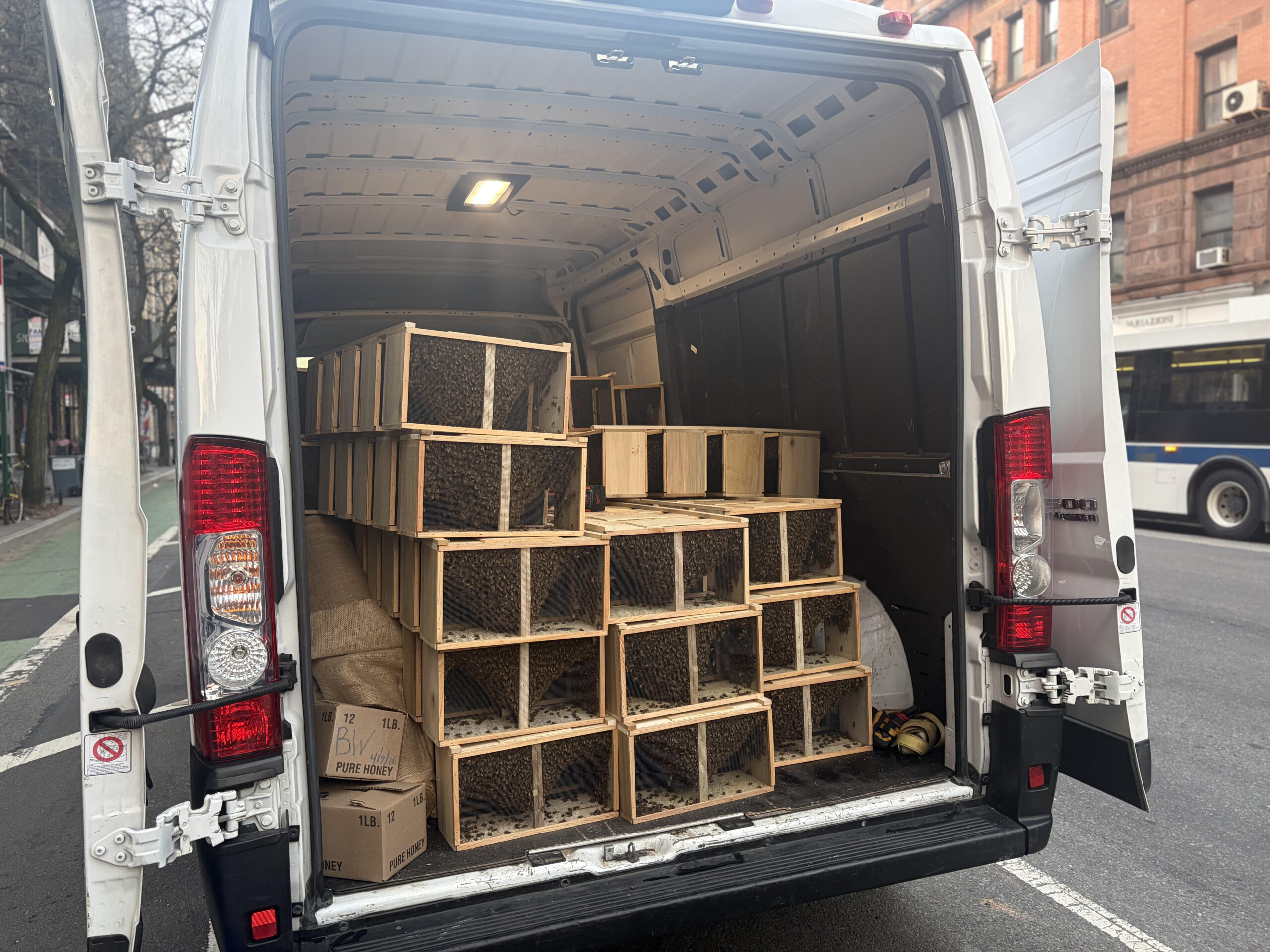 Containers with some of the bees sold at last week’s “running of the bees” on the UWS.
Like baking sourdough bread and watching “Tiger King,” beekeeping gained in popularity during the pandemic. There were more than 400 registered hives in NYC as of 2023, NY1 reported.
If the proliferation of hives in the city has gone largely unnoticed, it’s maybe because the bees are too busy searching for nectar and making honey to bother people. Over the course of a year, a colony can produce up to 100 pounds of honey, Coté said.
Morgan said around 15 jars of honey were harvested from her rooftop hives, which she split with Coté and also shared with neighbors.
An average bee lives six weeks, though queens live three to four years on average. Morgan’s bees didn’t survive the winter, which was especially cold. Theoretically, though, the queen can produce new queens, meaning the colony can survive in perpetuity, as long as the queen is healthy.
Cold weather, diseases, and mites can be fatal to bees, but city life is actually quite hospitable, Coté explained. New York provides a diversity of nectar sources, such as the various wildflower meadows in New York City’s parks (conversely, honeybees that are trucked from farm to farm subsist on a monoculture diet). There’s also “little to no spraying [of pesticides] here,” he said, compared to suburban and rural areas that often use chemicals on golf courses, lawns, and farms.
There are more than 200 bee species in New York City, and “having a diverse bee population is important for the city’s ecological health,” according to the NYC Department of Health.
Honeybees may compete with native bee populations for resources, so a good way to support local pollinators, including butterflies, is by planting native plants and reducing the use of pesticides.
Subscribe to West Side Rag’s FREE email newsletter here. And you can Support the Rag here.