
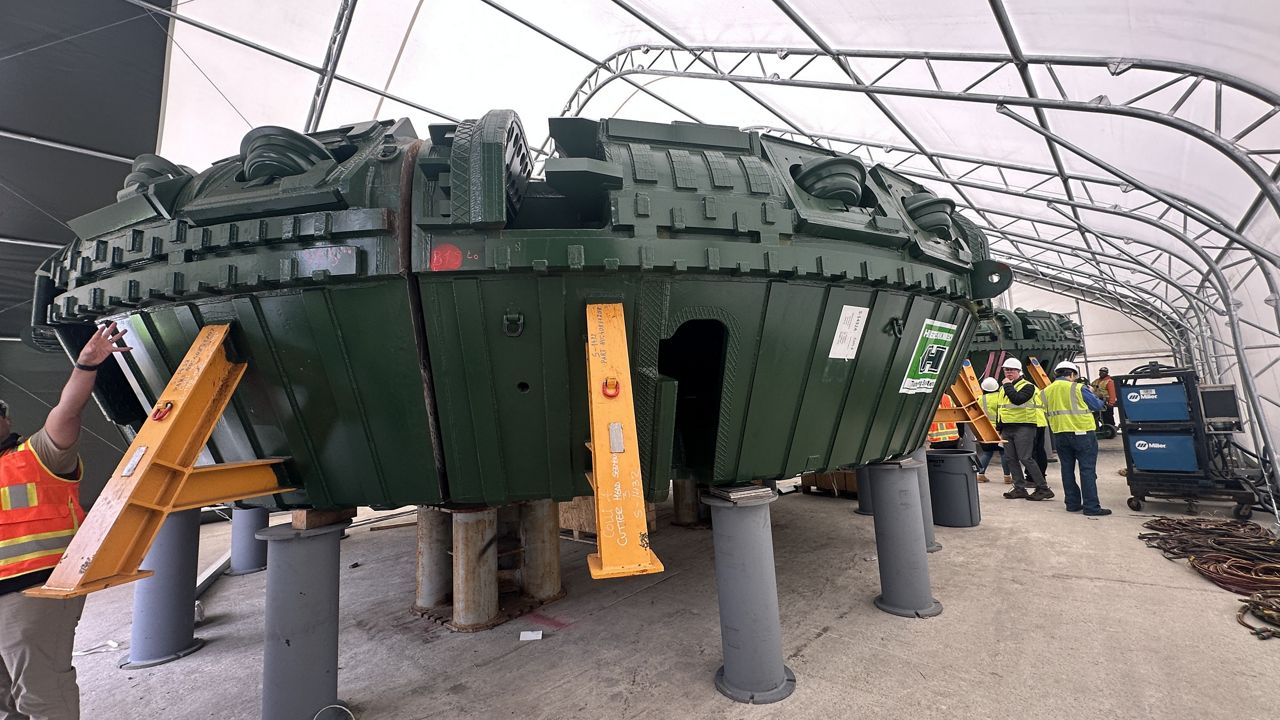
Preparations are underway to excavate the Gateway Tunnel — the new rail tunnel under the Hudson River between New York and New Jersey.
“What you’re looking at behind us here is the future portal,” said James Starace, the chief of program delivery for the Gateway Development Commission. “That will go back about another 75 feet to a vertical face, and that’s where the boring operation will begin.”
He was standing in front of a section of rock before the New Jersey Palisades.
What You Need To Know
Workers on the Gateway Tunnel between New York and New Jersey are assembling the two 1,700-ton, 500-foot-long tunnel boring machines (TBM’s) that will create the portal to the two tubes of the tunnel under the New Jersey Palisades toward the Hudson River
The rock is especially hard in New Jersey and the manufacturer has produced many replacements for the 59 cutting wheels on each machine
As assembly continues, workers will blast the 75 feet that remain until they reach a vertical face where the boring machines will take over to the edge of the Hudson in Weehawken
Then, the second of three sets of TBMs will take over to tunnel under the river
The 75-foot excavation is done using small, controlled blasts in North Bergen, then two boring machines, one for each tube, will be lifted down to begin their work under the Palisades before reaching the Hudson River in Weehawken.
Fifty-nine cutters break through the rock, then a conveyor belt in the machine moves it away, and another part lays down the concrete lining — everything customized.
“It’s like getting a custom suit. It fits you. It fits your size. It fits your dimensions,” Starace said. “Every tunnel is a little bit different size-wise. Every tunnel is a little bit different with material it’s cutting through.”
The tunnel boring machines weigh about 1,700 tons and will be 500 feet long once assembled. They’ll also have 30 to 40 people working on them as they excavate the tunnel.
Tunneling through the Palisades, as one might imagine, is very different from the material under the Hudson River. The Palisades are rock, and the path tunnels under homes.
“The average is 35,000 PSI, and it’s very abrasive,” Hamed Nejad, chief engineer for the Gateway Development Commission, said. “So these are very hard rock conditions that we have to excavate.”
So hard that the individual cutter wheels will wear down.
“You always have to have spare parts because you’re going to go through a lot of them,” said Nejad. “The contractor has like a projection based on the rock how much they need.”
It’s a lot of moving parts, and there was a weeklong work stoppage in February after the Trump administration withheld funding. However, a court ordered the administration to reimburse Gateway and the administration even paid a second disbursement without a court order.
There are two cases making their way through the courts to ensure funding continues. Gateway is moving full-steam ahead but there is no timeline on when those machines will start working. Once in the ground, it will take a year for them to get to Weehawken.
Then a second set of boring machines will be dropped in to make it across the Hudson, where one more set of machines will be used for the last part on the Manhattan side.