
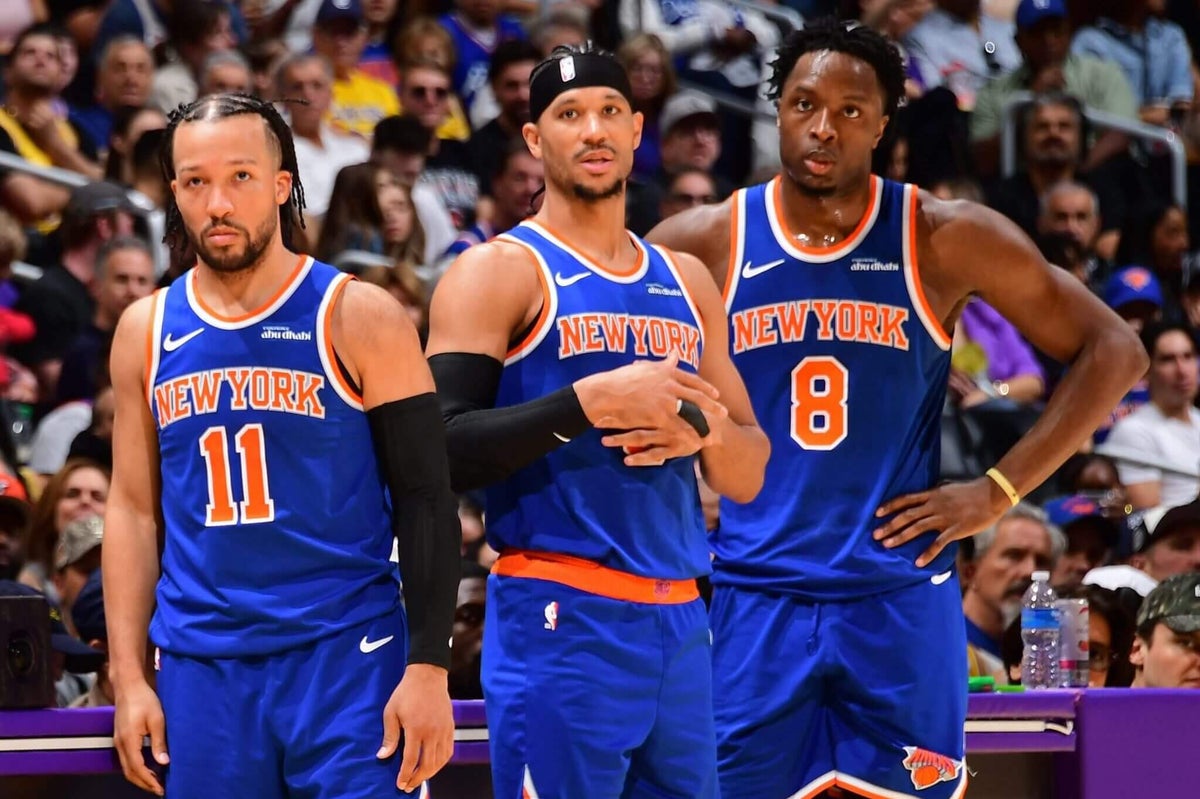
NEW YORK — A roller coaster of emotions has come to a brief halt. The New York Knicks are giving fans a breather from a winding, stomach-dropping ride — one that has touched every nerve and feeling imaginable over the last six months.
There was a three-game losing streak a week into the season. Then, there were just four losses total over the next six weeks. The Knicks won the NBA Cup in December, only to not hang the banner. The owner did something he rarely does, speaking publicly about his expectations for the team and proclaiming that a trip to the NBA Finals is something the Knicks “absolutely have to do.”
Shortly after, the Knicks went out and got pulverized by the East-leading Detroit Pistons and were in the middle of a run that saw them win just two games in 11 tries between Dec. 31 and Jan. 19. In March, there was a 39-point road victory against the Denver Nuggets, which, like the convincing win against the mighty San Antonio Spurs three games prior, felt like the Knicks were re-entering their name amongst the league’s top contenders. There was also a monthlong stretch in March where New York had a seven-game win streak against the worst teams the league has to offer — several of which they struggled to beat. The Knicks finally ended the regular season taking down a trio of postseason-bound teams in the Atlanta Hawks, Boston Celtics and Toronto Raptors and, once again, poured optimism in a glass for everyone to drink.
The 2025-26 Knicks, ladies and gentlemen.
They were orchestrators of confusion and curators of optimism all at the same time. Their trek, though, isn’t over. Nowhere near. New York was always going to be graded on what happens in the postseason by the media, fans and, most importantly, the owner. The time has come to see which of the many versions of the Knicks seen over the course of 82 games is going to get off this ride — and when.
“Perception and standards have, obviously, changed for us since we continued to make that stride last year in the playoffs,” Karl-Anthony Towns said last week. “In the first round, we weren’t supposed to make it out of there. In the second round, we definitely weren’t supposed to make it out of there. We showed the world that we can compete with these teams, especially in the playoffs. In doing that, we put the antennas up for the rest of the league, as well. They know what we can do.
“Coming into the season with the expectations we had this year, finding a way to win the Cup, even with all the ups and downs, finding ourselves in the third seed … I think that the world isn’t unaware of how good we are. But it’s up to us to execute in a seven-game series, be disciplined and find a way to win.”
This iteration of New York is eerily similar to last year’s, despite head coach Mike Brown taking over for Tom Thibodeau, who helped lead the team to its first Eastern Conference finals appearance in 25 years. The Knicks are the No. 3 seed in the playoffs, just like last year. They’re going to face a young, scrappy and overachieving team in the first round, just like last year. They are likely on a collision course with the East-favorite Celtics in the second round, just like last year. New York finished this season with a top-five offense, just like last year.
The defense, though, has improved despite having very low lows throughout the course of the season. The offense plays a bit differently in contrast to a season ago, with the volume of 3-point shots taken significantly up. There are some subtleties that separate the two teams, and in turn, the Knicks are hoping those differing qualities lead to a trip to the NBA Finals and more.
In preparation of the Knicks’ first-round matchup — which begins this weekend against the Atlanta Hawks — as well as their overall postseason run, here are five reasons why or why not the team will make it to the sport’s pinnacle come June.
Josh Hart’s 3-point shooting
Over the last two seasons, opposing teams have decided to guard the Knicks a certain way when the starting lineup is on the floor. The proverbial book says to put an athletic, strong wing/guard on Towns and a traditional center on Josh Hart. Teams do this to willingly bait Towns into tough decision making and drives, as well as being able to switch pick-and-rolls with Jalen Brunson, while betting on Hart, a career 35 percent 3-point shooter, not taking and making enough 3s to crumple up a defensive game plan and throw it in the trash.
The Knicks have seen this night after night this season, and there’s no doubt that every playoff opponent they face will take this approach.
There are games when this defensive game plan works perfectly, but because of Hart’s improvements from beyond the arc this season, the Knicks have been able to weather the storm more often than not. The veteran wing is shooting a career-best 41.3 percent from 3 this season on 3.7 attempts per game. Yet, teams are still allowing him to shoot uncontested (or lightly contested) 3s. Boston did it in a matchup last week, and Hart made them pay by knocking down five 3s in the Knicks’ win.
Hart’s intangibles are desperately needed on this New York team. He’s an elite rebounder for his size, he is the best non-Brunson initiator of the trio of wings, and he always tends to come up with 50-50 balls. The best version of Hart makes New York feel unbeatable, and that version features a willing and able 3-point shooter. Factor in that Hart has proven recently to be one of New York’s best point-of-attack defenders against certain types of ballhandlers, and the Knicks really need Hart on the floor late in games.
How Hart shoots the 3-ball will likely determine if he’s in the closing unit based on how Brown has managed the roster this season.
Brunson-KAT two-man game against a specific defense
The aforementioned defensive strategy that opponents deploy against the Knicks is a big reason why the Brunson-Towns two-man game hasn’t taken the league by storm in their two seasons together.
In the instances when a traditional center is guarding Towns, the duo works tremendously in unison. That was made evident last week when Atlanta, Boston and Toronto primarily guarded Towns with a traditional center. That won’t be the case in the postseason, not if a team wants to advance or they have a big who moves like a wing defensively, as the Pistons do with Isaiah Stewart or the Raptors with rookie Collin Murray-Boyles. When teams deploy the small-on-Towns coverage, Brunson and Towns more often look like two talented individuals than a tantalizing tandem. For New York to maximize itself on offense, both players need to find a way to have a potent two-man game under those circumstances.
There’s enough sample size now to suggest that this duo isn’t able to find the same connection consistently in that specific coverage. The Knicks have the sets and principles to get into it, and they often do, but the plan tends to deviate against this type of defense.
Brunson has been tremendous as a pick-and-roll passer as of late. Towns has also been awesome moving the ball out on the wing in the two-man game. Maybe they’ve unlocked some confidence over this past week to better utilize the two-man game against more athletic defenders. The Knicks need that to be the case.
“We’re running it a little bit more than what he had before,” Brown said of that two-man game following the win against the Celtics. “They’re getting a rhythm at the right time. Jalen is great without the basketball. His ability to get open because he understands angles is second to none. His ability to change direction without the basketball is second to none. And when you have a passer like (Towns), who can hand it off or pass late to you, it makes that play really effective because of those two guys and the characteristics they have as individual players.
“What also makes it good is that (Towns) can shoot the 3 and put the ball on the floor, so his man has to be up into him. He’s big enough and long enough to still protect the basketball and make that pass, but now you’re talking about there’s a lot of room that Jalen has got that defenses have to try and cover with Jalen moving.”
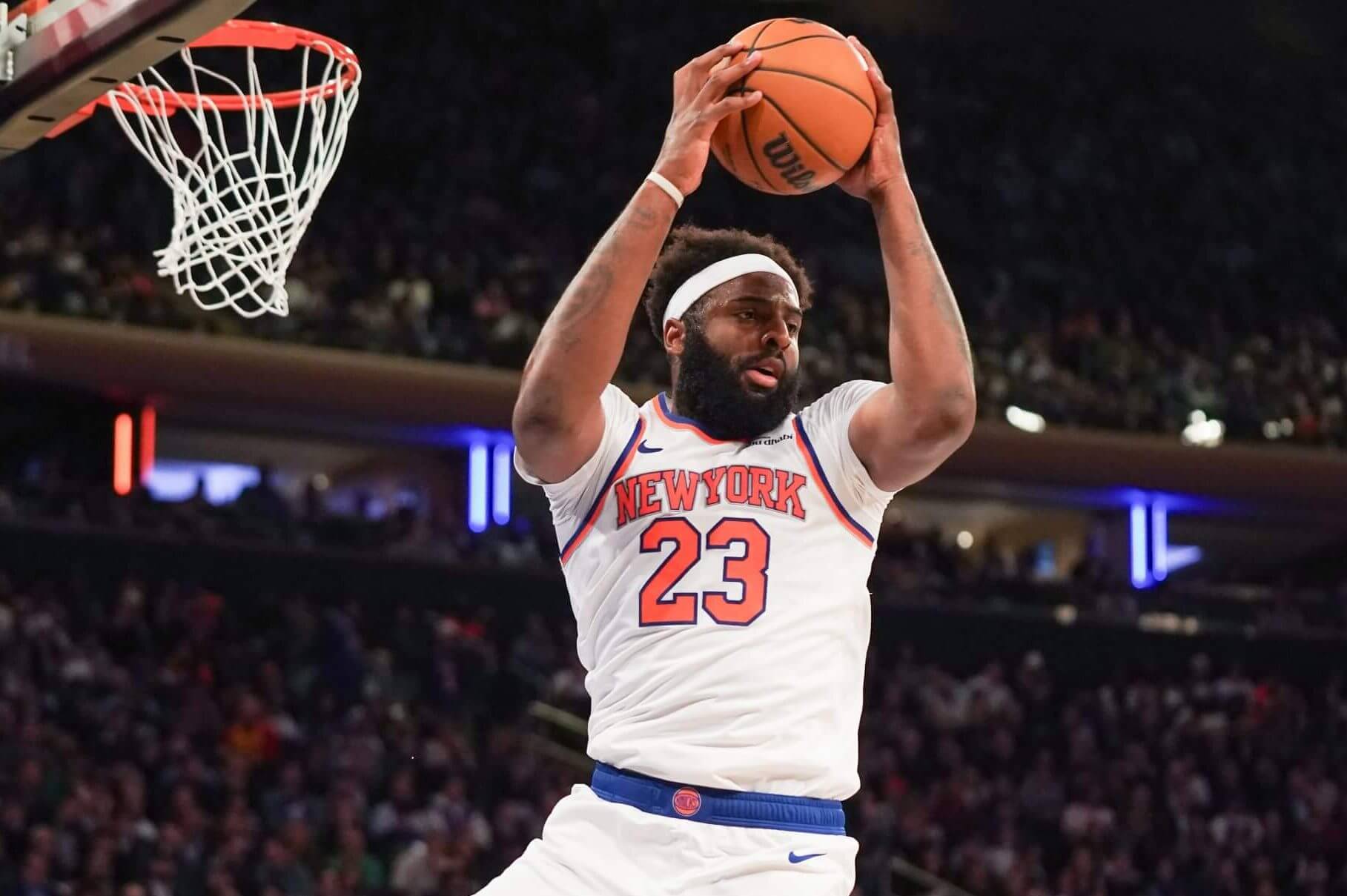
Mitchell Robinson has averaged 3.7 offensive boards per game throughout his career. (Lucas Boland / Imagn Images)
Impact from the bench players
The biggest talking point about the Knicks over the last two seasons is that the starting lineup, to put it frankly, hasn’t been good enough. Including last year’s playoffs, that group has been outscored when on the floor together since January of 2025. This season, it had a net rating of just 2.3, despite playing the second-most minutes of any five-man lineup in the NBA. For comparison, the Hawks’ starting lineup has a net rating of 20.3. New York’s starting lineup is the only five-man group in the league that has played at least 350 minutes together and doesn’t have a double-digit net rating.
What does this mean?
The Knicks have won 50-plus games over the last two seasons, but since the starters have, essentially, broken even when they share the court, the team is at its best when two or three starters share the floor with bench players.
Reading the tea leaves over the last week of the season, it feels like Brown will rely the most on Mitchell Robinson, Landry Shamet, Miles McBride and Jordan Clarkson off the bench in the postseason. Robinson has been the biggest difference-maker of this group because of his world-class offensive rebounding. Shamet has been a great story as a key piece to this team, despite going into the season on a non-guaranteed deal. McBride has been hurt most of the season but is still one of the best shooters on the roster. Clarkson reinvented himself completely after being taken out of the rotation at the top of the calendar year and has turned into a scrappy player who can still score.
New York can’t afford to have these guys not contribute meaningful minutes this postseason. Shamet, while largely being a positive this season, is shooting just 30.4 percent from 3 since March 1. He hasn’t played this many minutes in a regular season since the 2021-22 campaign. McBride underwent core muscle surgery at the end of January and returned on March 29 against the Oklahoma City Thunder. He’s still trying to find his rhythm again. Robinson has made it through the entire regular season without any major injury scares. He’s been a big part of New York’s success as the league’s second-best offensive rebounder (minimum 50 games played).
The oft-injured center played more minutes this regular season than his previous two combined. It’s fair to wonder how strong his motor will continue to run as the season progresses. From the start of the regular season to the All-Star break, Robinson was averaging 4.5 offensive rebounds per game. Since the All-Star break, the big man is averaging 3.6 offensive rebounds per game.
New York will need big contributions from three players who have all dealt with serious injuries over the last year and some change and, in the case of Shamet and Robinson, played the most minutes they’ve played in quite some time.
The offensive rebounding weapon(s)
All of the top seven teams in the NBA have a top-10 player. Most also have a top-25 player. Many of these teams shoot a lot of 3s and defend at a good-to-great level.
The Knicks aren’t special in those regards. What makes them unique is their offensive rebounding.
Robinson and Towns were both in the top 10 in total offensive rebounds during the regular season. Houston is the only other team in the NBA that has two players in the top 10. In the East, Atlanta is the only other team to have two players in the top 25 in total offensive rebounds.
Allowing this Knicks offense to get second-chance opportunities can be deadly for most opposing teams. They’ve got enough shot makers to punish opponents with one shot on a possession, let alone two.
New York doesn’t play fast. It doesn’t generate a ton of turnovers. Therefore, the Knicks need to continue to be dominant in the playoffs when it comes to the offensive glass, because that’s how they most often generate more possessions.
Point-of-attack defense must be really good
There were stretches this season when the Knicks defense was one of the NBA’s best. Conversely, there were stretches when it was one of the worst.
What often determined how good New York’s defense was — or wasn’t — rested on how physical the point-of-attack defense was. At points of this season, offenses were found in advantageous situations simply because the point-of-attack defender was getting blown past off the dribble in space or struggling to navigate screens.
Mikal Bridges has often been tasked with leading the charge in that regard, and he’s had mixed reviews since joining the team two summers ago. OG Anunoby can do it, but he’s better used away from the ball where he can cause havoc. And as noted earlier, against bigger, ball-handling wings, Hart has shown a knack to make life difficult for offenses as of late. Even Brunson did a good job when the likes of Jayson Tatum and CJ McCollum hunted him on defense recently. Shamet can do it, too.
New York has shown the ability to be a physical defense, but it has come in waves all season.
Teams are going to hunt both Brunson and Towns. That’s no secret. How those two defend in space will determine a lot of the Knicks’ success. Furthermore, if Bridges can be a steady, physical presence in that role, it makes New York a far more dangerous team on that end because of his length and the pouncing legs of Anunoby and Hart ready to make a move on the ball if physicality from the point of attack is present.
The Knicks’ No. 1 goal on defense is to take away the paint. It needs ferocious on-ball defenders and good communication to do that, both of which have been absent for long periods this season. New York can’t afford those lapses now.