
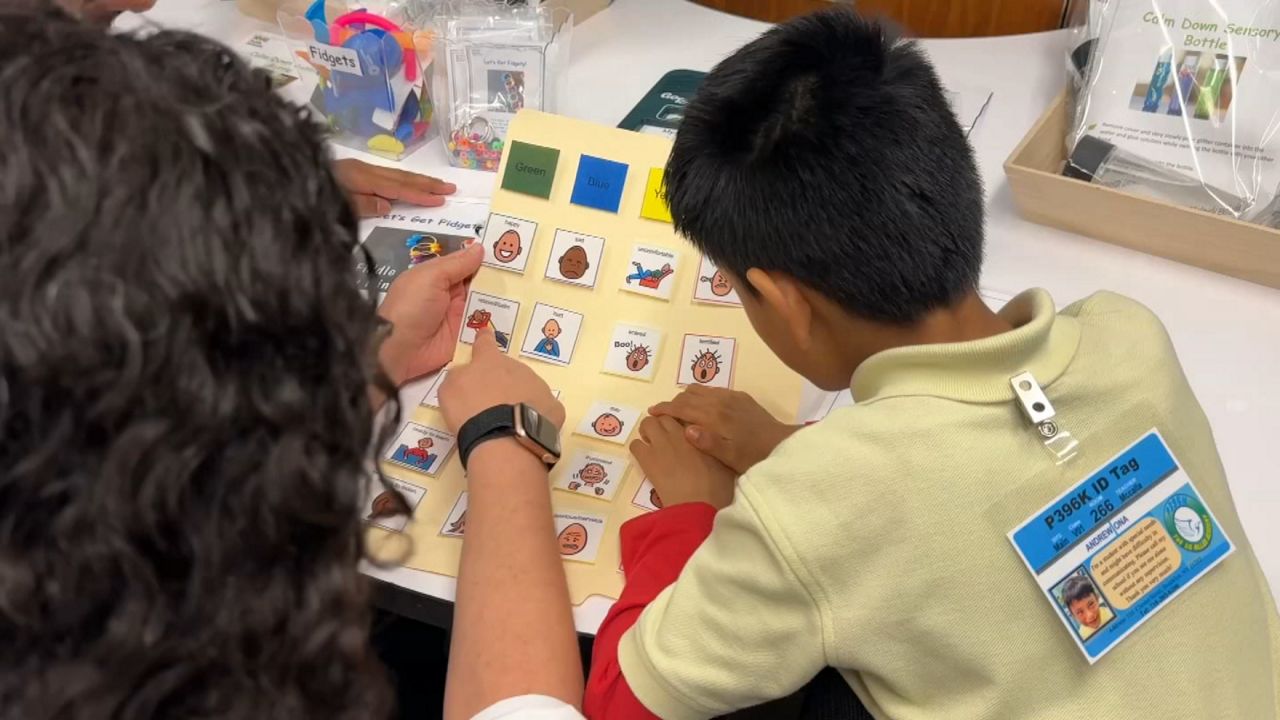
At P396K, The Sid Miller Academy, students with disabilities take a moment to share how they’re feeling before activities like creating a sensory bottle, balancing on a ball, or gliding on a swing.
This is the school’s sensory room designed to help these children get ready for their day. Many of them have long commutes on school buses.
What You Need To Know
With funding from Brooklyn Borough President Antonio Reynoso, the city is expanding the number of sensory rooms in Brooklyn schools
An additional 18 elementary school sites within District 75 will get new sensory rooms in the borough
The rooms contain equipment like swings, trampolines and exercise balls to help children feel more regulated in order to learn
“Bumpy bus, sometimes loud, traffic, honking. They are already dysregulated, meaning they are not in a state to learn. And what a sensory space like this does is it gives our therapists, our clinicians, our teachers, our paraprofessionals the opportunity to give students in a structured, organized movement,” Suzanne Sanchez, the DOE’s chief of special education, said.
That opportunity will expand to eighteen more Brooklyn elementary school sites within District 75, which serves children with the most significant special needs — thanks to an investment from Brooklyn Borough President Antonio Reynoso.
“My son is a child [with] autism, and I’ve seen just how beneficial immersive sensory experiences like sensory rooms can be for students,” Reynoso said.
Similar experiences are available for private sensory gyms across the city, but they can be expensive.
“For years I wanted the opportunity to create free spaces, so that families did not have to work an extra shift, have to get a second job, all so that they could take their child to a sensory gym on the weekends or after school,” Deputy Chancellor Christina Foti said. “And we were hearing so much of that from families, talking about all they were doing and the lengths that they were going to so that kids could have access to spaces like this.”
The city created more than 70 sensory rooms after the pandemic, using stimulus funds, and they have proven popular with schools, parents and students.
Reynoso’s office says the new funding means every District 75 elementary school in Brooklyn will have a sensory space.
“To know that this is a service that we’re going to be providing for kids as the norm, as our standard level of service, certainly it is everything our kids deserve and more,” Foti said.