
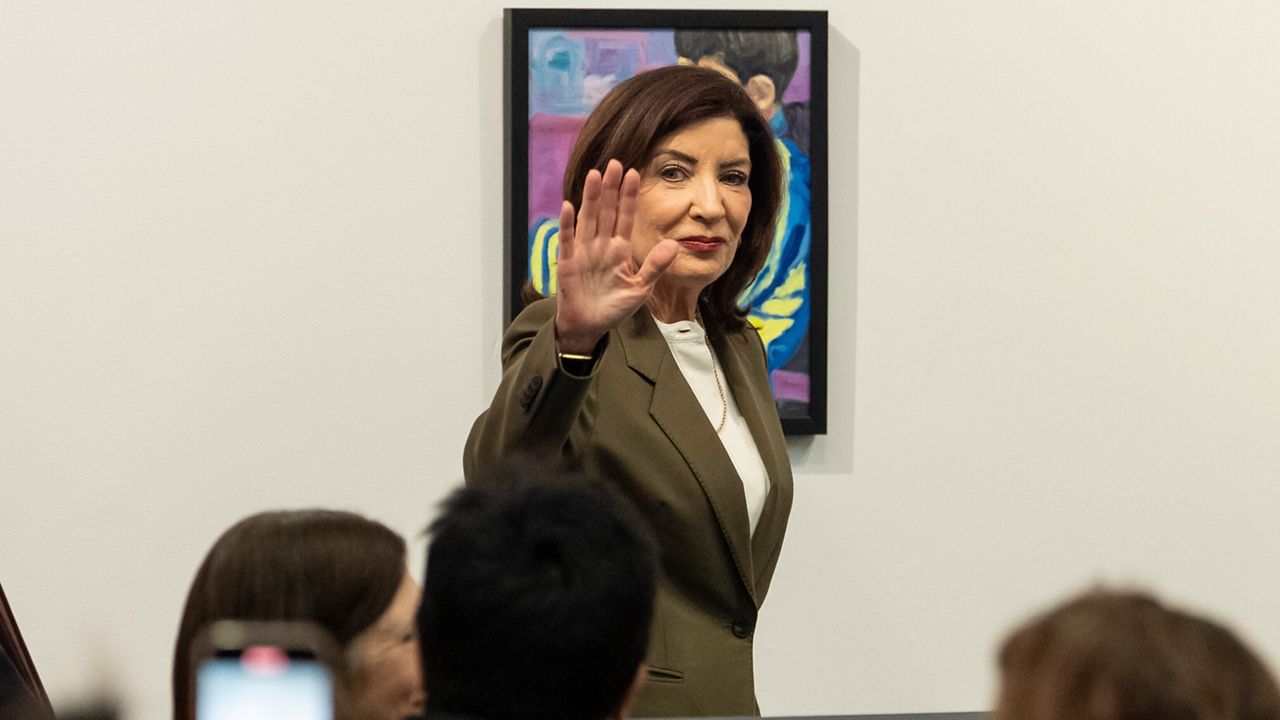
New York may not have a state budget, but there was plenty of posturing in Albany Tuesday as the state spending plan approached being two weeks late.
Both Governor Kathy Hochul and state lawmakers in the Democrat-led legislature held simultaneous news conferences to make their points around sticky environmental issues which are contributing to the protracted stalemate in which no major policy issues have been resolved.
While state lawmakers were scheduled to be on the second week of a planned recess for the Easter and Passover holidays, many rattled around the Capitol on Tuesday, bridging the gap between a $3.4 billion budget extender passed Monday and another expected on Thursday.
Neither legislative chamber held session Tuesday, and the state Senate also canceled a scheduled conference amid frustration with the progress of negotiations and, apparently, little to discuss.
How stagnant talks have become depends on who you ask.
“I wish we could get to a place where we’re talking about the actual budget,” Deputy Senate Majority Leader Mike Gianaris told reporters Monday, notably criticizing Hochul for being unwilling to compromise on her policy proposals around car insurance and climate, which he said are preventing spending discussions from moving forward.
“We’re getting to the right places,” Hochul said, disputing Gianaris’s account: “That is not true,” she said, insisting there has been give and take.
Despite the relatively tense atmosphere, Assembly Speaker Carl Heastie told Spectrum News 1 in passing Tuesday evening that he felt conversations were moving along on multiple fronts.
Hochul spent the morning Tuesday away from the Capitol, up the Hudson River in Troy, working to stave off changes she told reporters the legislature is pushing for amid negotiations over her proposal to ease the state’s environmental quality review process, or SEQRA.
Dubbed “Let them Build,” the initiative is part of Hochul’s affordability push and she says slashing red tape that she and others say is contributing to stagnant housing development will boost supply and bring down housing costs.
State lawmakers have expressed concern with how far-reaching the governor’s plan is, covering things like bike paths and daycare centers in addition to housing, and the Senate in particular has expressed a desire to limit the scope of projects impacted by the changes in more rural areas upstate.
“There’s been some efforts to restrict the locations, for example, and limit the use,” Hochul said. “I’m not looking to have our ambition curtailed.”
As Democratic lawmakers and environmental advocates held a rally back in Albany criticizing Hochul’s proposed changes to the state’s climate law — passed in 2019 with vast emissions-reduction goals — Hochul placed the blame for the need to roll back the law on the shoulders of environmental advocates, though she acknowledged a variety of factors, from the Trump administration’s lack of support for renewables to the COVID-19 pandemic, have contributed to a broader environment that has made meeting the goals more challenging.
“No one gave us any grace for the realities in the global marketplace, or now with the war. They take us to court, we lose, and now I have no alternative but to change the law or be in violation of the law,” Hochul said, referring to litigation over missed environmental deadlines.
After missing the 2024 deadline to release and implement regulations for a cap-and-invest program to drive and fund emissions reduction, Hochul has insisted the proposed changes are necessary to prevent rate hikes, which her administration says would result from forced compliance with the law. The advocates involved in the lawsuit have disputed this.
State Sen. Pete Harckham, chair of the Environmental Conservation Committee, said Democratic lawmakers have expressed only limited resistance to the aspects of Hochul’s plan that deal with the practical matters surrounding deadlines tied to the lawsuit. But he said it is the rest of the proposal — including changing the way the state tallies emissions and tracks progress, and the fact that it remains unclear what regulations for reaching emissions-reduction goals would look like — that is fueling resistance.
“We realize we’re behind when it comes to emissions because we have not implemented cap and invest. We need to do cap and invest. If the governor needs more time on that, the legislature is willing to discuss that,” he said. “What’s on the table now is a wholesale gutting of the state’s climate law, and that’s something that I don’t think most of us in the legislature are willing to do.”
While the environmental debate takes up much of the discussion, the tension surrounding it was to be expected. But the governor’s car insurance plan has emerged as especially stubborn.
Supporters of the governor’s proposal argue the state’s system is being driven up by organized fraud schemes, medical billing practices and litigation costs which get passed on to drivers in the form of higher premiums. Critics, especially the state’s trial lawyers, say the Hochul’s approach risks going too far by tightening access to the courts and limiting injured New Yorkers’ ability to recover damages, even as both sides broadly agree that premium costs have become unsustainably high across much of the state.
The vast scope of the lobbying involved in the debate has been a key topic of conversation around the capitol, as has the governor’s disdain for the role trial lawyers are playing in their opposition.
“Let them say why they’re standing with trial lawyers to the detriment of the public,” Hochul said of state lawmakers Tuesday, responding to a question about her spat with Gianaris.
Tom Stebbins, executive director of the Lawsuit Reform Alliance of New York, was on hand in Albany to stump for the governor, and argued that trial lawyers wield disproportionate influence in the debate amid charges that Hochul herself has been influenced by Uber’s nationwide campaign for insurance reform.
Stebbins slammed the idea that the actual policy debate can or should be summed up as “Uber vs. the trial lawyers,” even if that’s where much of the money is coming from.
“It’s the trial lawyers versus everybody else,” Stebbins said. “The truckers have come out against it. Nonprofits have come out against it. Businesses large and small.”
Gianaris countered that Uber’s spending in New York to run a multimillion-dollar campaign in the governor’s favor is no better, adding that if they’re spending that much, they must be anticipated making even more off of the change.
“The Uber playbook that has been very successful in Republican states all around this country is trying to be implemented in New York,” Gianaris said. “They are the ones who are spending, I think, past $8 million to advance this campaign. The trial lawyers haven’t done that, as far as I know.”
It comes as a chief objection from state lawmakers who are pushing back against the governor remains the idea that insurance companies could be let off the hook absent a mechanism to force them into lowering rates or facing significant reforms themselves.
“Rather than encouraging New Yorkers to blame one another for fraud, wise policy would look at the far more significant and costly abuses being driven by insurers themselves,” said Doug Quinn, executive director of the American Policyholder Association. “Nothing in this plan addresses those practices. Insurers can’t keep logging record profit years while at the same time, shorting claims and crying poverty to increase premiums. New Yorkers should be able to count on their elected officials to create common sense solutions that work for the citizens of the state, and not further tipping the tables in favor of the insurance industry.”