
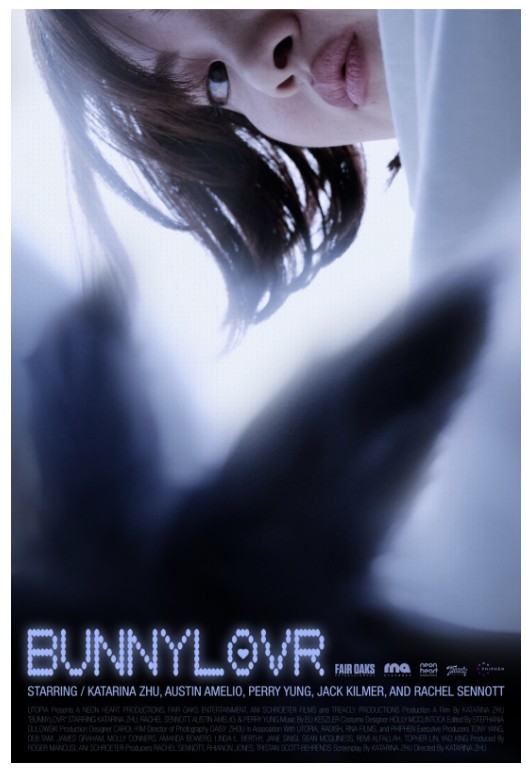
There’s a particular kind of filmmaker who makes their debut feature the way Katarina Zhu did, not because someone handed them the opportunity, but because they got tired of waiting for it. Zhu, an NYC-based writer, director, and actress, premiered her first feature Bunnylovr at the 2025 Sundance Film Festival. Now, over a year later, she’s only just beginning to come up for air.
“I’m only just sort of coming down off of the whole experience,” she says, laughing a little at herself. “There were a couple of other festivals in Europe — I did a little festival tour all last year,” she adds.
Bunnylovr, which hit theaters April 10, 2026 via Utopia, is the kind of film that stays with you in the same slow, creeping way its protagonist Rebecca drifts through her own life. The film follows a Chinese-American cam girl navigating a toxic relationship with an increasingly obsessive client while trying to reconnect with her estranged, dying father. It’s a quiet, intimate, and deeply observant debut.
It isn’t a light lift, and Zhu didn’t make it any easier for herself by starring in, writing, and directing it. The urge to take on all three roles stemmed from a hunger for creative control. “The autonomy you have over your own creative life as a director and a writer is so amazing,” she says. “I had never booked anything, so being able to give myself this role and take control over my career in that way was my favorite part of doing all three.”
Taking on so many responsibilities seems like a lot for a debut feature, but the multihyphenate credits the team around her, including her DP and producers, for making it feel manageable. “Having a DP who I trusted with my life really made my job so much easier,” she said.
Bunnylovr didn’t happen overnight. Zhu lived with the script alone for about two to three years before she let anyone else read it. “I think I was scared to make the jump from shorts to features,” she admits. “It felt really daunting.”
The person who finally nudged her to make the jump was her close friend from NYU, Rachel Sennott, who would later co-star in the film. “Rachel was sort of like, you should just make the feature. Just do it,” Zhu recalls. “One of her love languages is talking out life goals and career goals with you as a friend.” Having someone in her corner who had already navigated that leap made it feel, in retrospect, much less scary than it seemed. “With hindsight, I can see that the jump from short to feature — it’s actually not that big.”
If there’s one thing Zhu is certain of, it’s that she couldn’t have made this film without the community she built at NYU and carried into the industry. “Community, especially in the indie filmmaking scene, is everything,” she says. “Indie filmmaking revolves around, exists on, community.” Friends from school came on as her cast and crew, not just as a job, but because they believed in what she was making. “They wanted to support me, and that was so huge.”
That sense of collective investment shaped the entire production experience. “It’s also the reason why I’m drawn to filmmaking in the first place, because of this community that gets built around achieving a singular goal.”
Filming in Chinatown was important to Zhu in a way that went beyond location scouting. The neighborhood holds a complicated place in Zhu’s sense of identity, a place she wanted to portray on screen with real honesty. “When I’m walking around Chinatown, I have this inherent sense of belonging, because I’m surrounded by people who look like me,” she explains. “But then at the same time, if we try and speak to each other, sometimes we don’t even speak the same language.” That push-and-pull feeling of alienation and belonging in the same space is carefully woven into the fabric of the film.
This nuance extends to how she thinks about representation in film more broadly. Growing up, Zhu rarely saw young Asian American women portrayed in ways that felt layered or real. “It was rare to see myself in film,” she said simply. “And so it was really important to me to portray that.” In Bunnylovr, Zhu puts a young Asian American woman on screen in a way that feels genuinely lived-in.
Zhu deliberately kept the film grounded. In tackling internet culture, specifically cam work, online relationships, and screen-driven loneliness, she was careful not to let the tech aspects of the film feel gimmicky. She filmed computer screens practically and steered clear of visual effects, avoiding anything that might feel trendy or overly stylized. “My hope is that you would be able to watch this in 10 years and not feel like it’s too dated,” she said.
As Zhu’s first feature, Bunnylovr feels less like a first attempt and more like the beginning of something sustained.
Bunnylovr is now playing at the Quad Cinema in Greenwich Village and will be available on TVOD beginning May 19th.