
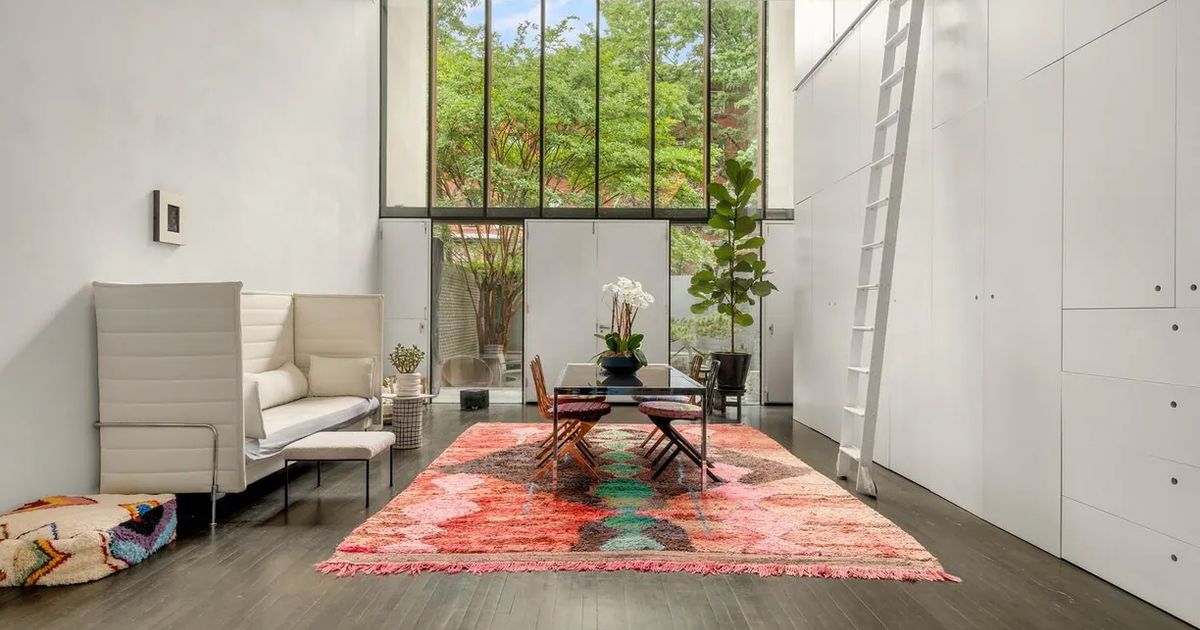
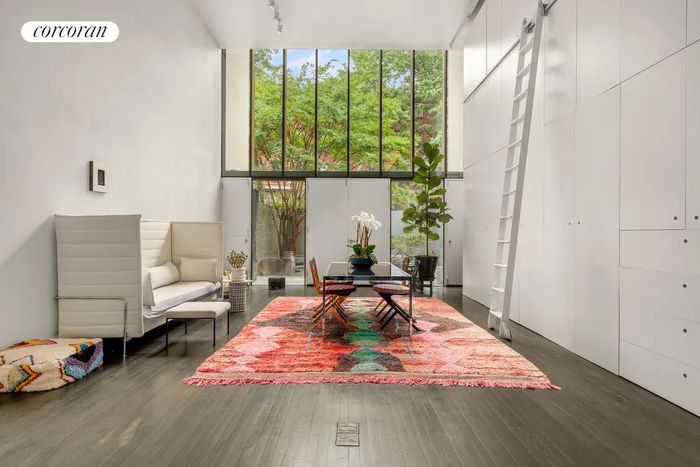
A listing image attempts to show the massive scale of 208 Vanderbilt, where a double-height great room has 23-foot high ceilings and a view of a private courtyard. Minimalist storage, right, lines the entire room.
Photo: Corcoran
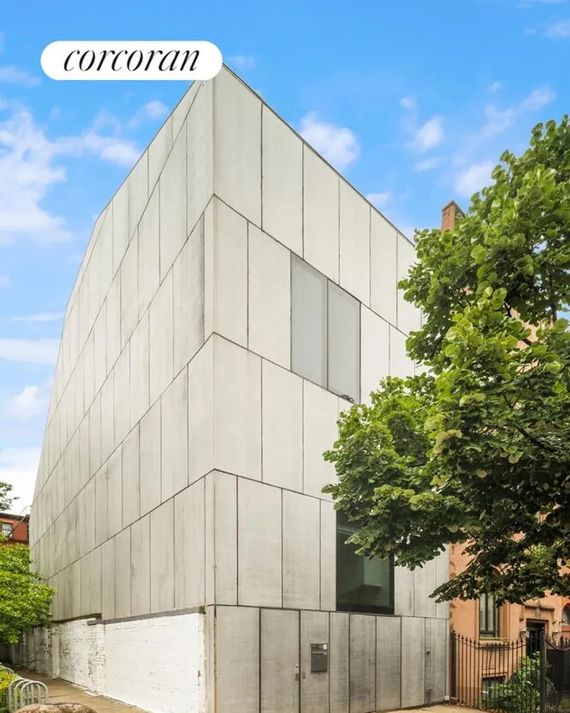
The listing shot shows an exterior clad in industrial polypropylene panels and a roofline Adjaye designed with a subtle, triangular shape that mirrors the façade of a church on the block.
Photo: Corcoran
A postcard of Fort Greene might show row after row of tightly packed brownstones, dating back to the 1850s, with views over leafy avenues. On Vanderbilt, No. 208 is only four blocks off the park, near the corner at Willoughby — a closed street that’s a summer paradise for cycling. But the house doesn’t fit the neighborhood stereotype. Covered in silvery industrial panels, with a door that closes flush against the façade, the four-story building stands out for its museumlike minimalism. Built in 2006 as a live-work studio for two artists — James Casebere and Lorna Simpson — it was listed at $6.5 million last July. This week, the price was reduced to $5 million, a 23 percent cut. That’s closer to the $4 million median for a single-family townhouse in Fort Greene, per John Walkup of the real-estate data-analytics company UrbanDigs. He says the pricing likely accounted for “a significant premium for a product with niche appeal.” Niche because the pool of buyers going after modern, minimalist spaces here might be smaller, and even those buyers may be wary of No. 208. It was the first project in the U.S. by David Adjaye, the starchitect who went on to design the National Museum of African American History but was accused in 2023 of sexual assault, harassment, and a “toxic work culture.” Adjaye has denied the allegations, but there’s been a drop in interest in his work. (The listing says the home is an “architectural gem” but leaves out his name.)
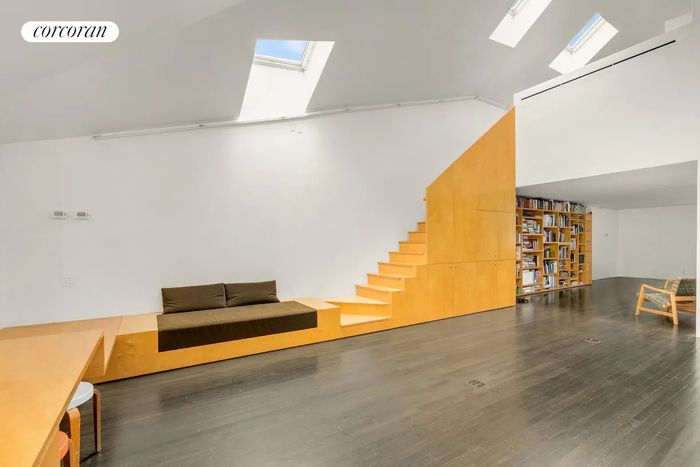
A listing shot shows the third and fourth floors, designed to serve as an art studio.
Photo: Corcoran
And at a price point where buyers have room to be discerning, the floor plan and location may be tough sells, too. There’s the “potential for multiple bedrooms,” per the listing, but right now, this is a four-story, $5 million townhouse with only one real bedroom. Then there’s the issue of the next-door neighbor: a 43,000-square-foot sports center with a 270-seat basketball arena, which opened in 2014 as part of the St. Joseph’s University campus. It hosts alumni events and volleyball tournaments, with space for 90 cars accessed via a ramp between the two buildings.
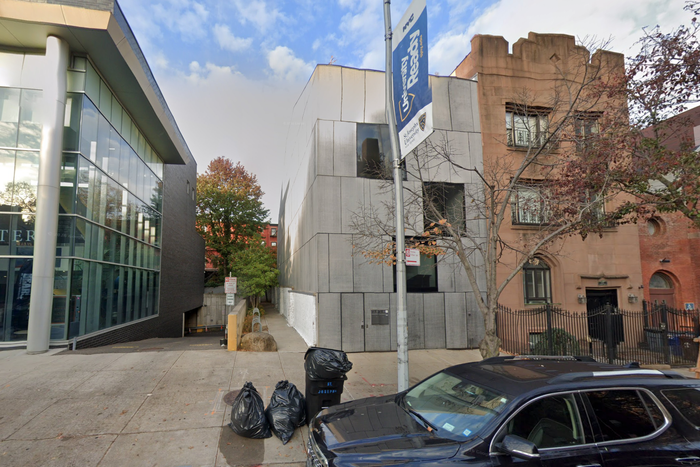
A Google Maps view shows a parking ramp separating the sports center (left) and the private home (right).
Photo: Google Maps
The brokers for the listing declined to comment, and Simpson didn’t respond to an inquiry through her gallerist, Hauser & Wirth. But she didn’t seem to be using the house much in recent years — instead renting a studio at the Navy Yard, living elsewhere, and using the home for offices, meetings, and “thinking about what the pieces are going to be,” as she told Antwaun Sargent in 2017. Still, if it’s not the right space for Lorna Simpson, it might be for her collectors. As her broker Leslie Marshall told the New York Times last year, the 23-foot high ceilings mean “the exhibition potential is great.”
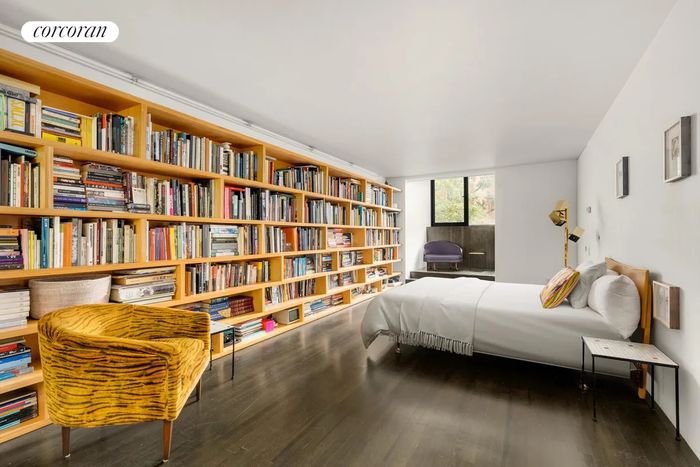
A listing shot shows the only room initially designed as a bedroom, on the second floor, furnished with art books. The window alcove looks over Vanderbilt Avenue.
Photo: Corcoran
Sign Up for the Curbed Newsletter
A daily mix of stories about cities, city life, and our always evolving neighborhoods and skylines.
Vox Media, LLC Terms and Privacy Notice
Related