
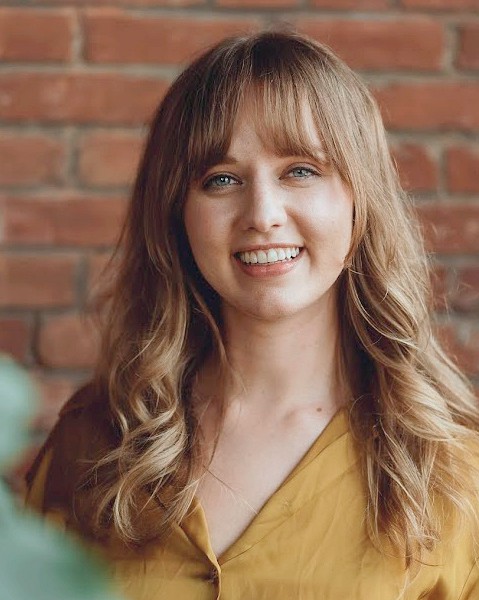

Maria Giesbrecht is a Canadian poet whose work explores her Mexican and Mennonite roots. Her writing has appeared in The Literary Review of Canada, Narrative, Grain, ONLY POEMS, San Pedro River Review, and elsewhere. She is the winner of the 2025 Jack McCarthy Book Prize, the Lesley Strutt Poetry Prize, a finalist for the 2025 Narrative Poetry Prize, a Best of Net nominee, and the founder of Gather, an international writing community that connects poets worldwide. Maria will read from “A Little Feral,” currently trending as a #1 release in Canadian poetry on Amazon, before her conversation with fellow poet and author Trev Cimenski at Astoria Bookshop, 36-19 30th Street, on Monday, May 11, at 7 p.m. Born in Durango, Mexico, she now lives near Toronto, Canada with her fiancée.
 NB: What advice do you have for readers who are hoping to develop their writing or artistic practice? Is writing or artistic talent innate and/or can it be taught/developed? How important is daily practice? Do you ever get stage fright/camera shy/performance anxiety or have advice about overcoming it?
MG: My best advice for writers developing their practice is to play! So many wonderful things can happen when we give ourselves permission to follow our curiosities. It’s important, of course, to expand our craft by learning new things and becoming disciplined in our editing, but all of this can be done with an attitude of play. This makes it sustainable. Writing daily is a good way to keep the channels open; however, it’s hard to do when it feels like a chore. If I’m excited to tumble onto my page, try new things, and have fun, I’m more likely to stick to it every day.
I get nervous when I read my poetry to an audience, or right before I share it online with my readers. A long time ago, I read somewhere that being afraid or nervous lights up the same area in the brain as being excited. So I try to remind myself it’s just excitement coming up for me in different clothes.
Sharing poetry is a gift. It’s an offering to the world. Publishing can be scary. Its prerequisite is a lot of rejection. Many writers like to collect rejections instead of acceptances. We’ll aim for 100 rejections in a year, as proof that we are putting ourselves out there and trying. It reframes rejection as a necessary step, not a mark of failure.
NB: How important is personal connection and communication (networking?) in your industry?
MG: Networking in the writing industry is incredibly important. Both for professional success and for sustainability. The isolated writer in a room of their own is a bit of a myth. Sure, we need time alone to marinate in our thoughts, swim with our musings. But the sweetness of what we are trying to do, distill a moment into a few short lines, only becomes ten times sweeter in the company of those who understand it intimately. We need our writing friends, colleagues, and mentors to stay the course. A group of writers willing to share their knowledge, connections, and opportunities with one another is worth more than gold. (Hot writers don’t gatekeep!)
NB: What is the best piece of advice you’ve ever received? What is something you wish you knew a decade or two ago?
MG: The best piece of advice, with respect to my artistry, I’ve ever received is that it’s impossible to lose your voice. When I first started writing, I was scared to read too much, in fear that I would begin to emulate my favorite poets and not sound like myself. My mentor encouraged me, saying it’s impossible. Your voice will always bleed onto the page. So read as far and as wide as you can. It will only make you a better writer in the end. Ironically, through spending time with others’ voices, you will find your own.
NB: Who are some of your favorite artists, poets, event hosts, writers, and other creatives with a Queens connection?
MG: Two incredible poets, Kiran Josen and Alina Kalontarov, both live in Queens. I’m lucky enough to write with them in community. Last December, we had the pleasure of reading together in NYC at a sold-out venue. After, we wandered until we found a little wine bar to nibble on bites with and bend the night with our poetic talk. I cherish time with artists more and more these days. In a world of digital connections, these in-person encounters in a city like NYC are gems I treasure deeply.
NB: What do you wish more people knew about being a poet? What is something you wish you knew before you became a poet?
MG: I wish more people knew how exciting poetry can be. Especially contemporary poetry. It often gets a reputation for being stiff and uptight, but if you pick up a contemporary poetry magazine, you’ll be surprised to find poems that are in conversation with pop culture, social issues, and more. Poets are doing really neat things with language right now, because we don’t have a choice. It’s exhilarating to be a part of.
Before I became a poet, I wish I had known that there is an ever-flowing abundance of style, form, and genre, that my tastes would change over the years, and that this is completely normal and part of the wild ride. As poets and artists, we do not need to pick a lane and stay in it. In fact, swerving in and out is often what makes our work interesting.
NB: What is something you wish I had asked? Please let me know what that question is, and answer it. Thank you.
MG: Where do you find your inspiration for your poems? I get it from ordinary moments that feel bigger to me than they might to someone else. I’m always trying to distill a moment of time in my poems to a few lines. If I feel that I can compress or expand time like that, then I feel like I’ve caught my inspiration and translated it onto the page. I collect moments I see on the street, at the post office, walking in my neighborhood, and in public bathrooms. Anywhere. Everywhere
NB: Do you have any events or projects coming up that you’d like to promote? Your answer to this question helps with our production schedule. Can you tell us more about your upcoming reading at Astoria Bookshop?
MG: I’m truly excited to share my upcoming book, A Little Feral, with my readers at Astoria Bookshop. I’ll be in conversation with Trev Cimenski, another artist and poet with whom I’ve written for years. You may have stumbled upon his popular video-poetry Instagram account (@of_a_hound). I’m inspired by Trev’s dedication to making beautiful things and telling the truth with his words.
Many of my poetry friends from Queens will be at the event as well, ones I’ve written with for over two years in community. I’m looking forward to signing some books, meeting new friends, and grinning big!
NB: What is a typical day like for you?
MG: I wake up at around 7 in the morning, make a quick coffee, and begin writing. I find that I can squeeze the most out of my creativity if I do it as soon as I wake up. That almost dream-like state is perfect for creating the necessary abstract associations I like to make in my poetry. Usually, my cat is purring in my lap the whole time. In the afternoons, I will plan lessons for upcoming workshops, respond to emails, and do other miscellaneous admin work. I try to take meetings in the afternoon to protect my sacred writing time in the mornings. After work, you can find me grabbing a girly drink with friends, at the gym, cooking up a mean Mexican dish, or just puttering around the house as one does.
NB: Can you tell us more about how your work explores your Mexican and Mennonite roots?
MG: I was born in Durango, Mexico, into a religious community called the Old Colony Mennonites – a group of Russian conservative Mennonites who believe in living a life outside of worldly influences. I was not allowed to wear pants, use makeup, cut my hair, or wear jewelry. To escape my world, I read a lot. It was easier to enter a fictional world and spend a few hours with characters I adored than to live my own reality. That made me fall in love with words. I started writing poetry in high school with the encouragement of my creative writing teacher, Mrs. Stronach. It was like I had discovered the magic formula for expressing myself without anyone telling me I couldn’t. At seventeen, I moved out with two hundred dollars in my bank account and a wild dream of becoming exactly who I wanted to be. Poetry was my constant companion in hard times, and the perfect medium for parsing through my upbringing in a container that felt safe for me to do so.
NB: How do you know when something you’re working on (or piece, or any type of art) is “done” (finished editing, complete)?
MG: One of my favorite poets, Jane Hirshfield, taught a workshop in my writing community about this very concept. I’ll never forget what she said. Jane said that she knows when something is done after she is satisfied with it. Simple. She uses satisfaction as a marker of completion. For me, the second part of that is also time. I like to let my poems sit for a few weeks after writing them. Just like a steak must be rested to enter its best state, a poem must as well.
NB: Can you tell us more about being the founder of Gather, an international writing community that connects poets worldwide? How did you know there was a need for such a community?
MG: When I started meeting other poets in the online poetry community, something we all had in common was this: we knew almost no one in real life who was a poet. And yet we deeply longed to connect with people who also had this deep desire to fiddle with language for meaning, beauty and pleasure. I believe poems need to be cared for. More than they need to be published. So I wanted to create a space where poets could connect with others like them and care for each other’s poems. We do this through generative writing sessions, feedback sessions, community open mics and social events. Last December, 25 of us met in NYC to host a sold-out reading event. I think more than ever before, we need each other.
—Nicollette Barsamian
The Local-Express interview series was originated on July 3, 2013 by Nicollette Barsamian.