
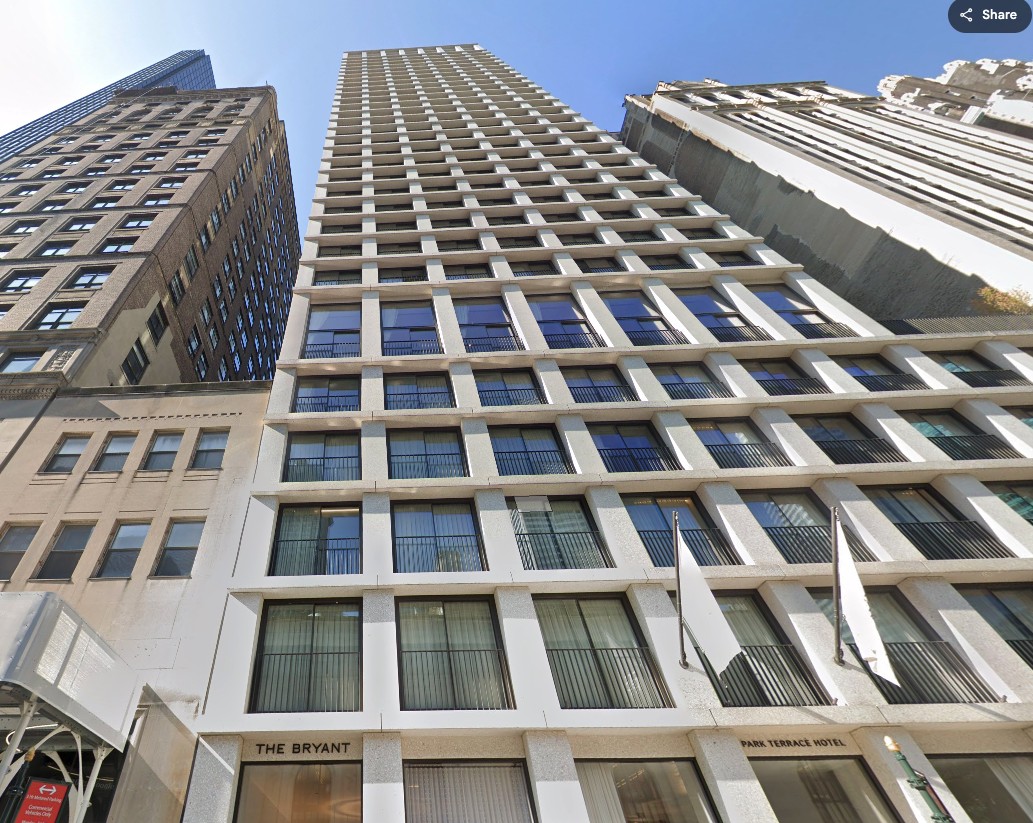
A New York appellate judge in Manhattan awarded a Chinese businesswoman two condos she had invested in for her daughters in a Midtown skyscraper before the deal went sideways.
New York’s Appellate Division, First Judicial Department, decided on Tuesday to cancel the mortgage of the two condos held by Bryant Park Funding 100 LLC (BPF), an LLC controlled by Nicholas Mastroianni II, the businessman who convinced Ying “Vivian” Ding to invest $11.5 million in the condominium development project in exchange for the units.
In early 2017 Ding began working on a deal with Mastroianni and real estate developer HFZ Capital to buy two condos in The Bryant, HFZ’s luxury building across the street from Bryant Park, according to the complaint Ding filed against Bryant Park Funding 100 and another HFZ-linked LLC.
Ding used Qiaoshang International, a limited-liability company that she owns, to reach a purchase agreement for the two units at 16 West 40th Street once the process for converting them into condos was finished in exchange for $11.5 million paid up front to HFZ, the complaint said. Ding had previously worked with Mastroianni to solicit Chinese investors to provide capital for real estate projects in the U.S.
But in March 2021, after the condos were ready, Mastroianni claimed that Ding had never filed documents to finalize the purchase. Qiaoshang said it never received the offering notice to do so, according to the suit.
In July 2024, Manhattan Supreme Court Justice Jennifer Schecter determined that BPF was not the legitimate holder of the condos’ mortgage, finding that HFZ and Mastroianni had treated Ding’s LLC as the owner of the property and HFZ, which defaulted on its debt in 2019, had waived the requirement for Qiaoshang to file its paperwork.
The court granted summary judgement on Ding’s claim to void BPF’s mortgage and transfer the condos to her ownership. BPF appealed, insisting that a multitude of fact questions required discovery and that the court was premature in its decision, arguing that the court could not enforce and apply the agreements as written.
Appellate Justices Troy Webber, Ellen Gesmer, Manuel Mendez, Bahaati Pitt-Burke and Shlomo Hagler unanimously affirmed the lower court’s decision on Monday. They denied BPF’s request for additional discovery because it failed to show how further information would change the outcome or disprove that it had notice of Qiaoshang’s interest.
“The timeframes set in the agreement do not undermine the conclusion that the record establishes that Qiaoshang had an interest in the property sufficient to defeat BPF’s status as a bona fide encumbrancer,” the court wrote.