
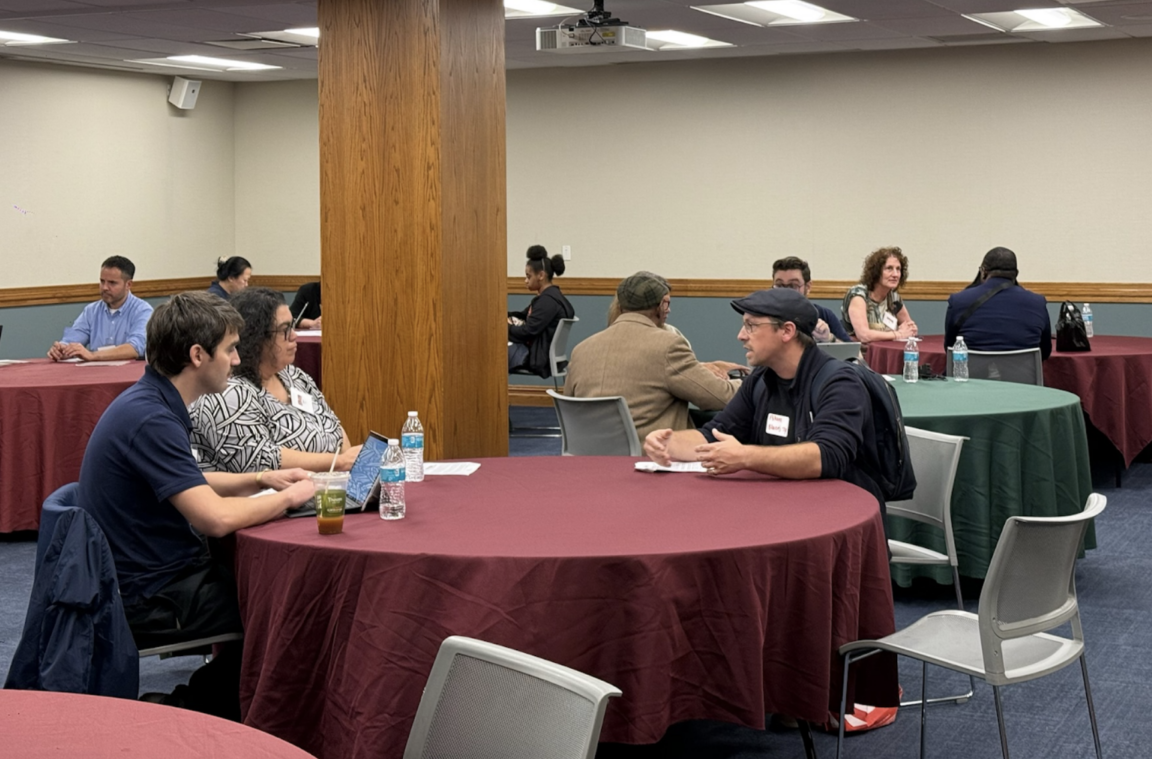
Hundreds of Bronx residents lined the halls of Fordham University’s McShane Center on March 11, waiting for their three minutes to tell the city what their landlords had been getting away with. It was the third of Mayor Zohran Mamdani’s “Rental Ripoff” hearings across the five boroughs, and the first that he personally attended.
The hearings were inspired by a “The Mayor is Listening” event that Mamdani held before taking office, designed to make a more direct connection with tenants than run-of-the-mill public hearings. Tenants registered in advance for three-minute, one-on-one sessions with senior city officials in a side room, while the main atrium had city staff standing beside poster boards that outlined policy areas under review, inviting public input on topics from housing quality and code enforcement to hidden fees. Tenants attend these hearings to speak to support services from agency partners including the Attorney General’s office, the Mayor’s Office of Immigrant Affairs, and New York City Housing Authority (NYCHA) representatives.
When Mamdani delivered the opening remarks, a woman in the audience yelled out: “Public housing first, Mayor, public housing first.”
The frustration had been building for weeks before Mamdani set foot in the Bronx. Ahead of the first hearing in February, when NYCHA residents tried to register for the hearings online, the site automatically routed their complaints to a NYCHA representative rather than into the one-on-one sessions with senior city leadership. At the Brooklyn hearing, a viral activist known as Crackhead Barney stormed the stage. “There is no tenants association without NYCHA. Poor people have a f–king voice!” she said, with cheers from the crowd.
At the Bronx hearing, Mamdani was present to directly respond.
“NYCHA residents have been dismissed and have been neglected,” he said, to a mostly silent room. “I know that, not only have NYCHA residents faced chronic disinvestment, they have also come to expect little from a city government that has constantly turned a blind eye to disrepair.”
However, Mamdani did not stick around to listen to the bulk of the testimony. Before his opening remarks, he sat with three tenants before leaving, with the rest of the hearing session run by Cea Weaver, director of the Mayor’s Office to Protect Tenants. She was joined by the heads of the city’s housing, buildings, and worker and consumer protection departments, as well as Council member Pierina Sánchez of The Bronx, who chairs the chamber’s housing committee.
The day after the hearing, Mamdani announced a landmark $2.17 million judgment against Seth Miller, who owns 919 Prospect Avenue in the South Bronx. It was the first time courts had levied maximum civil penalties under the Nuisance Abatement Law, with fines of $1,000 a day accruing since 2019 for violations including mold, lead paint and collapsed ceilings.
Ultimately, 330 people signed up to attend the Bronx hearing, with 145 registered to give one-on-one testimony to city officials across two 90-minute sessions. Many arrived with folders of documentation to show the city officials. Their complaints were consistent: unaddressed repairs, unreliable heat and hot water, and pests.
Jasmine Williams, an Emergency Medical Technician who lives in Morris Park, said she lived in a basement apartment for seven years. Every time it rained, she said, the apartment flooded. There was mold, furniture damage, and leaks “coming from everywhere you can think of.” She reached out to her landlord with these concerns, with little success.
In February, with no heat or hot water for eight days, she finally called 311. Inspectors came, took pictures, and declared the apartment illegal and uninhabitable. Her landlord responded by filing for a holdover eviction, saying that she had overstayed.
“I was evicted,” Williams said, quietly. “And I am currently in a women’s shelter.” Her 7-year-old son stayed with his father. She had to cut her work hours from full-time to part-time to qualify for assistance. “I didn’t choose to be there,” she said, of the shelter. “I want my time back.”
For some tenants, the problem wasn’t a bad landlord; it was no landlord at all. Olga Perez and her family have lived for over a year at 337 East 146th Street, a private building that fell into foreclosure and is now owned by a bank. It has no superintendent, no property manager returning calls, and no heat or hot water through the winter, according to Perez.
Despite forming a tenant association and reaching out to Legal Aid, residents, many of them Spanish-speakers, said they have received no communication from anyone responsible for the building. “We don’t know what’s going to happen,” Perez said.
Not everyone at the hearing was a tenant. Small landlords like Barbara Oakes and her husband Antonie Oakes came to find a solution to their tenant who had not paid rent for nearly two years. She said she had offered him rental assistance resources but did not get a response. “It’s not just horrible landlords versus amazing tenants,” Oakes said. “Sometimes it’s bad tenants versus the little guy. This is our home. This is our investment.”
Critics had accused Mamdani of structuring the forums around private renters while sidelining public housing residents. Before the hearing, a coalition of community groups, including Save Section Nine, Committee for Independent Community Action, The Residents To Preserve Public Housing, rallied outside the center to keep NYCHA under federal government ownership.
Inside the hearing room, Kingdom Justice Church’s Reverend Kevin McCall, a community activist, stood during the hearing in a shirt that said, “Mayor Mamdani doesn’t care about NYCHA residents.”
“NYCHA should not have been an afterthought,” he said. “It should have been a thought from the beginning.” He pointed to a city portal showing nearly 122,000 open repair complaints from public housing residents.
Weaver said her agency will compile the testimony from each Rental Ripoff hearing into a report with policy recommendations in May.