
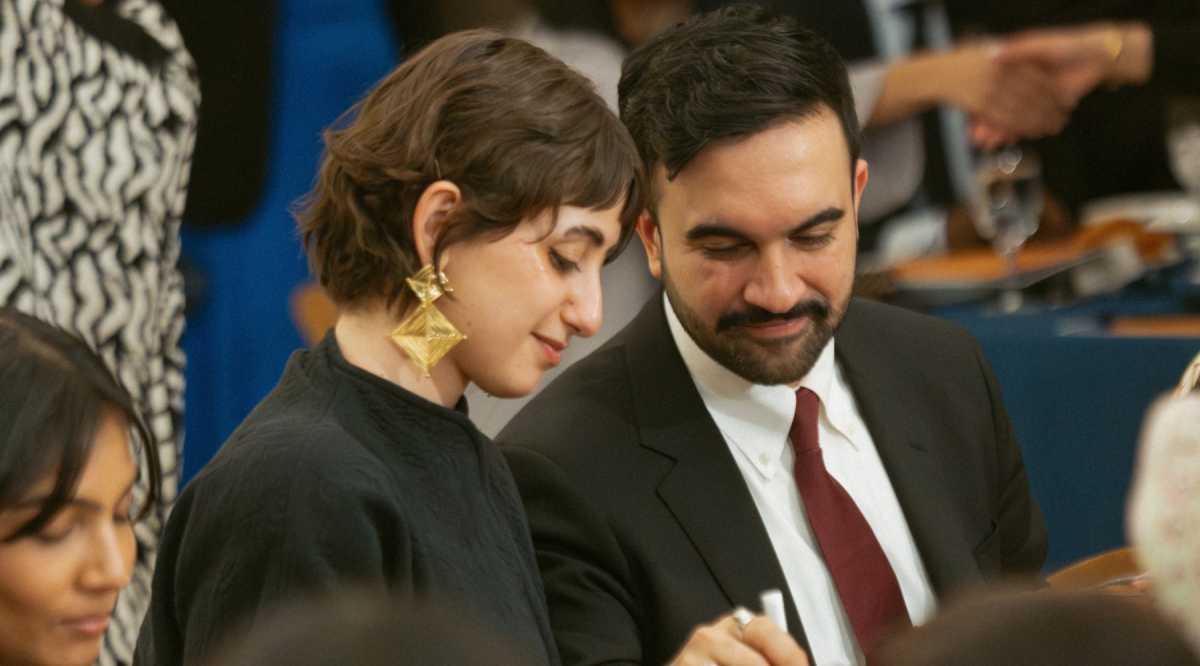
A month after saying his wife, Rama Duwaji, was a “private person” with no role in his administration, Mayor Zohran Mamdani faced renewed questions Thursday after she apologized in a recent interview for “harmful” posts she wrote as a teenager.
The questions followed a Hyperallergic profile of the city’s first lady, published Wednesday; it was Duwaji’s first interview since Mamdani took office. In it, she addressed the publication of “old tweets I wrote as a teenager,” saying she felt “a lot of shame” over language that was “so harmful to others.” She added that “being 15 doesn’t excuse it” and said she was “truly sorry.”
“I’ve read and seen a lot of what others have had to say in response, and I understand the hurt I caused and am truly sorry,” Duwaji, a Syrian-American artist who married Mamdani last year, told the outlet.
But the interview did not settle the broader questions surrounding Duwaji’s online history. While she apologized for posts from her teenage years, she did not specify which remarks she regretted making. Mayor Mamdani, on Thursday, declined to clarify the posts when he was asked about them at an unrelated press conference.
“She shared some of her reflections in this interview. I won’t add much to them,” he said. “What I will say, however, is that she is someone of incredible integrity. She’s someone that I’m lucky to be able to call my wife, and that I am proud of her each and every day.”
The Hyperallergic interview also did not directly address the separate controversy over Duwaji’s Instagram activity related to Oct. 7, 2023. In March, Jewish Insider reported that Duwaji had liked Instagram posts tied to the Hamas attack and pro-Palestinian messaging that circulated afterward.
Asked about the report at the time, Mamdani declined to discuss the posts themselves and instead stressed that his wife was not part of the city government. “My wife is the love of my life, and she’s also a private person,” the mayor said.
On March 13, Mamdani again defended Duwaji after reports that she had illustrated an essay by Susan Abulhawa, a writer whose past social media posts have drawn accusations of antisemitism. The mayor called Abulhawa’s rhetoric “unacceptable” and “reprehensible,” while saying Duwaji had been hired by a third party as a freelance illustrator, had never met or engaged with Abulhawa, and had not seen the posts at issue.
Also last month, the right-wing Washington Free Beacon published a story linking dormant X and Tumblr accounts to Duwaji and reviewing posts from her teens and early 20s. The outlet said the posts included her use of the N-word at age 15, along with later posts praising Palestinian “freedom fighters,” invoking PFLP figures including Leila Khaled and Shadia Abu Ghazaleh, and retweeting messages saying Tel Aviv “shouldn’t exist in the first place.”
Duwaji referred to those revelations only generally in the Hyperallergic interview, describing them as “old tweets I wrote as a teenager.”
The Hyperallergic profile also included a brief reflection from Duwaji on the scrutiny that has followed her husband’s election. She said becoming a public figure had “absolutely changed” her life, while also saying her focus was not on public attention but on continuing her work “with care and responsibility” and allowing her art to speak for itself.
Asked how becoming first lady had affected her freedom as an artist, she said “everything is political” and said the role had made her more committed to being “honest and attentive” and making work that reflects “the times around me.”
Mamdani further explained Thursday that while he had chosen to run for mayor and become a public figure, his wife had chosen to be an artist — thus she will remain out of the public limelight.