
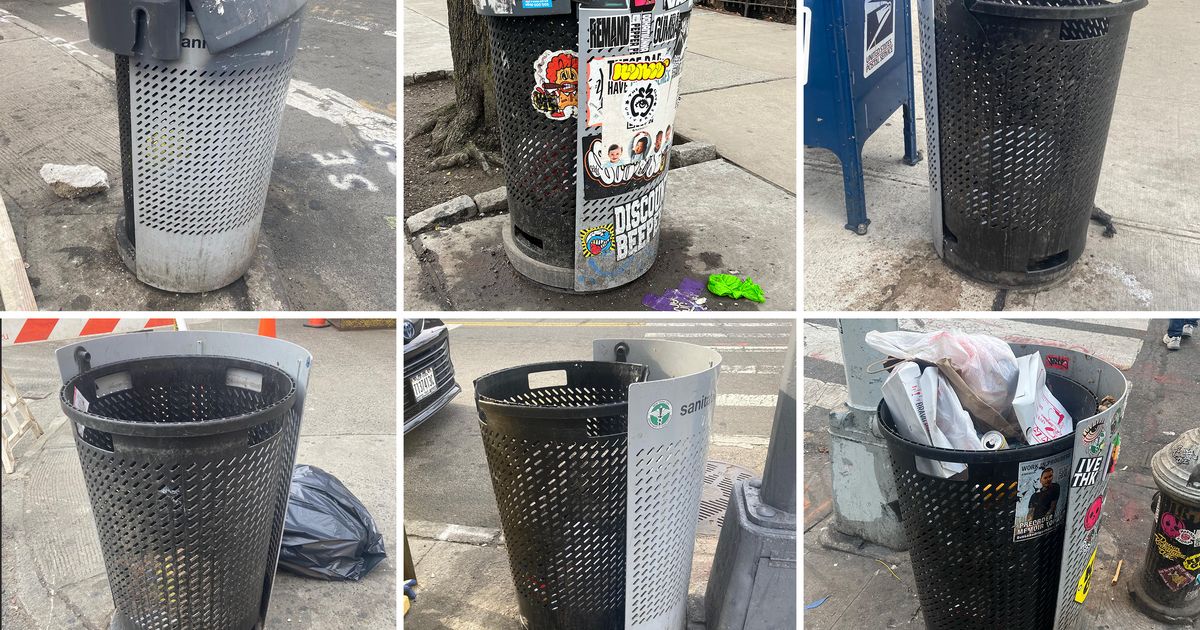
Photo-Illustration: Curbed; Photos: Christopher Bonanos, Courtesy of the owner
It’s been about two and a half years since the Department of Sanitation’s new litter basket began to arrive on New York street corners. The Better Bin, as it’s called, now constitutes roughly a quarter of the curbside population. As we noted at the time, it has some clear advantages over its wire-mesh predecessor. Instead of hefting a heavy steel basket, Sanitation workers flip back half of the upper steel collar and pull out a lightweight plastic liner. Unlike the mesh bin, which sometimes ended up rolling around the street or repurposed to reserve a parking place, the whole thing is built on a concrete base that stays put. The split top deters people from dropping in a full bag of household garbage. It’s more ratproof than the mesh one; the plastic liner is easy to swap when it needs replacement; it contains liquids as its predecessor did not. It’s a better design by most measures.
Except one: All those parts means there is more to break. And more than a few Better Bins are, indeed, broken.
Not every one, of course. But an informal survey around the city reveals Better Bins with their tops either missing or split at the hinge. Here’s one on the Bowery at East 3rd Street. The flip lid is entirely gone.
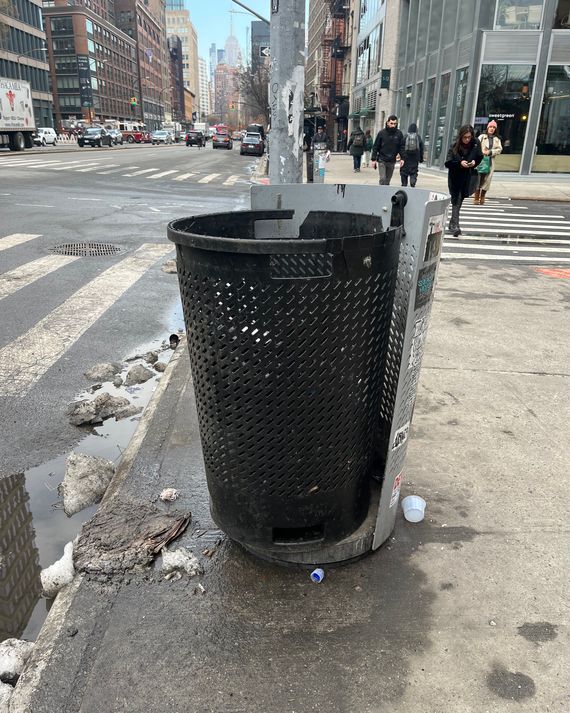
Photo: Christopher Bonanos
Here’s another, similarly beheaded, on Seventh Avenue near 30th Street. It was installed before September 2024, so it’s about two years old.

Photo: Christopher Bonanos
This one, on Avenue C, has kept half its lid, but the flip-up section is gone.
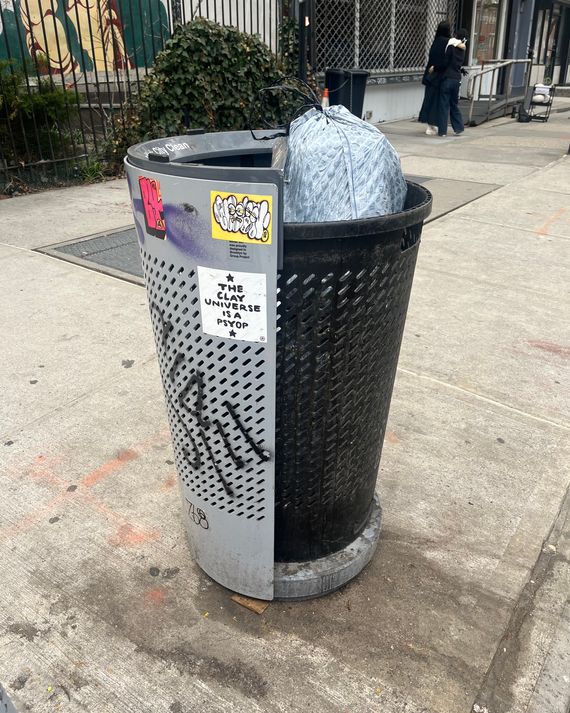
Photo: Christopher Bonanos
On this can, also on the Bowery, the top is complete but the hinge is beginning to lose its grip and is pretty evidently about to let go.
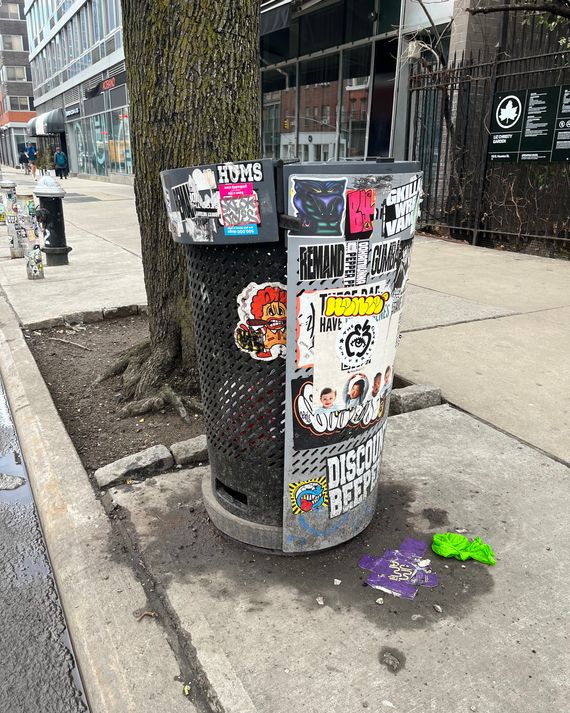
Photo: Christopher Bonanos
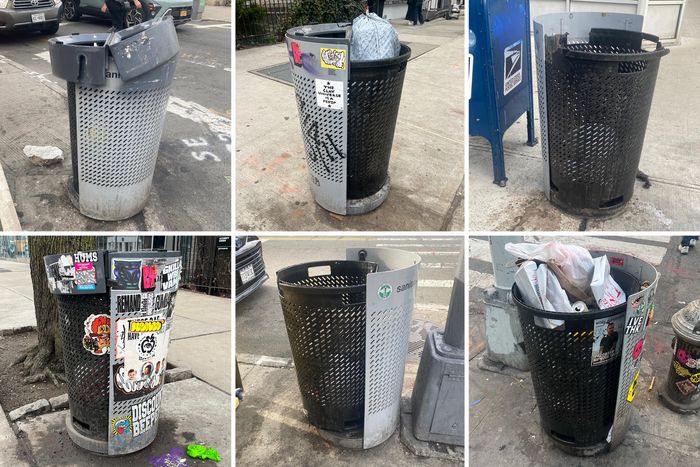
A colleague of mine in Jackson Heights spotted four broken Better Bins between his apartment and the subway, all in the space of six blocks on 37th Avenue.
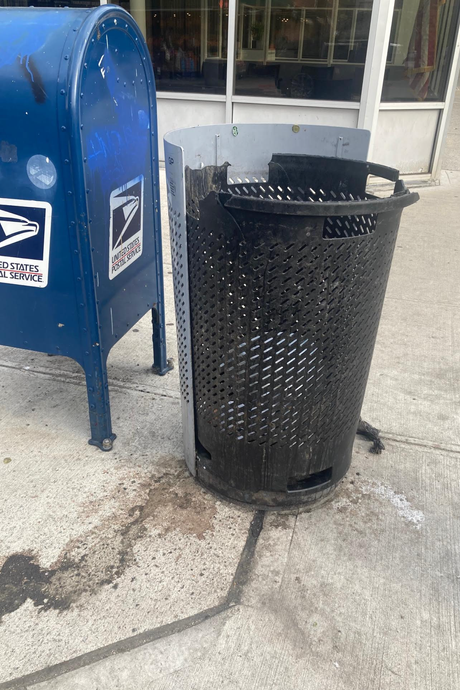
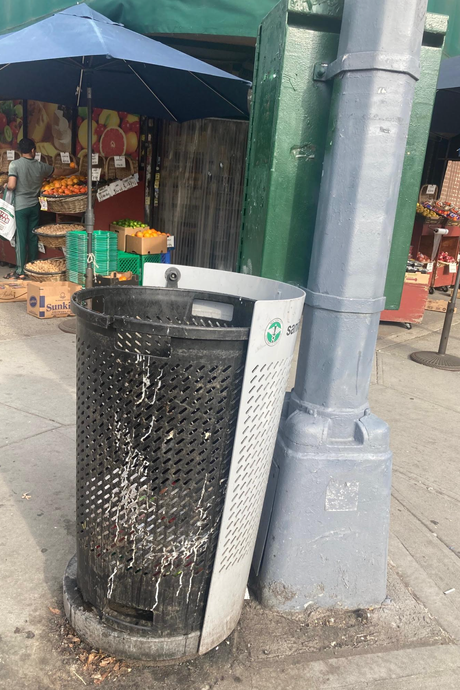
Photo: Courtesy the owner.
Photo: Courtesy the owner.
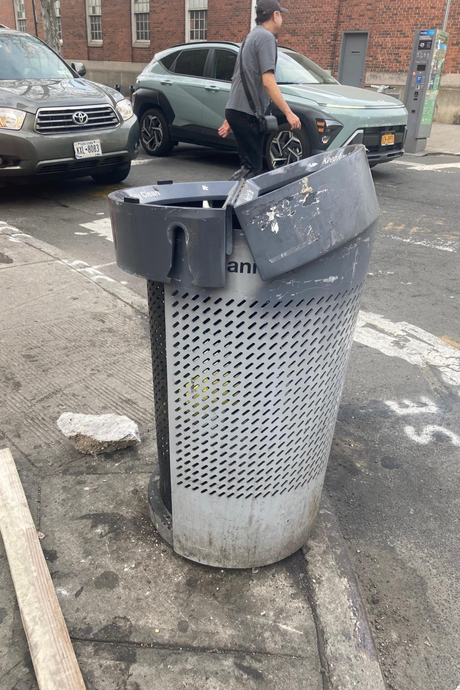
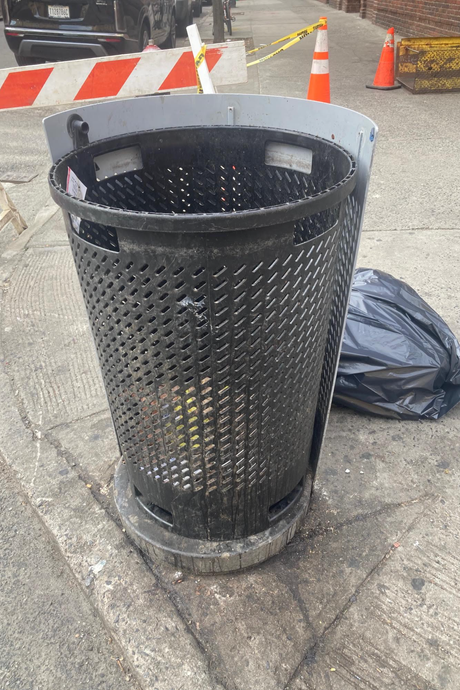
Photo: Courtesy the owner.
Photo: Courtesy the owner.
Here’s another headless one on Avenue B.
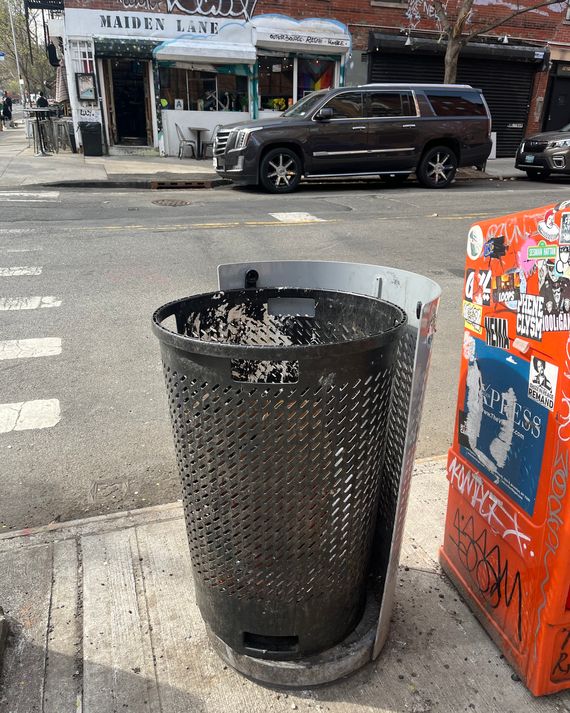
Photo: Christopher Bonanos
Is this problem inherent to the design? Any object with moving parts has a failure point that a stoutly welded unibody does not. Until a mesh bin rusts out, there isn’t much that can happen to it, apart from some denting.
Joshua Goodman, the Department of Sanitation’s representative, is adamant that this is a legitimate tradeoff. “That’s part of the point of the modular design,” he said. “Parts can be replaced instead of the whole thing.” Repairs take place, he says, after damage is reported either by the collection crews who empty them daily or the public via 311. His principal argument is that the features of the new bins far outweigh any increase in fragility. “Remember, the old bins leak trash juice all over the street, and that isn’t ‘broken,’ that’s how they’re designed!” And, he added, “Is it doing a better job of keeping the trash out of sight, out of nose, in addition to making them easier for sanitation workers to service? You have to think: What do you want? Does a Porsche break more than a go-kart?” The Porsche is an apt comparison: The Better Bin, made by Roy Metal Products up in Ontario, cost (as of 2023) about $1,000, whereas the wire bin is made by Corcraft, a company that uses convict labor upstate, and retailed (also as of 2023) for $175.
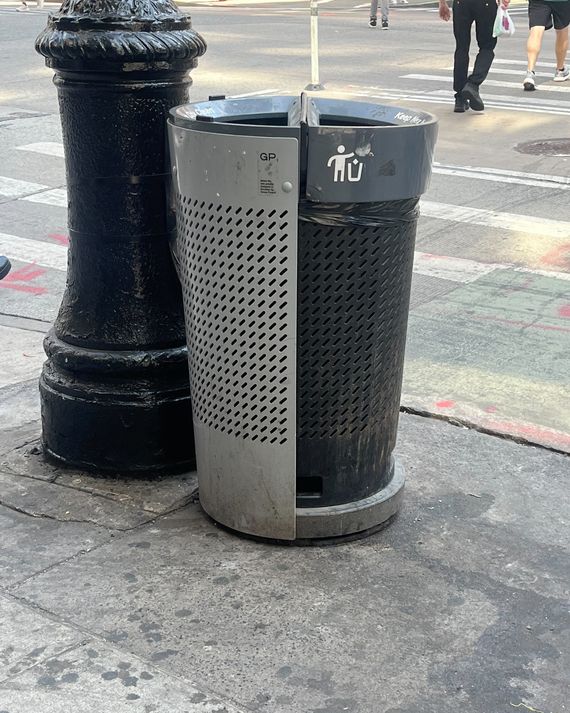
A better Better Bin: This (on Sixth Avenue in midtown) is how they’re supposed to look.
Photo: Christopher Bonanos
That said, Goodman did add that the issue is known and has at least partly been addressed. Avenue B, where I saw at least one broken top, “received original prototype Better Bins. Since those baskets were placed, we upgraded the design and durability of the Better Bin several times.” The plastic brackets and rubber bumpers around the top section have been upgraded, he explained, and there are more bolts holding it together. “We have seen great success with the baskets that have all the modifications and do plan to phase out the ‘first gen’ baskets. We are constantly monitoring the field to replace the older models after they break.” He added that repairs sometimes take a little longer lately than they had because the parts come in from Canada, and you know what that means: “It’s a tariff issue.” So, yes, you can partially blame Donald Trump for this one as well.
Sign Up for the Curbed Newsletter
A daily mix of stories about cities, city life, and our always evolving neighborhoods and skylines.
Vox Media, LLC Terms and Privacy Notice
Related