
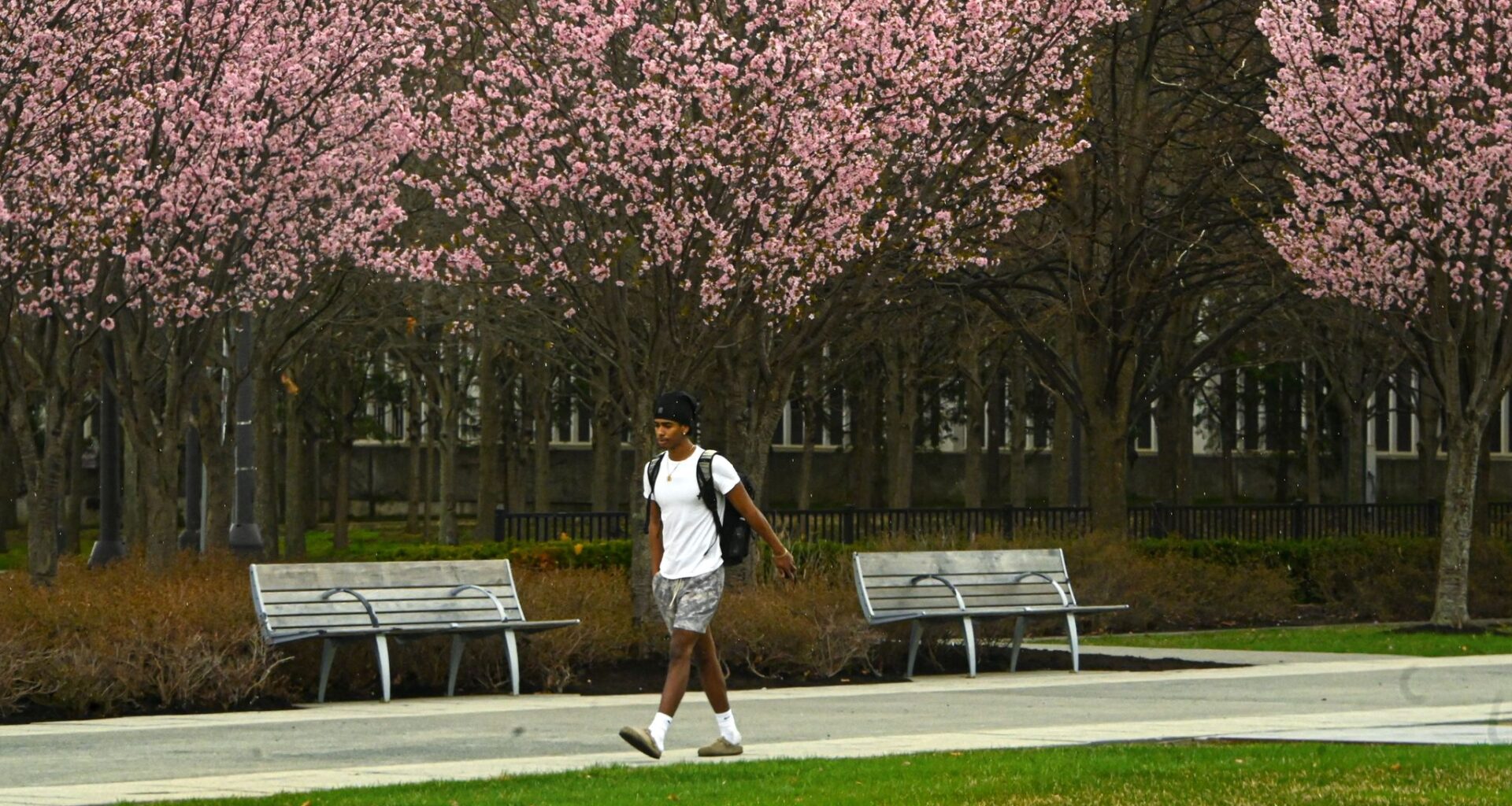
A student walks to class along a path lined with blooming trees at University at Albany on Wednesday. Some high school students are debating whether to go to college, where they may incur large amounts of debt, or go straight into the workforce, where they may earn less without a degree.
Lori Van Buren/Times Union
Russell Sage President Matthew Shaftel offered his best arguments for why college is still worth it. Students who get good internships can get jobs, even in obscure degree programs, he said.
Madison Scisci and Joe Putrock/Provided
Christopher Bast, CEO of Bast Hatfield, hires many people right out of high school to do work like this. He made his best argument for why not every high school senior needs to go to college. They can earn a good living working in a trade without a college degree, he said.
Lori Van Buren/Times Union
It is decision time for high school seniors: within the next two weeks, they must decide which college among the ones that sent them acceptance letters they will attend in the fall.

But many seniors are weighing whether to go to college at all.
Article continues below this ad
For seniors who are facing big college loans and are unsure of what they want to study, this is a difficult decision.
Local college leaders are trying to persuade them to enroll and have begun talking frankly about job prospects to reassure students that they will be able to pay off the tens of thousands of dollars of debt they may amass over the next four years of their education.
But many local businesses are also trying to hire them, offering them blue-collar careers in carpentry, manufacturing and other trades that do not require a college degree.
Make the Times Union a Preferred Source on Google to see more of our journalism when you search.
Add Preferred Source
For those weighing both options, here are the stats.
Article continues below this ad
Among young adults ages 20 to 24 who earned a bachelor’s degree in 2024, 68% of them were employed by October 2024, according to the U.S. Bureau of Labor Statistics.
The news was far better for young adults who earned an associate’s degree in 2024. By that October, 85% of them were employed.
The more pressing question for high school students might be: Did those graduates get jobs that matched their majors?
The simplest answer is that there are no national statistics tracking that information. But at Russell Sage College, President Matthew Shaftel gave it a shot.
Article continues below this ad
The college surveys its recent graduates, and the vast majority respond. In the most recent survey, 94% of graduates had a job related to their field of study, Shaftel said.
That’s well above the national average, partly because Russell Sage graduates many nurses and teachers. Those fields have high vacancy rates, so the graduates are in demand.
But Shaftel himself graduated with degrees in music — and nothing else. He even got a doctorate in music theory.
He has not had a problem getting a job.
Article continues below this ad
There’s a trick for getting a job from a less career-centered degree, he said.
Students should select a college with strong internship connections, he said. Then they should take those internships, no matter how unpalatable they might seem.
There are other options. Seniors could go straight into the job market, starting work the moment they graduate from high school.
Bast Hatfield, a construction company based in Clifton Park, hired a high school senior on Wednesday morning, on the spot, after a masonry presentation.
Article continues below this ad
“We have a lot of folks here who didn’t go to college and are very successful,” said CEO Christopher Bast Jr. “A majority of our employees did not go to college and they make substantial money. These folks stay with us because they can earn a living.”
Just how much is a living? At least $30 an hour, he said. With fringe benefits, workers can double that.
“You could be making $50 to $80 an hour building stuff,” Bast said.
He isn’t anti-college. Bast went to college, albeit reluctantly. Bast, a second-generation part-owner of the business his parents founded, started in 1995 and worked his way up from a position as a carpenter. Another part-owner who started in 1997 began as an intern after graduating from engineering school, he said.
Article continues below this ad
“You can succeed on either side of it,” Bast said.
For students who aren’t sure what to study in college — or who don’t want to go but feel that society says they must — Bast has one piece of advice: “Get your ass in the trades and learn how to earn a real living.”
Unemployment among recent college graduates is growing, according to the U.S. Bureau of Labor Statistics. But it’s higher for young adults without a college degree.
As of December 2025, according to the most recent data available, 5.6% of recent college graduates were unemployed, compared to 7.8% of young adults without a bachelor’s degree who were unemployed.
Article continues below this ad
The data also showed that college graduates continue to earn more than workers without a degree.
By mid-career, age 44, 40% of workers with a bachelor’s degree had earned more than $100,000, while only 13% of those without any degree had reached that salary, according to a survey by the U.S. Census Bureau.
So, Shaftel thinks college education is still a good bet.
But he also still believes in college as a place where students learn to think critically, creatively and collaboratively. That prepares them to solve problems that haven’t happened yet, he said.
Article continues below this ad
His message to parents is to let students pursue majors they are interested in — like his degree in music theory — even if they don’t seem likely to lead to a job.
“I use my degree every single day, no matter what,” he said.