
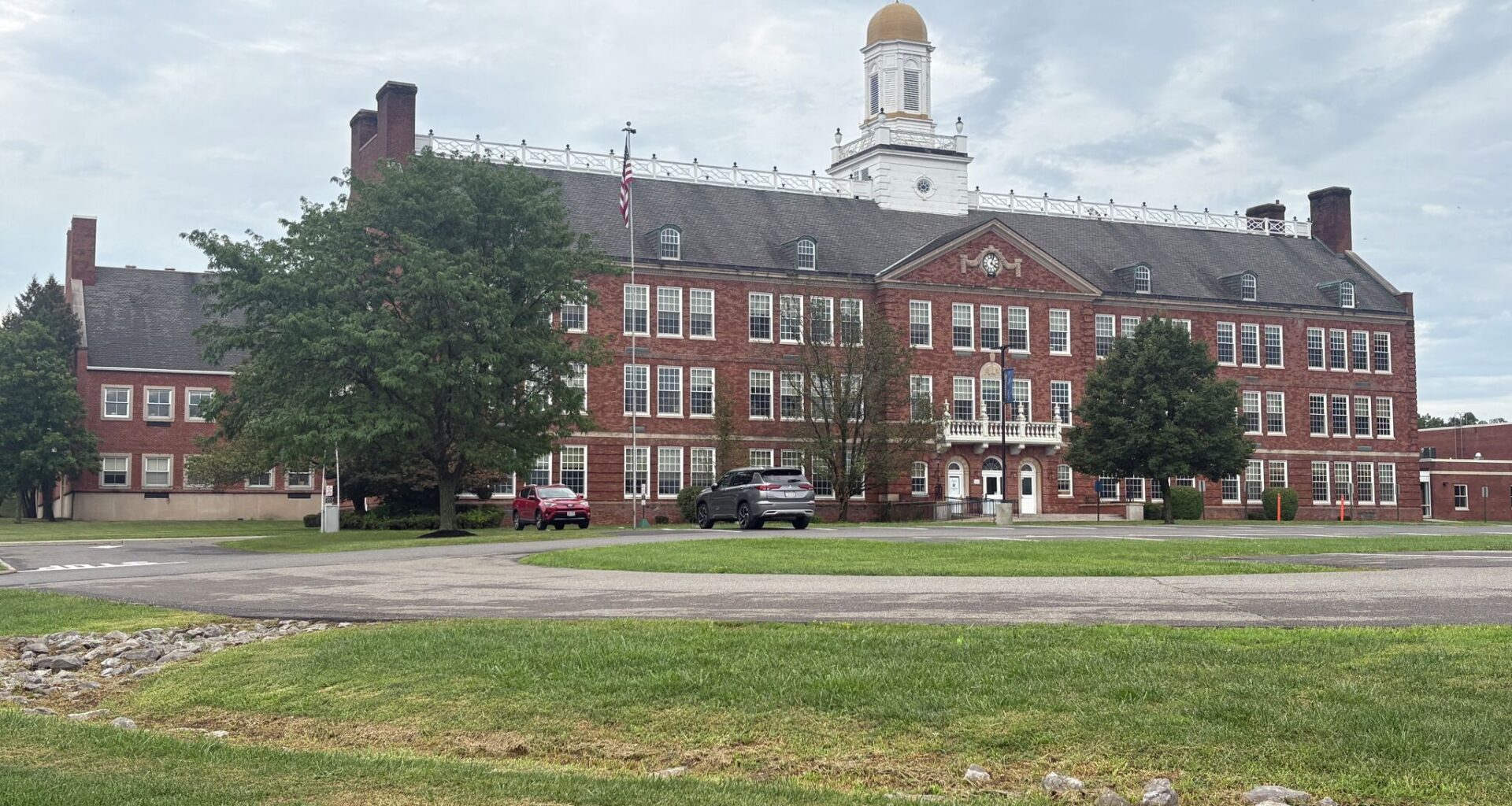
Montgomery C. Smith Elementary School is seen in Hudson. The incorrect use of financial planning software is partially to blame for a budget gap of $4 million, and the administration and school board are now tasked with coming up with cuts.
Roger Hannigan Gilson/Times Union
HUDSON — The Hudson City School Board’s interim superintendent presented a series of options to plug a $4 million budget gap to the school board on Tuesday, including cutting 33 full- and part-time positions and consolidating bus routes.

The budget deficit assumes the district will raise taxes by the maximum allowable amount — 5.8% — and use $2.3 million left over from last year and reserve funds. State aid, which comprises half of the district’s budget, will remain flat.
Article continues below this ad
But board members expressed unease at the cuts and sent district leaders back to flesh out possible budgets with more revenue, either by tapping more reserve funds or raising property taxes above the tax cap, which would need approval from 60% of district voters to pass.
The district finds itself in this position due to the rising cost of health care and retirement benefits — issues felt in districts around the state — but also because of the incorrect use of the financial planning software WinCap.
Interim Superintendent Brian Bailey, who took the helm in August, said at a January board meeting that some employees did not do all the onboarding for the program in 2016, resulting in some people being hired without their information being put into the software. Those salaries were therefore not included in the budget, mistakes that were rolled over in subsequent years. Because of the issue, the district did not know exactly how many employees it had as of January, Bailey said. The district’s website states it has “nearly 600 employees” overall.
Make the Times Union a Preferred Source on Google to see more of our journalism when you search.
Add Preferred Source
The suggested staff cuts include one administrative position, one building administration position, 15 aides, one clerical position and one custodial position. Fourteen teachers and student support personnel positions could also be cut, including four classroom teachers.
Article continues below this ad
The cuts do not include three positions eliminated through attrition, including two teachers.
Specific positions were not discussed at Tuesday’s meeting due to privacy issues, but Bailey said district officials have had individual conversations with anyone they are considering cutting. The 33 positions that may be cut amount to the majority of the necessary budget reductions — $2.4 million.
Four classes would have to be eliminated because of the staff cuts, with students consolidated into slightly larger classes. It would be up to schools to choose which classes to cut, Bailey said.
More than $860,000 could be saved by consolidating transportation, Bailey said, an issue discussed at a March 24 budget workshop and embraced by the school board. All grades — kindergarten through high school seniors — would be picked up by the same buses.
Article continues below this ad
“It’s going to be a little unsettling for families,” Bailey said Tuesday, adding aides would be present on all the buses to alleviate this.
The district would also outsource tech help and tutoring to BOCES, Bailey said. The tutoring is given in-person to students on suspension, whereas the BOCES tutoring would be remote. Several board members took issue with that, including Michael Zibella, who asked how effective it would be given the poor performance of students during pandemic-era remote learning.
Other cuts would come from the elimination of student electives and giving up software subscriptions.
Board members asked Bailey what would happen if they used more of their unassigned fund balance — the money left over from the previous year. The proposed budget uses about $1.8 million of the $4.7 million available, as well as $500,000 in reserves.
Article continues below this ad
Bailey downplayed that as an option. If the district used an additional $500,000, “next year, you could do it one more time, and then you have no money left,” he said.
The school board also asked about overriding the tax cap. That would require 60% approval from voters, as opposed to the simple majority that suffices when the budget does not go above the tax cap.
According to a state law, if the budget does not pass after two votes, New York state would step in and prepare a contingency budget under which many new costs are prohibited, including equipment purchases, salary increases for non-union employees and new capital projects. A contingency budget would have deeper cuts than the district’s proposal, Bailey said.
“A contingency budget would be a disaster, that’s safe to say,” school board President Mark DePace said.
Article continues below this ad
Board member Diana Howard expressed unease with cutting staff, saying she “didn’t want to just give up on our people,” to applause from the audience. She has also expressed reservations about raising taxes.
“I don’t really want a whole lot coming in from the taxes, but I think the sting would be a little less if we were more supportive of our people (and voters knew) at least we’re protecting them through our taxes,” Howard said.
Shannon Sullivan, a teacher and the vice president of the Hudson Teachers Association, said during public comments that she was “really, really angry.” In 2011, when the school budget failed a vote, Sullivan said she “remember(ed) how our community came together and came up with a booster club, we funded a full position for music teacher, we did amazing things, and I’m heartbroken that we’re in this position again.”
She also questioned why there was only one position being cut to the district’s central office.
Article continues below this ad
About 70 people attended the meeting on Tuesday night, which often only has a few attendees. About 350 had watched the YouTube recording of the meeting as of Wednesday afternoon.
The Hudson City School District — which has students from Hudson and the towns of Greenport, Livingston, Ghent, Stockport, Taghkanic and Claverack — has struggled in recent years. Bailey is the third superintendent to lead the system since longtime leader Maria Suttmeier retired in January 2022. The graduation rate in the 2024-2025 school year was 67%, compared to 85% for the state as a whole, according to the state Education Department.
Many district students also live in poverty. Though there is wealth in Hudson, Bailey said about two-thirds of students at the school are economically disadvantaged.
Article continues below this ad
The final meeting on the budget is April 21, when the school board is expected to vote on a budget. District residents will vote on May 19.