
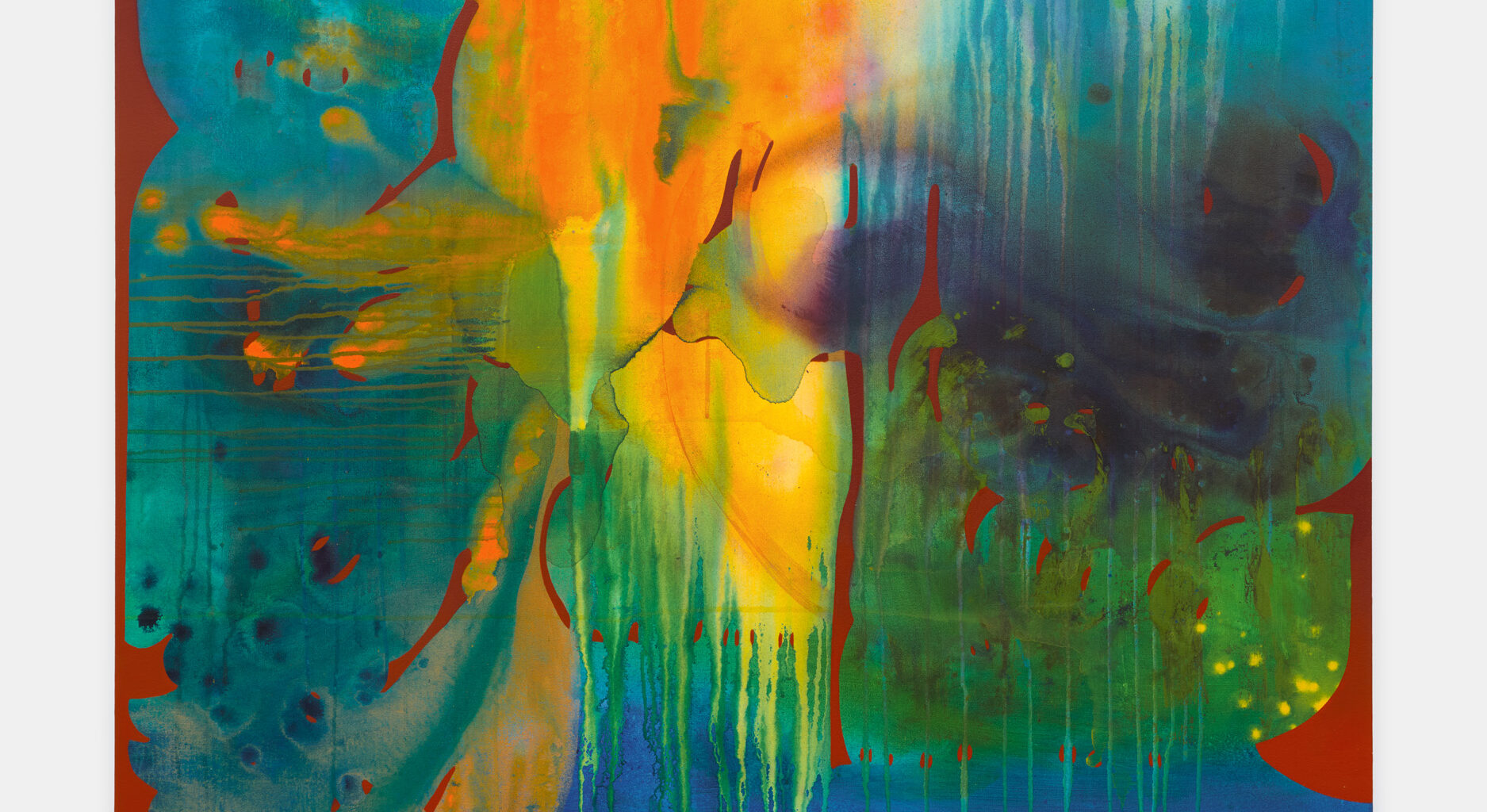
Vian Sora: Tepe Gawra
Bortolami Gallery
March 6 – April 18, 2026
New York
Vian Sora’s Tepe Gawra is a testament to the artist’s ability to navigate through historical and modern-day tensions. The tension of one’s mortality, the tension of horrors that occurred decades ago still being sharply felt today, the tension of pushing forward towards the unknown—as all painters must strive to do. Titled after the ancient Mesopotamian settlement in contemporary Iraq, Sora’s first exhibition with Bortolami presents viewers with a body of work that is as fierce as it is dazzling, filled with art historical odes and much needed optimism.
Visible from the entryway is Celestial capsule (2026), a large-scale work that serves as an immersive beginning into Sora’s personal narrative and visual vocabulary. Aptly titled, the artwork’s nocturnal obsidian blue is repeatedly pierced by mixtures of canary yellows, copper crystalline textures, and molten ambers, the latter of which pours down through the middle and lower center of the painting, an uncontrolled fiery underlayer compared with the sharp execution of the electric yellow oil paint that defines the left border of the composition. White droplets hover on the top layer of the canvas, mixing with the obsidian and hazy lavender to add another element to the galactical mystery within the painting. We are witnessing the aftermath of drastic change, within the artwork as well as the exhibition as a whole. Celestial capsule is an excellent example of one of the larger themes that resonates throughout Sora’s practice: the dichotomy of survival and death, coupled with the duality of grief and resilience.
Much of Sora’s artistic identity is rooted in her upbringing as an Iraqi woman who came of age during multiple wars in that country. The suffering and tragedy, both personal and national, that accompanies invasions of one’s homeland are palpable throughout the gallery. Sora’s use of multiple types of paint—acrylic, used during the initial creation of a painting, whereby she repeatedly pours different pigments onto the canvas as it lays face up, and oil, which she applies onto the dried acrylic to create hard-lined compositions, reminiscent of Arabic calligraphy or the remnants of an ancient ruin—situates viewers in the center of the emotional upheaval, instead of allowing us to remain safely on the sidelines.
The paintings’ intensive layering process allows Sora to cede an element of control to the materials themselves, where the insistence of survival combines with the creation of a painting. In describing the exhibition via an artist statement accompanying the press release and checklist, Sora describes the completion of the exhibition as something that “feels less like a discrete body of work and more like a threshold, formed under pressure, accumulated rather than designed, insistent rather than resolved.” This feels readily apparent in Scarlet (2026), the most clearly textured artwork in the exhibition, in which a vivid shade of crimson outlines a dynamic mixture of black, grey, teal, and gold. The metallic tones of the gold combine with the sharpness of the red, drawing attention immediately, while the silky hues of grey and teal wash over one’s senses, providing an element of relaxation without forfeiting the inherent sense of struggle and decay. It is as much of a forceful eruption as it is a silent reminder of forgotten ruins, left by the wayside of a species intent on advancement—through times of war, but also through times of peace.