
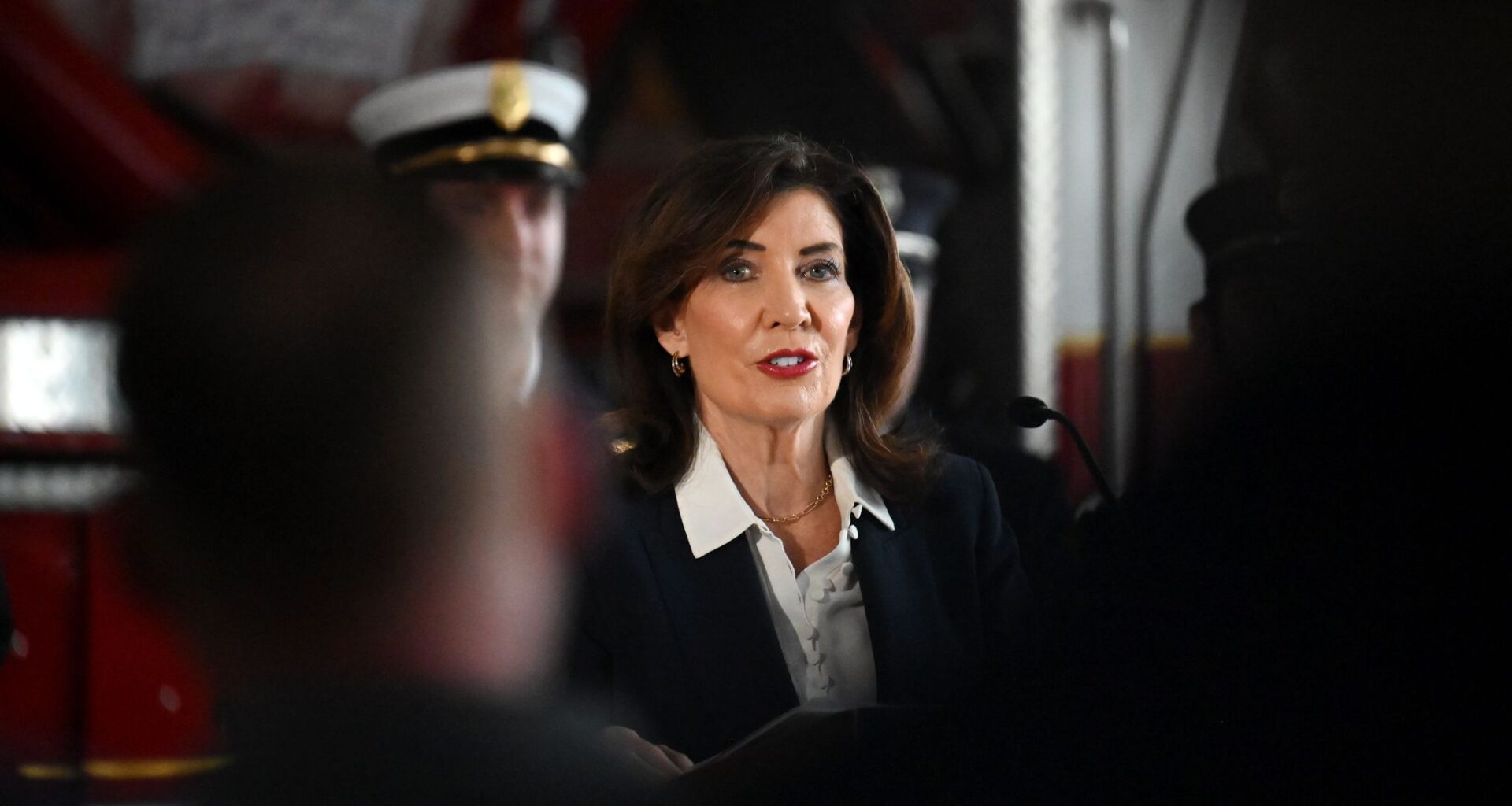
Gov. Kathy Hochul at a news conference in Guilderland Friday advancing her proposed auto insurance relief plan, which includes cracking down on fraudulent claims. The proposal would limit damages paid out to bad actors. (Will Waldron/Times Union)
Will Waldron/Times Union
Insurance advocates hold a news conference at the Capitol in Albany last month. (Will Waldron/Times Union)
Will Waldron/Times Union
A three-car accident last year involving a police car on Sand Creek Road near the intersection with McNutt Avenue in Colonie.
Jim Franco/Times Union
Kaitlin Asrow, right, acting superintendent of the Department of Financial Services, and Hope Knight, center, State Department of Economic Development commissioner and Empire State Development president & CEO, at legislative budget hearing on economic development in February. (Will Waldron/Times Union)
Will Waldron/Times Union
Gov. Kathy Hochul arrives at Westmere Fire Department in Guilderland Friday to talk about her plan overhaul the state’s auto insurance system, which has some of the nation’s highest rates. (Will Waldron/Times Union)
Will Waldron/Times Union
ALBANY — Gov. Kathy Hochul’s push for changes to the laws governing auto insurance has contributed to the stalled state budget negotiations, as some lawmakers have scoffed at her assertion that the amendments would lower premiums.

Both sides have also accused one another of being beholden to lobbying interests, including the New York State Trial Lawyers Association, which opposes the governor’s proposal and the car insurance companies that support it.
Article continues below this ad
Beyond trading barbs over lobbying influence, a data analysis provides more insight on the key issues driving the debate: why New Yorkers’ auto insurance premiums cost what they do; the prevalence of fraud, and just how often insurance companies pay out claims to customers.
Factors behind high costs
One thing that isn’t in dispute is that New York ranks as one of the most expensive states for auto insurance. According to the Insurance Information Institute, a nonprofit trade association representing insurance providers, the state ranks fourth-worst in the nation for auto insurance affordability, behind Florida, Mississippi and Louisiana.
Insurance companies use a complex set of factors to determine auto insurance premiums in every state, including the frequency of accidents, vehicle repair costs, and the number of injury claims filed by drivers. Data from the institute show New York ranks near the bottom on a variety of factors, including cost of repairs, accident frequency and expenses incurred by insurers to process claims.
Article continues below this ad
While the institute’s data show that 30 more states have a higher relative tendency for injury claims, New York ranks third-highest in terms of the amount paid per claim, a factor that can drive up costs. The institute estimates the average personal auto injury claim in New York is $46,726, more than twice the U.S. average.
Make the Times Union a Preferred Source on Google to see more of our journalism when you search.
Add Preferred Source
In 2024, the most recent year available, there were nearly 900,000 people in the state who were involved in a motor vehicle crash, according to the state Department of Motor Vehicles. That includes drivers as well as passengers, pedestrians and bicyclists who were involved in a crash. Of those involved, 33,000 people suffered injuries described as “moderate” or “severe,” with an additional 118,000 described as sustaining minor injuries.
Article continues below this ad
While the number of crashes in the state has remained constant over the last several years, the number of injuries reported has risen by 8.5% since 2021, the motor vehicle data show.
During a news conference Friday at the Westmere Fire Department in Guilderland, Hochul said that high auto insurance costs affect not just individual policyholders but also local municipalities. She noted that high insurance costs for municipal vehicles can increase municipal budgets — which are largely funded by taxpayers.
“Whether it’s firefighting equipment, emergency vehicles, police cars, senior vans, the recreation vans, all that has to come at a cost to the local taxpayers,” Hochul said. “This is something that’s just often absorbed, but it is a hit on local taxpayers through these additional expenses.”
Prevalence of fraud
New York is one of 12 so-called “no-fault” states, that require all drivers to file a claim with their insurance provider after a motor vehicle collision, regardless of who is at fault. Drivers in no-fault states must purchase personal injury protection as part of their auto insurance policies. No-fault policies can lead to higher premiums, as well as a propensity for fraudulent claims, said Sean Kevelighan, CEO of the Insurance Information Institute.
Article continues below this ad
“We looked at New York versus the other 12 states, and you see that New York was higher than the other no-fault states,” Kevelighan said. “We do see that having direct relation to litigation and fraud.”
In 2025, the state Division of Financial Services’ Insurance Fraud Bureau received more than 51,000 reports of suspected insurance fraud in the state from insurance companies, with 72% of all fraud reports related to no-fault auto insurance claims, numbers that have trended upward over the past few years.
Apart from the reports submitted from insurance companies, which often go directly to law enforcement, the bureau opened 57 of its own investigations related to no-fault insurance fraud last year. That’s more than any other type of fraud and represents about one-fifth of all fraud investigations reported for the year.
Kaitlin Asrow, acting superintendent of the Division of Financial Services, said that the Insurance Fraud Bureau has recruited new members from federal agencies such as the FBI and U.S. Department of Justice as a result of increased fraud investigations.
Article continues below this ad
“We’ve seen such a massive increase in suspicious fraud reports that we really are working to keep pace,” Asrow said.
In one incident, the bureau conducted a joint investigation with the New York City Police Department that resulted in the arrest of an organizer of an insurance fraud ring in Queens. The perpetrators had staged several accidents, with dashcam footage of one staged crash garnering attention after being shared on social media. The fraud ring also met inside a medical clinic in Brooklyn that had coached them on how to stage the crashes, and directed individuals to go to a specific medical clinic following the crash for treatment and diagnosis.
Why ‘float’ matters
The New York State Trial Lawyers Association has countered Hochul’s assertions with some statistics of its own. The group has cited a report from Weiss Ratings, an investment and insurance rating firm, that shows that insurers in New York have increased the number of denied claims over the past two decades, with some firms denying more than 50% of all claims submitted.
Article continues below this ad
An important factor in profitability for insurance companies is the “float,” or the money the company holds between collecting premiums and paying out claims to providers. Rather than just holding the money, insurance companies often invest the float in the market to increase profit. Famed investor Warren Buffett has often championed investing floats from insurance companies under his ownership as part of his renowned investment strategies.
Doug Quinn leads the American Policyholder Association, a nonprofit that advocates against fraud committed by insurance companies. Quinn, who lives in the New York City metro area, said too much leniency for insurance companies could incentivize them to deny more claims to increase their float.
“There’s no acknowledgement that fraud happens on all sides,” Quinn said of the proposed insurance reforms. “When you’re only looking at change by restricting consumers’ rights, we’re not looking at the insurance industry to play a fair role in bringing premiums down.”
Asrow said that the Division of Financial Services has hundreds of people working in its insurance division to oversee insurance companies and make sure they handle claims appropriately.
Article continues below this ad
“Their job is to oversee the insurance company, making sure that the premiums that they’re collecting are going out into claims, making sure their expenses are reasonable,” Asrow said. “We are also obviously looking at the finances of the company to make sure it’s solvent.”
The policies in question
Proponents of the governor’s proposed changes say that by taking steps to combat auto insurance fraud, it would give an incentive to more insurance companies to do business in the state. That in turn will create more competition, causing insurers to lower premiums to attract clients.
There are several provisions in the governor’s plan that are intended to address insurance fraud in the hopes of bringing down costs. The trial lawyers association has expressed support for some of the measures, including strengthening criminal penalties for individuals who organize staged car crashes.
Article continues below this ad
But the association remains strongly opposed to other portions of the proposal, including a section of the governor’s transportation bill that would deny paid claims to parties found to be more at fault in a crash and would cap personal injury compensation at $100,000 if they are uninsured, were driving under the influence or committing a felony at the time of the incident.
In a memo, the association said that section “represents an unprecedented weakening of core protections in New York’s civil justice system for car accident victims and shifts the cost of crashes from wrongdoers and insurance companies to victims and taxpayers.”
Hochul has cited similar amendments launched in Florida as a model for her own proposal. In 2023, Florida enacted changes that tightened the rules around lawsuits for auto insurance claims. Following those changes, Florida’s average auto premiums declined by 5% in 2025, according to the Insurance Information Institute, although it remains one of the costliest states for insurance.
Article continues below this ad
Kevelighan acknowledged that the insurance landscape in Florida differs from New York and that companies may act differently depending on where they operate.
“Each of the insurance carriers works with what variables they are able to use,” Kevelighan said. “Different states have different characteristics that impact pricing.”