
Offseason Approach
Start the process of moving towards playoff contention
Actual Cap Space
-$6.4 million
Practical Cap Space
$44.6 million
Projected Luxury Tax Space
$83.4 million
Under Contract (9)
Nic Claxton
Noah Clowney
Egor Demin
Terance Mann
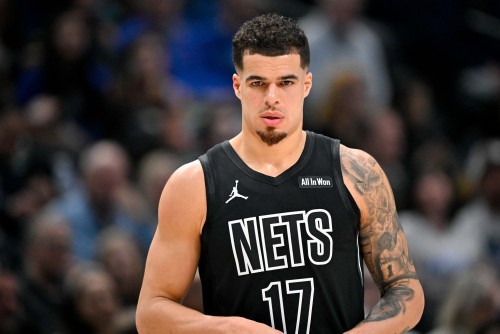
Michael Porter Jr.
Drake Powell
Ben Saraf
Nolan Traore
Danny Wolf
Potential Free Agents (9)
Ochai Agbaji (restricted)
Tyson Etienne (restricted – two-way)
Chaney Johnson (restricted – two-way)
E.J. Liddell (unrestricted – two-way)
Josh Minott (unrestricted – team option)
Day’Ron Sharpe (unrestricted – team option)
Malachi Smith (restricted – team option)
Ziaire Williams (unrestricted – team option)
Jalen Wilson (restricted)
Dead Cap (0)
None
Projected Signing Exceptions
Room Exception ($9.4 million)
Notable Trade Exceptions
None
Projected First Round Draft Pick (pre-Lottery)
#3
Notable Extension Candidates
Nic Claxton (veteran extension)
Noah Clowney (rookie scale extension)
Terance Mann (veteran extension)
Michael Porter Jr. (veteran extension)
Jalen Wilson (veteran extension – through June 30)
Analysis
The Brooklyn Nets hit the offseason in a very interesting place. They don’t have control over their 2027 first-round pick, as it’s controlled by the Houston Rockets via swap rights. That would suggest that the Nets have no reason to tank next season, which is very likely an accurate assessment.
However, this team isn’t anywhere near contention. And they do have control of their first-round picks moving forward, as well as six additional first-round picks coming their way through 2032. And that’s on top of terrific cap flexibility moving forward.
That means that Brooklyn has no reason to tank next season, but they also don’t need to go all out to try and field a playoff contender by locking into long-term contracts through free agency and trades. Finding a nice middle ground this summer can set up next season and, more crucially, beyond to be a lot more successful.
Of the players the Nets have under contract for next season, six are still on their rookie scale contracts. The other three include Michael Porter Jr. and Terance Mann entering the final season of their deals, as well as Nic Claxton, who has two years of declining money left on his contract.
That has Brooklyn positioned to have nearly $45 million in cap space this offseason. That’s considerable spending power, but who are the Nets going to add via free agency or trades?
Sure, if Sean Marks can wiggle his way into the Giannis Antetokounmpo sweepstakes (assuming there even are Giannis Antetokounmpo sweepstakes!), it’s worth getting involved. Antetokounmpo has been a long-rumored target for the Nets. Should Brooklyn trade every future pick they have, plus a package of kids for the superstar forward? Probably not. If the price is some picks, some of the kids, and the ability to not make Milwaukee to take on unwanted salary, well, that’s a lot more enticing.
Beyond trading for Antetokounmpo, the free agent market doesn’t look flush with an instant-contender type of addition for Brooklyn. Marks could wade into restricted free agency again and toss around offer sheets to players like Peyton Watson, Tari Eason or Walker Kessler (we’re assuming Jalen Duren is a lock to re-sign with the Detroit Pistons). Landing one of them could make sense, provided the price isn’t too high.
There are also a host of win-now veterans that could be available for the Nets to add this summer. A combination of three or four additions to the vet trio of Porter, Claxton and Mann, plus some growth from the kids could see Brooklyn compete for a spot in the Play-In Tournament next season.
But should that really be the goal, even in the absence of controlling their own first-round pick?
If Brooklyn could sign players like Norman Powell, John Collins, Kelly Oubre Jr., and C.J. McCollum to one-year deals, fine. But those players aren’t going to want to take a one-year deal to compete for a Play-In spot, unless it’s the last option on the table. Signing players like that to long-term deals would eat into the Nets ability to add impact players down the line.
Essentially, unless they are getting players on a one-year contract (or two-year deal with team control), or at an absurdly team-friendly price, Brooklyn should stay away. Instead, there’s an in-house way to use some cap space, while creating value down the line that Marks and the Nets should look at.
Michael Porter Jr. is extension-eligible this summer. He’s said that he would like to stay in Brooklyn. The feeling seems relatively mutual…provided the Nets can get the right deal. That’s where Marks can get creative.
Porter is set to make $40.8 million this season. He has eight years of service, making his max for next season $49.5 million. Because they’ll have cap space, Brooklyn can use some of that to bring Porter’s contract up to that max of $49.5 million for next season through a renegotiation-and-extension.
Let’s pause here, because context is critical in this proposed contract structure.
Porter had a very good season for the Nets. He set career-highs nearly across the board. He stayed mostly healthy (a lot of the games he missed were more about the team tanking than Porter being unavailable). Despite being the focus of opposing defenses to the nth degree, Porter was still pretty efficient.
All of that said, Porter isn’t a max player. Not at nearly $50 million. But that doesn’t really matter, because he’d only be a max player for one year in this situation.
Do you like Michael Porter Jr. a lot more as a player who makes $30 to $33 million per year than nearly $50 million? You probably do, right? This is where the Nets can use the renegotiation-and-extension rules in their favor.
In a renegotiation-and-extension, teams can use cap space to bring a player up to their individual max salary in the remaining years on their current deal. Then, in the first year of an extension, the salary can drop by as much as 40% from the prior year. Essentially, you give the player some of your cap space as an upfront payment, which is only allowed in this specific type of situation.
We already covered off on using about $8.7 million to bring Porter up to the max this year. Then, the Nets could offer him a three-year extension off that at somewhere between $90 to $99 million. In total, Porter would around $100 million or slightly more, but the AAV on the extension would be at far more palatable number for the team. The Nets would do well to keep that salary flat at $30 to $33 million per year throughout the extension, as it would give them more flexibility down the line.
Brooklyn could do the same with Nic Claxton or Terance Mann, but there’s no reason to. Claxton has an additional year left on his deal at a fair number. Mann isn’t seen a key member of the team moving forward. Noah Clowney is also eligible for a rookie scale extension. Clowney has shown flashes, but hasn’t been a consistent producer yet. Brooklyn should only offer Clowney the type of extension that he’s best-off betting on himself to earn more as a restricted free agent in 2027.
Last thing on this idea of renegotiating-and-extending Porter: The Nets would still be left with about $38 million in cap space. That could be used to re-sign some of the team’s free agents (another re-up with Day’Ron Sharpe and Ziaire Williams perhaps?), while adding undervalued free agents or taking on some money in trades.
At the draft, unless multiple teams jump them, Brooklyn should be positioned to add a sought-after prospect. Ideally, the Nets would be able to draft a wing, a scoring guard or a big forward. A.J. Dybantsa, Darryn Peterson, Cam Boozer or Caleb Wilson would be ideal fits alongside Porter, Claxton and the young core.
If the Nets slip in the lottery, they shouldn’t shy away from adding a point guard like Darius Acuff Jr., Kingston Flemings, Mikel Brown Jr. or Keaton Wagler. Yes, Brooklyn added multiple ballhandlers in in the 2025 draft, but none of Egor Demin, Nolan Traore or Ben Saraf shined so much as rookies that fit should outweigh selecting the best talent available.
This is an interesting offseason for the Brooklyn Nets. They certainly could go all-in on chasing a playoff spot, because they don’t control their own 2027 first-round pick. But another year of patience, letting Sean Marks do his diamond-mining thing and nailing this year’s draft pick, should pay off in a far bigger way down the line.