
Krown Point Capital is ramping up investment in retail development in Connecticut, betting on a sector that is drawing renewed interest from investors, lenders and national tenants.
The five-year-old commercial real estate investment and development firm began building its portfolio in 2020 with a $33.3 million partnership acquisition of a newly built, 130-unit luxury apartment complex in Granby.
Since then, Krown Point has backed construction of three additional luxury multifamily rental projects north of Hartford; acquired two Long Island office buildings; partnered in the purchase of a 100,000-square-foot, Big Y-anchored plaza in Ellington; and, last year, completed a 23-story apartment tower in Manhattan with its partners and plans to begin construction later this year on a 36-story tower nearby.
More recently, the firm has expanded into ground-up retail development.
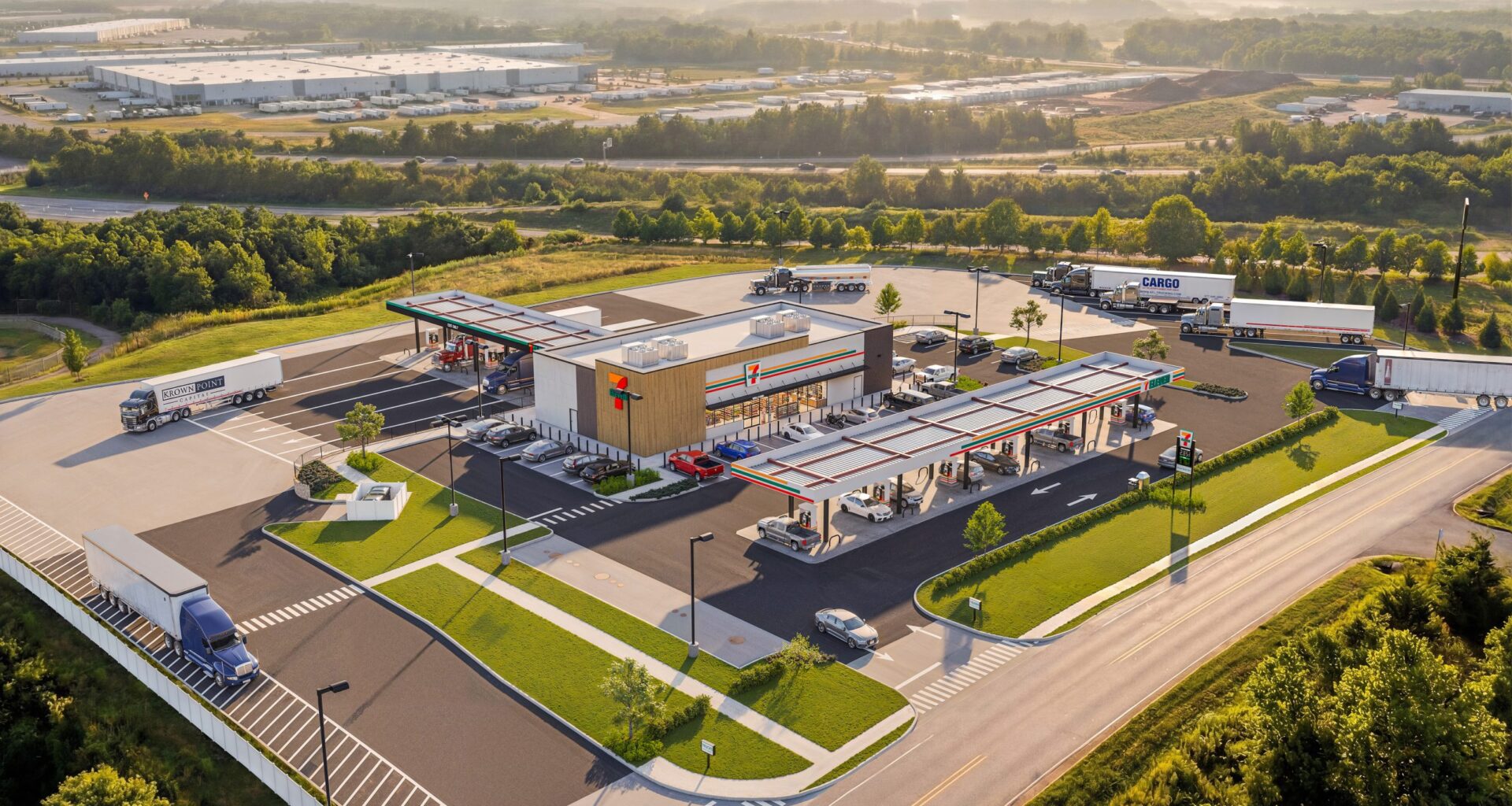
Krown Point is nearing completion of a 4,824-square-foot 7-Eleven convenience store and gas station along a busy commercial corridor near Interstate 91 in North Haven. It also recently spent $1.8 million on an 11-acre site just off Interstate 395 in Killingly, where it plans to build a larger 7-Eleven with truck refueling lanes.
Krown Point founder Reggie Kronstadt said the firm is focused on building relationships with retail tenants looking to expand, while pursuing a range of projects from standalone pad sites to multi-tenant strip centers and larger retail properties.
 Reggie Kronstadt
“We’re really leaning into developing purpose-built retail projects across the Northeast and pockets of the mid-Atlantic,” Kronstadt said, adding that the firm will continue to develop apartments alongside its expanding retail focus.
Growing the pipeline
Krown Point is not new to the retail sector. After acquiring the Ellington plaza in 2023, the firm and its partners built a 7,701-square-foot freestanding retail strip on the site, quickly leasing its three units to a GoHealth Urgent Care center, Starbucks and a Jersey Mike’s location.
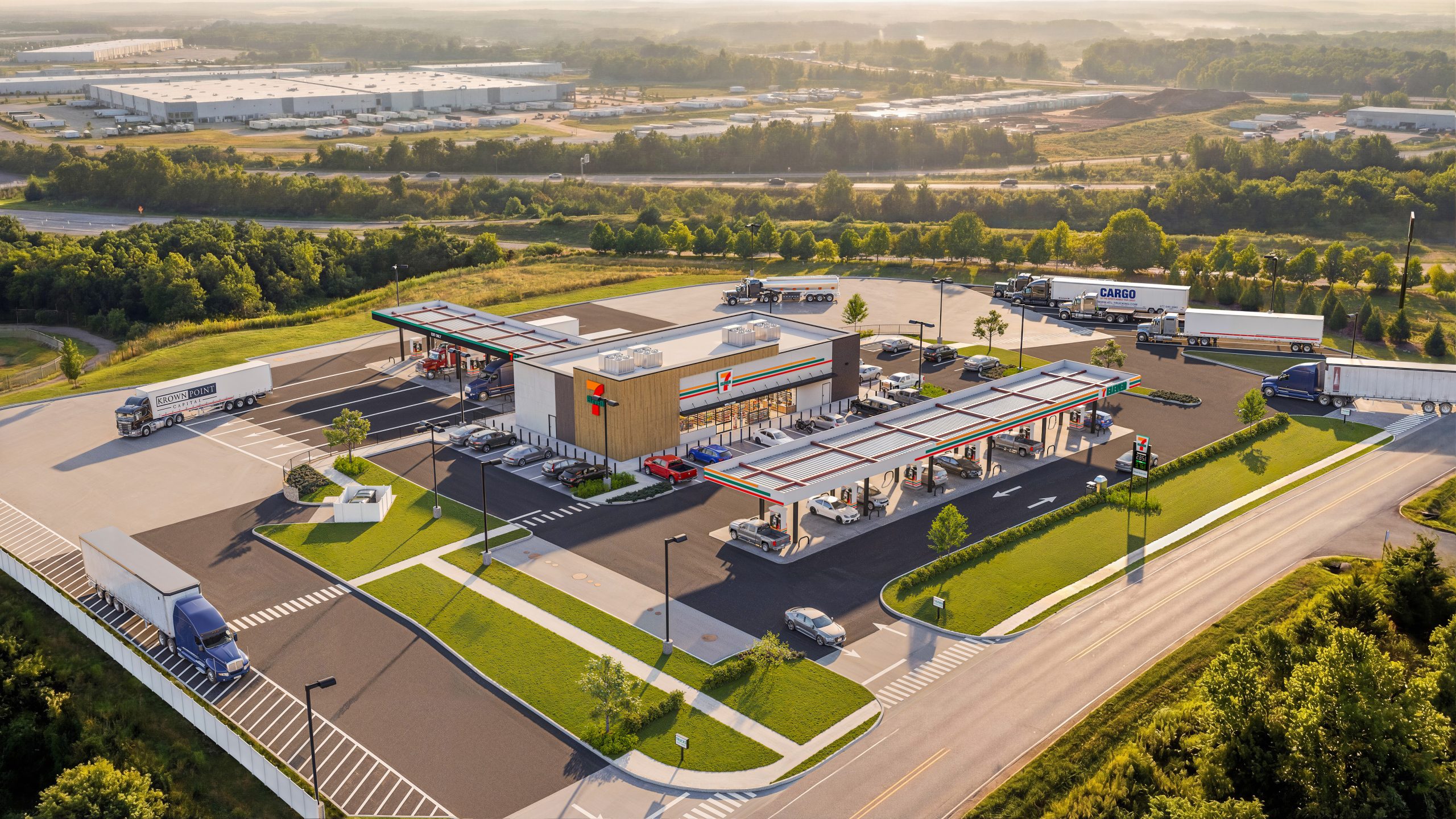 A rendering of a 7-Eleven convenience store and truck stop Krown Point Capital is building in Killingly. Contributed Image
The Killingly project, designed to serve truck traffic from a boom in local logistics centers, will push Krown Point’s retail portfolio past $50 million, with the firm pursuing another $50 million to $100 million in additional retail investments. Its overall portfolio is valued at more than $500 million.
Kronstadt said the retail real estate market has strengthened in recent years, particularly in “essential,” or convenience-based categories such as restaurants, beauty services and grocery-anchored centers — businesses less vulnerable to e-commerce competition.
Christopher Arnold, head of commercial real estate lending for Liberty Bank, said vacancy rates across many retail property types have fallen from pandemic levels, with demand strongest for necessity-driven, service-oriented tenants.
 Chris Arnold
“Especially for service industries where you can’t just buy it with the internet, there’s good demand,” he said.
Banks continue to show appetite for well-structured retail investments, Arnold said. Liberty Bank is focused on tenant stability and lease terms, and as the economy has strengthened, more deals are meeting the lender’s credit standards, he said.
Supply constraints
Limited new supply has also supported the sector, with total retail square footage remaining relatively flat since the 2008 financial crisis, said Jack Hayes, a principal at Farmington-based real estate services and advisory firm SullivanHayes.
“Over the last 15 years, you’ve seen a lot of absorption,” Hayes said. “You’ve seen obsolete products taken offline. And so, when those things happen over a 15-, 16-, 17-year period, your fundamentals start to get really good. You have really good occupancies at shopping centers; rents are starting to grow.”
Small, highly visible strip retail spaces are in high demand, Hayes said, with vacancies of about 2,000 square feet often drawing multiple prospective tenants.
That demand has drawn interest from institutional investors, which have begun buying unanchored retail properties that cater to smaller tenants, Hayes said.
“That’s bringing a spotlight on that product type, and it’s helping valuations,” Hayes said.
Retail vacancy rates remain low nationwide. Shopping center vacancy was about 5.7% at the end of 2025, near historic lows and below pre-pandemic levels of roughly 7%, according to an analysis by real estate services firm Cushman & Wakefield.
Developers have added little new space in recent years, keeping supply tight. At the same time, retailers have moved quickly to fill openings, helping drive 3.4 million square feet of net leasing activity in the fourth quarter — the strongest since late 2023, according to the Cushman & Wakefield report.
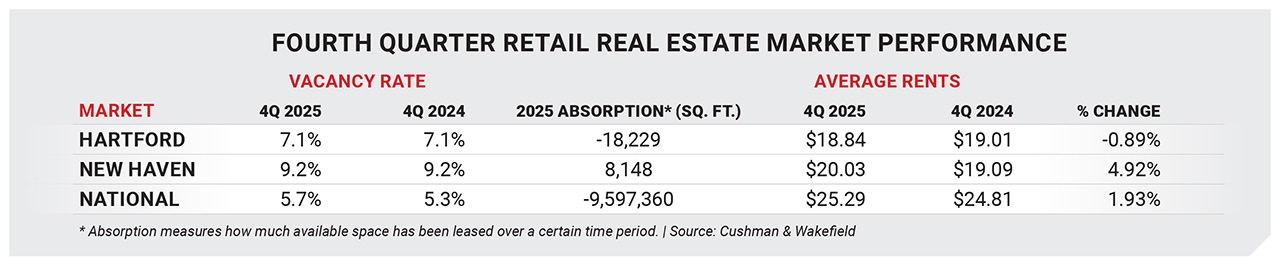
In Connecticut, conditions vary by market. The Hartford area posted a retail vacancy rate of about 7.1% at the end of 2025, roughly in line with pre-pandemic levels, while New Haven remained higher at about 9.2%.
Still, both markets showed signs of leasing activity late in the year, according to Cushman & Wakefield.
In-person shopping
Not all retail property types are performing equally. Enclosed malls continue to struggle, while open-air and strip shopping centers have rebounded “in a big way,” said Mike Goman, a principal at East Hartford-based real estate services firm Goman+York.
 Michael Goman
He said the shift is being driven in part by changing consumer behavior, with shoppers returning to physical stores after years of e-commerce growth. For younger generations raised on online shopping, in-person retail can feel more novel, he said.
Goman also pointed to a broader shift toward experience-driven retail, particularly in food and service categories.
“The reality is online retail growth has really plateaued,” Goman said. “People have come back to stores.”