
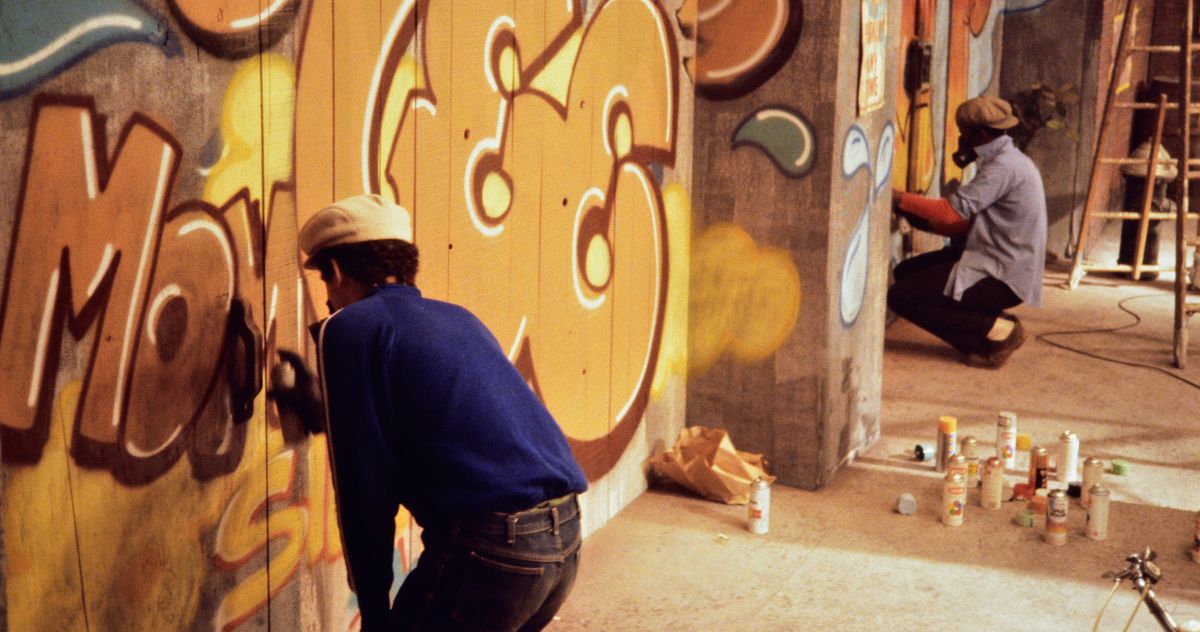
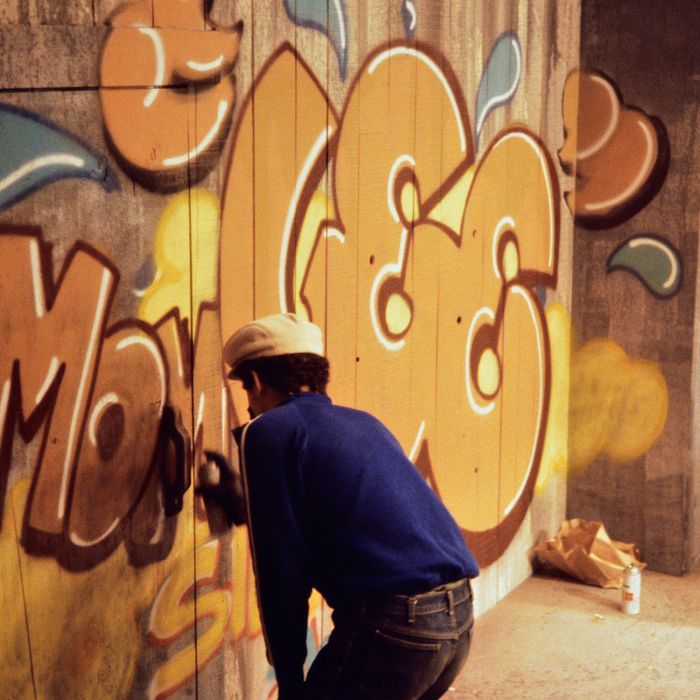
Quiñones on the set of the “Rapture” music video.
Photo: Charlie Ahearn
In 1980, Lee Quiñones was 20 years old and had already become, to anyone who rode the subway, a household name. On 4, 5, J, M, and R trains, LEE was graffitied across whole cars in giant blocks of text, the letters sometimes cracked or slumped and molded into barely recognizable shapes. Quiñones often took inspiration from cartoons and comic books, painting dragons or, most famously, Howard the Duck. He and his art collective, the Fabulous Five, used graffiti as a kind of dialogue with the city, parts of which believed their work was, as Mayor Ed Koch put it, “destroying our lifestyle.” WHAT IS GRAFFITI ART? they wrote on one car. TAKE A LOOK FOR YOURSELF.
City leadership did not respond in kind. “If I had my way, I wouldn’t put in dogs but wolves,” Koch said in 1980 when asked about how the city would crack down on graffiti artists. A year later, his administration actually did build high barbed-wire fences and stationed German shepherds around a Queens train yard. Then the MTA launched a pilot program that was referred to as the “Great White Fleet,” painting roughly a dozen 7 trains completely white, apparently in hopes that it would discourage vandalism. “Can you believe that?” Quiñones says. “They actually created a canvas.” (The program was promptly discontinued.)
My Lost Art World
Quiñones knew he would eventually have to move on from subway art, and throughout the early ’80s, he steadily brought more of his work aboveground. He painted murals on walls across handball courts in lower Manhattan, experimenting with shading and depth of field. “People were making pilgrimages to those walls,” he recalls. “I don’t even know how that happened.” One of those people was the graffiti artist Fab 5 Freddy, who later became a kind of godfather of downtown and a pivotal figure in the ’90s hip-hop scene. He sought out Quiñones while he was sitting in a classroom, still trying to earn his GED after flunking out of high school. “He walked in and said very formally, ‘I want to talk to that gentleman,’” Quiñones says. “I thought he was a cop.”
Fab 5 Freddy — confusingly not one of the original members of the Fabulous Five — became one of Quiñones’s biggest collaborators. At parties and art shows held mostly in “abandoned facilities,” Quiñones says, they met the variously mythologized artists who came to define the era — figures like Debbie Harry, Keith Haring, and Jean-Michel Basquiat. As a group, their aesthetic was defined in large part by the flashy, unabashed visual style of graffiti — so much so that Blondie commissioned Quiñones, Fab 5 Freddy, and Basquiat to create the set for two music videos, with Quiñones detonating paint onto the walls and Basquiat scribbling words onto the edges.
Major gallerists and curators eventually became curious about this irrepressibly cool little underworld. One of the first big shows spotlighting graffiti art, “New York/New Wave” at MoMA PS1, drew massive crowds from every corner of the scene. Barbara Gladstone asked to represent Quiñones shortly thereafter, walking into the pet shop where he worked at the time, arm in arm with gallery director Allan Schwartzman. When, in the late ’80s, Quiñones’s world seemed to suddenly fall apart — the art market collapsed, and the AIDS epidemic ravaged his downtown orbit — he channeled much of that into his work, creating murals like The Golden Child as an homage to his friend Haring.
Today, he paints mostly on canvas, but he kept creating murals into the early 2010s. In one, Requiem, he painted a full-scale medevac helicopter emerging from a vibrant, coiled jungle on the side of a building on the Lower East Side. “People to this day ask me, ‘How’d you do that, Lee?’” he says. “And the answer is always ‘Subways.’ They taught me three things: how to work with little or no light; composition, knowing how to work with all sides of a car; and timing — Be in and out by a certain time.” — Paula Aceves
Thank you for subscribing and supporting our journalism.
If you prefer to read in print, you can also find this article in the April 20, 2026, issue of
New York Magazine.
Want more stories like this one? Subscribe now
to support our journalism and get unlimited access to our coverage.
If you prefer to read in print, you can also find this article in the April 20, 2026, issue of
New York Magazine.