
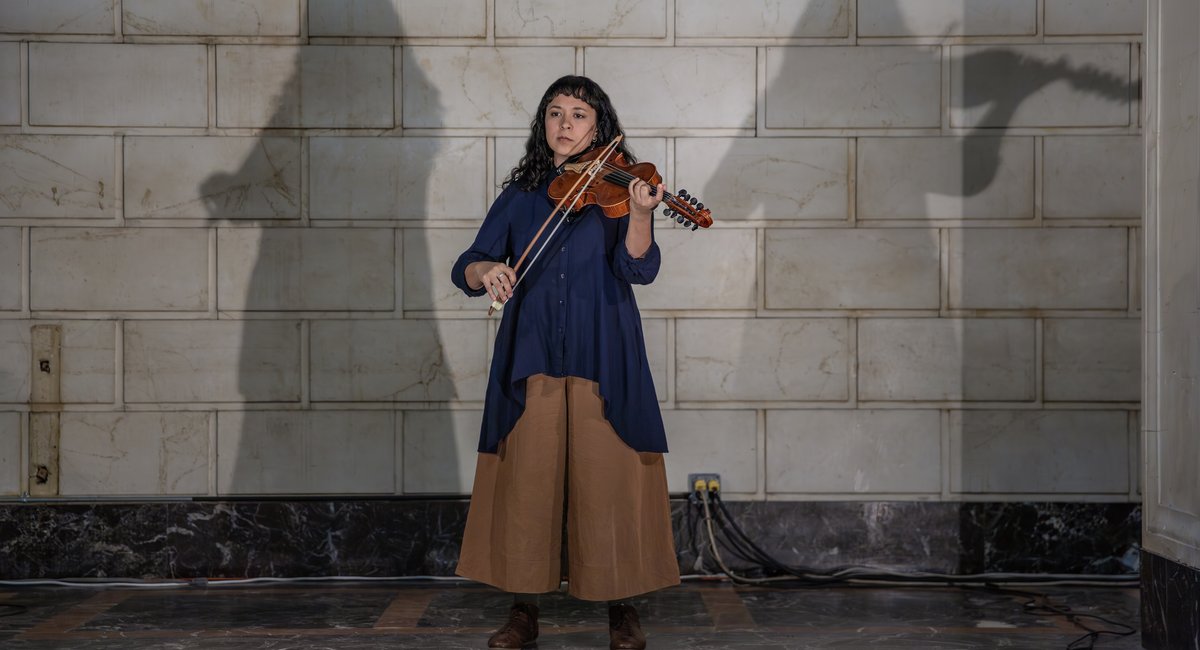
There’s an old marble theater inside a towering art deco skyscraper in Downtown Brooklyn. Architecture firm McKim, Mead & White designed the building not long after it built Penn Station. And though the room was once the ceremonial headquarters of the Benevolent & Protective Order of the Elks, its gaudy ornamentations have begun to peel and crumble over time.
Even in its faded glory, the theater’s high-arched ceilings make for remarkable acoustics. That’s why Zosha Warpeha, a 31-year-old fiddler raised on a rural Minnesota maple syrup farm, decided to record an album there.
“ I think of the room as a second instrument,” Warpeha said in a recent interview at theater, which is now run as an arts venue by the nonprofit ISSUE Project Room. “I think of it as an active performer and collaborator.”
Warpeha walked softly through the sprawling space in a flowing linen shirt and wide-legged pants. She was quiet but emanated a restless excitement to discuss her music — and the enigmatic instrument she plays.
Warpeha composes for the hardanger d’amore, a violin-like instrument related to the traditional Norwegian hardanger fiddle. It has five top strings and five sympathetic strings that resonate underneath.
Zosha Warpeha and her hardanger d’amore fiddle
Zach Gross
Warpeha moved to New York in 2013 to study jazz violin at the New School. But, she said, she struggled to find her place in the jazz scene, and craved a musical form that was more expansive and improvisational.
In her search for inspiration she became obsessed with YouTube videos of Norwegian hardanger folk fiddlers. When she learned one of her New School teachers had one, she asked to play it. She said something clicked for her.
“It really felt like the sound was coming from myself and my core rather than my fingers,” she said. “That was just really powerful to experience and I had to go deeper.”
With the help of a grant, Warpeha eventually got her hands on her own hardanger d’amore, custom-made by the renowned Norwegian fiddle-maker Salve Håkedal. She said she felt it was important to truly immerse herself in the Norwegian folk tradition before writing in a more contemporary space, and moved to Oslo for two years to study hardanger fiddle on a Fulbright scholarship.
“It was very difficult. The songs were difficult. The process of learning was hard,” Warpeha said. “But I just embraced it. And I think I was able to go so much deeper with that, like, beginner’s mind.”
The hardanger and hardanger d’amore are played widely in folk music circles. The droning sound created by the instruments’ resonant strings produces a unique and haunting quality — the hardanger fiddle features prominently in the “Lord of the Rings” soundtracks.
But what Warpeha is doing now with the hardanger d’amore is much more experimental.
“She’s taken it to a much more extreme direction in terms of the sustained drone space that she’s exploring,” said Daniel Trueman, a master fiddler who chairs Princeton University’s music department.
Trueman helped develop the first hardanger d’amore 15 years ago with Håkedal. Trueman wanted a five-stringed instrument with a longer neck and larger body that maintained the signature drone sound of the hardanger fiddle, but could more easily slot into American and Irish folk groups.
Since then, the hardanger d’amore’s popularity has exploded — the waiting list for a handmade Håkedal fiddle is about seven years. That demand is being driven by players like Warpeha.
Warpeha “is revealing a beautiful side to the instrument that I’m very excited about,” Trueman said. “I’m very proud of it, to be honest.”
Warpeha’s first album, “silver dawn,” a solo record on the hardanger d’amore, contains some elements of traditional folk music. Its 13 tracks are not standard verse-chorus-bridge songs, but there are recognizable chord structures and progressions.
Warpeha’s new album, “I grow accustomed to the dark,” represents an evolution and a departure. It features just two long tracks, which were recorded live at ISSUE Project Room.
Over the 20 minutes of the first piece, “filament,” Warpeha slowly builds chords that clash against each other and bounce around the room before coming back together. Sometimes she sings in a low hum, which intermingles with the vibrating tenor of the strings. It almost sounds like she’s leading a séance.
Zosha Warpeha at ISSUE Project Room
Zach Gross
Warpeha describes her compositional style as “meditative,” exploring not only the boundaries of resonance and dissonance, but positive and negative space, light and dark.
“When you play the hardanger fiddle, you have this little bit of reverberance, or little bit of a shimmer,” she said. “The note goes on longer in a really subliminal way and there’s just more room for taking space.”
Warpeha said that while writing the album she spent entire days just walking around the old theater with her fiddle, listening to how the notes echoed through the space. It was the dead of winter and she said the building’s heating system made a lot of noise — so she’d turn it off and bundle up in a puffy jacket.
“ Every acoustic space has its own sonic imprint, its own personality,” she said. “So I was kind of searching for what is the core tone of the room, what’s really responding to me the loudest when I give something to it.”
She eventually found the room had about five seconds of reverb. On “I grow accustomed to the dark,” Warpeha starts new notes as the old ones hang in the air. There are moments when it sounds like there are two or three players in the room alongside her.
The album is being well-received critically, with Pitchfork Contributing Editor Philip Sherburne calling it “severe” and “strangely beautiful.”
But composing experimental music for the Norwegian fiddle is a tough way to earn a living in New York City. To supplement her income, Warpeha said, she often backs up folk and country groups.
Last year she joined the Irish folk-pop trio Amble on an arena tour, playing her hardanger fiddle for thousands of people. Earlier this month she traveled back to Dublin to help record the trio’s forthcoming album on Warner Records.
“On these pop sessions, I’m not presenting my manifesto of contemporary music,” she said. “I’m doing a job, but I’m also really enjoying it and I’m getting to play my fiddle, and that’s really special to me.”
Warpeha said, though, in the end though she’s called back to play alone, in cavernous spaces like this old marble theater in Brooklyn.
“ I’m just really grateful that there’s been some momentum for me in the last couple of years,” she said. And more than that, “I finally figured out what I want to say as a musician.”
Warpeha’s album release show for “I grow accustomed to the dark” is May 12 at Light & Sound Design in Brooklyn.