
Students walk the campus on Syracuse University in New York. State election records show the university made contributions to PACs and the political campaign of its former rowing coach. (AP Photo/Carolyn Thompson)
Carolyn Thompson
Today, the name William E. Sanford graces the wall of Syracuse University’s world-class rowing center. But in 2002, the university’s longtime men’s rowing coach was running for a seat in the New York Assembly.

That September, Sanford had left the university to focus on his reelection effort. That’s when the university seems to have cut its former employee a check. It was a small donation — $125 toward the Republican’s political campaign.
Article continues below this ad
But for the university, the money has broader significance. The check is one of at least nine payments made by the university to a candidate or political action committee from 2001 to 2024.
As a charitable institution known by the Internal Revenue Service as a 501(c)(3) nonprofit, Syracuse University is prohibited by state and federal laws from engaging in election activity, including direct or indirect support for political candidates.
The sprawling university is far from the only college or large nonprofit in New York to have apparently violated those laws in recent years, a Times Union investigation found. Hundreds of New York nonprofits barred from making contributions have donated to candidates, party groups and PACs over the last decade, according to the newspaper’s analysis of state election data and IRS records.
Make the Times Union a Preferred Source on Google to see more of our journalism when you search.
Add Preferred Source
The list includes large nonprofits with deep pockets and financial teams. Their donations flowed to Democratic and Republican candidates, as well as PACs with a range of missions.
Article continues below this ad
“For an institution like a college to be making a political contribution, that is very surprising because they absolutely know they cannot do that,” said Brendan Glavin, director of Insights at Open Secrets, a nonpartisan campaign finance watchdog. “There are auditors and multiple layers of people who should be flagging something like that.”
The Times Union identified political contributions by Le Moyne College in Syracuse, the now-closed Cazenovia College, as well as Bryant & Stratton College, which operates multiple campuses across the state and around the country.
Bryant & Stratton College has a campus in Albany (shown here) Buffalo, Rochester and Syracuse, in addition to locations in Ohio, Virginia and Wisconsin.
Jim Franco/Times Union
Notable cultural pillars like the Munson Williams Proctor Arts Institute and the Binghamton Philharmonic also made prohibited donations.
Article continues below this ad
A large nonprofit, Liberty Affordable Housing Inc., gave over $22,000 to Democratic and Republican candidates and PACs, including a mayor in Oneida County who announced the company had been selected for a major development project shortly after receiving the funds.
Health care nonprofit Nascentia Health Inc. donated $5,000 to Gov. Kathy Hochul’s campaign around the time it received millions of dollars from the state for senior housing projects.
A public library group, Nioga Library System, held a fundraising raffle for a political action committee and promoted the PAC to its members. The Times Union also found at least one nonprofit that was listed as making a contribution in state election records, but the payment was for a refund of a security deposit that had been charged for an event held on its property.
All of these nonprofits reported on federal tax documents under penalty of perjury they did not engage in direct or indirect political activities to support or oppose candidates.
Article continues below this ad
Each of the nonprofits collects at least $1 million in annual revenue and several are subject to annual independent audits due to their size. But these donations appear to have been missed by auditors, as well as government regulators.
The nonprofits all said they were familiar with the decades-long prohibition against 501(c)(3) nonprofits making political contributions. Most claimed that their recent violations were the result of their own unintentional errors.
Syracuse University
In addition to supporting Sanford, the rowing coach, Syracuse University directed contributions to the political action committees United Steelworkers of America District 4, Business Industry PAC of Central New York and the New York State Broadcasters PAC, state election records show. Each of the donations was $500 or less.
Article continues below this ad
In 2019, 2021 and 2024, the university also contributed $150 per year to Syracuse Tomorrow, a political action committee run by the Central New York business organization CenterState CEO. Syracuse University’s Vice Chancellor for Strategic Initiatives and Innovation J. Michael Haynie serves on the board of directors of CenterState CEO.
Sarah Scalise, a university spokeswoman, said those contributions “were included with general membership dues invoiced by CenterState CEO.”
“These were administrative errors, not intentional political expenditures,” she said. “The university has requested that these payments be refunded and has taken steps to ensure this does not happen again.”
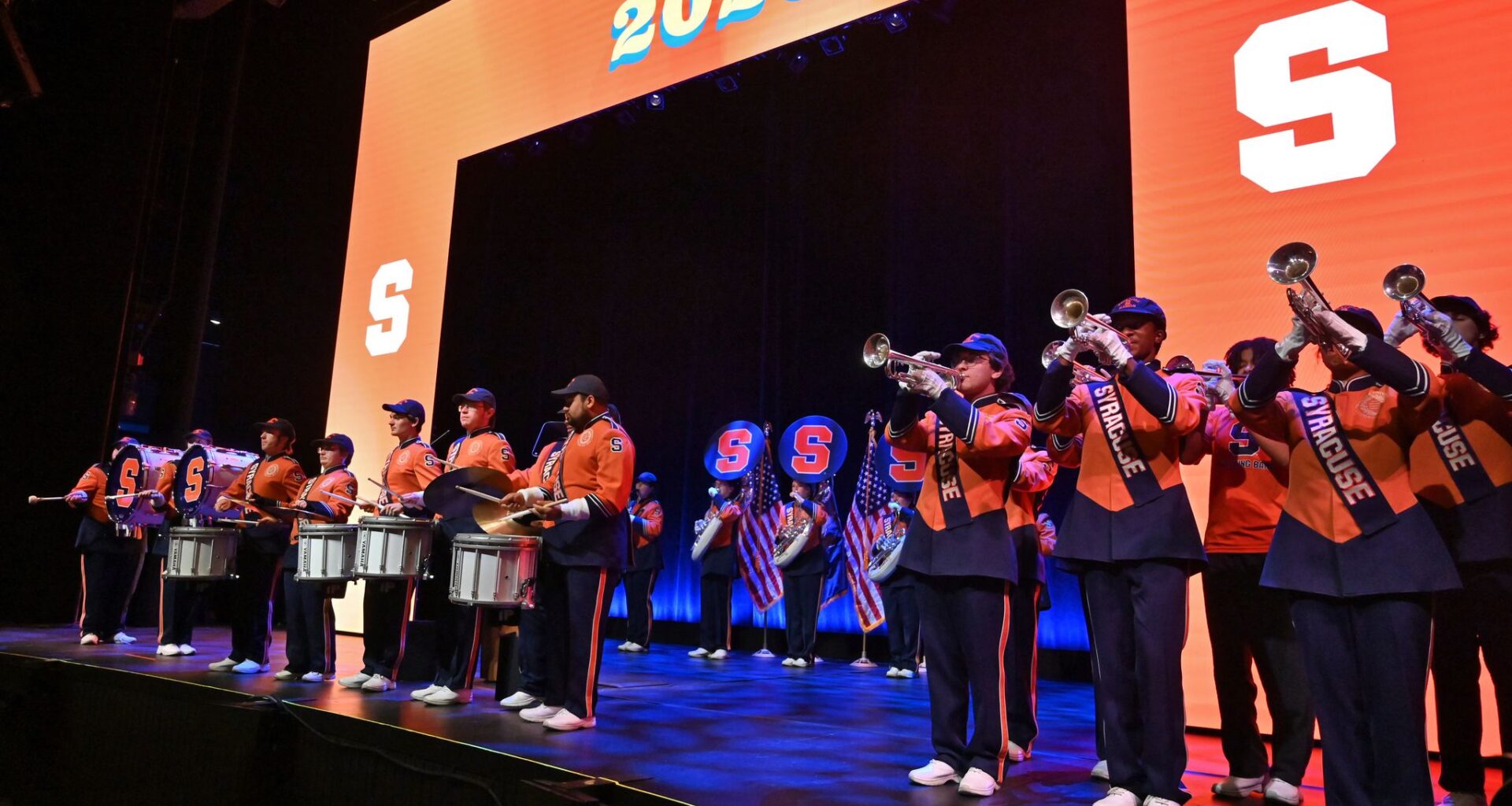
The Syracuse University Marching Band performs ahead of Gov. Kathy Hochul’s 2026 State of the State Address in January in Albany. The university said its political contributions were the results of “administrative errors.”
Lori Van Buren/Times Union
Scalise said the university could not explain the nature or intent of the earlier contributions, including the donation to Sanford, because it no longer has those records. University policy prohibits the use of school resources for partisan political purposes, she said.
Article continues below this ad
“We are reviewing our internal processes to ensure all expenditures are properly classified going forward,” she said.
Elle Hanna, a spokeswoman for CenterState CEO, confirmed the organization has optional contributions to its PAC available during membership renewal.
“Contributions to Syracuse Tomorrow have always been voluntary, with members choosing to opt-in,” Hanna said. “Syracuse Tomorrow has a wide range of supporters. Recently, the PAC was advised that some of its supporters’ contributions were inadvertent. The PAC will continue to work with any entity that wishes to have its contribution refunded.”
David Donovan, president and executive director of the New York State Broadcasters Association, said he believes the university’s 2016 donation to the PAC was made by mistake by the college radio station when paying membership dues. He said he would refund the money.
Article continues below this ad
Jess Kamm Broomell, a spokeswoman for United Steelworkers of America District 4 PAC, said its records showed the PAC made a payment to the university in 2001, which the university appeared to have paid back. Further context was not available.
Do you have information about election activity by 501(c)(3) nonprofits in New York? Email reporter Emilie Munson at emilie.munson@timesunion.com.
Liberty Affordable Housing
In late 2021, a chain-link fence marked with “No Trespassing signs” encircled the historic Olbiston apartment building in downtown Utica. The building was an eyesore and unsafe for tenants, according to the city.
Article continues below this ad
For months, Utica discussed restoring the building with Liberty Affordable Housing, a city news release said. In October 2021, Utica Mayor Robert Palmieri announced the city would allocate $3 million toward converting it into affordable housing.
Liberty Affordable Housing runs a portfolio of developments across New York, including Ashfield Apartments in Latham.
Lori Van Buren/Times Union
One month later, Liberty, a 501(c)(3) nonprofit, donated $250 to the Democratic mayor’s reelection campaign. And in December, Liberty and Palmieri jointly announced the company’s $55 million plan to redevelop the building was official.
Liberty has also contributed to state politicians who backed its projects.
Article continues below this ad
Liberty gave $14,600 over the course of a decade to former state Sen. Betty Little, whose district contained three of its developments. Little, a Republican, was described as a “strong advocate” for a multimillion-dollar Liberty senior housing project in Ticonderoga by the firm’s regional property manager in 2011.
Little said in a recent interview that she knew the wife of one of Liberty’s former executives. She surmised the contributions may have stemmed from company leaders playing in her annual golf fundraiser in Glens Falls. She said she had no idea the company was a 501(c)(3) nonprofit.
Now, GOP state Sen. Dan Stec represents the same district and has received $3,400 from the company in three years. Those contributions were made at the golf fundraiser that Stec continued to organize after Little’s retirement, he said. The senator said his treasurer would review the donations.
Former state Sen. Betty Little received political donations from the 501(c)(3) nonprofits Liberty Affordable Housing and Nascentia Health. (Will Waldron/Times Union)
Will Waldron/Albany Times Union
The company also gave to former Democratic Assemblywoman Roann Destito, who helped the nonprofit secure financing for an apartment rehabilitation project; former Republican Mayor Jackie Izzo of Rome, where the company had another apartment project; and Republican state Sen. Joe Griffo, who has supported two projects by the company in Utica.
Article continues below this ad
Liberty Affordable Housing, which has received millions in tax-exempt bonds, federal tax credits and state subsidies, did not respond to multiple requests for comment.
Izzo said she has known the principals of the company for 30 years, but had no direct knowledge of the nonprofit’s contributions to her campaign.
David Catalfamo, a Griffo campaign spokesman, said the campaign is issuing refunds.
“We are updating our contribution forms to clearly remind supporters that donations from not-for-profit organizations cannot be accepted,” Catalfamo said.
Article continues below this ad
The New York Senate Republican Campaign Committee, which received $1,000 from the firm in 2008, said nonprofits shouldn’t be donating to political candidates or committees.
“The reality is, these organizations overwhelmingly funnel support to Democrats and far-left causes,” said Katy Delgado, a spokeswoman for the Republican committee. “That’s why we need stronger enforcement to ensure nonprofits aren’t being used as a backdoor to subsidize the Democratic Party in New York.”
In March 2024, the nonprofit Nascentia Health received $5.8 million from the administration of Gov. Kathy Hochul to transform an inn into senior housing. But the health care company was seeking even more funding.
Article continues below this ad
Two months later, an arm of the nonprofit made a $5,000 contribution to Hochul’s campaign. And more government money flowed to the company. The next year, Nascentia Health and the City of Rome got $3.9 million from the state for a senior housing project.
State election records show Nascentia Health President Mary Kate Rolf also personally gave $6,000 to Hochul in 2020 and 2021.
In 2024, Gov. Kathy Hochul received a $5,000 donation from Nascentia Health, a 501(c((3) nonprofit that has received state support for its projects. (Will Waldron/Times Union)
Will Waldron/Times Union
Hochul was not the only candidate the nonprofit supported. Nascentia Health, directly and through two related companies that fall under the same tax status, made over $4,000 in contributions to Griffo, Little and the PAC Syracuse Tomorrow. Rolf serves on the board of directors for CenterState CEO, which operates Syracuse Tomorrow.
Article continues below this ad
Nascentia Health declined to comment on its political contributions.
Hochul campaign spokesman Ryan Radulovacki said: “The governor’s campaign follows all applicable campaign finance laws and issues refunds as requested by donors.”
Nioga Library System
The Nioga Library System coordinates resource sharing for 21 libraries across three counties in western New York. Each year, the nonprofit has a dinner where it raffles off a basket, said Thomas Bindeman, the system’s executive director.
Article continues below this ad
Some years the basket is better than others. Occasionally, it has contained new cookware for the lucky recipient, but other years, the contents included “three cans of V8” juice or “used glassware,” Bindeman said.
Whatever money Nioga Library System raises from the basket, it gives to the political action committee New Yorkers for Better Libraries. The PAC, in turn, boosts the campaigns of state legislative candidates who want to fund the public library system. In eight years, Nioga’s basket raffles have resulted in $6,815 for the PAC.
Bindeman said the nonprofit also encourages its members to donate to the PAC. He added the nonprofit believed the raffle was permitted because the money did not come directly from its coffers and auditors had previously approved it.
Exterior of the New York Capitol in Albany. Many nonprofits barred from making political contributions have donated to the campaigns of current and former state lawmakers and governors, a Times Union investigation found.
Lori Van Buren/Times Union
But guidance from the New York attorney general’s Charities Bureau explains 501(c)(3) nonprofits are barred from “soliciting contributions” for candidates for office, including via PACs.
Article continues below this ad
“If it’s prohibited, we may have to end it,” Bindeman said of the raffle.
The Times Union found since 2004, eight other public libraries or library associations that are 501(c)(3) nonprofits also donated to the same PAC, although none gave as much as Nioga. Officials with the Nassau County Library Association, which gave $1,800 to the PAC across seven years until 2021, declined comment.
Joe Burke, chair of the steering committee for New Yorkers for Better Libraries PAC, said many library group leaders are volunteers who might not have a “sophisticated understanding” of tax-law rules around political contributions. He called the donations “innocuous” and “inadvertent.”
Burke said the PAC would highlight information on its website and other materials about the prohibition on political donations by 501(c)(3) nonprofits and seek guidance from an attorney about refunding the money.
Article continues below this ad
Cazenovia College
A small, liberal arts college in central New York made 15 donations to candidates and PACs — likely in violation of state and federal laws — before it closed in 2023.
From 2003 to 2022, Cazenovia College paid about $4,000 to Republican former state Sen. Nancy Hoffmann, Democratic former Assemblyman William Magee, Republican former Assemblyman Jeff Brown and the political action committee Syracuse Tomorrow, state election records show. The contributions stretched across the leadership of three college presidents.
Assemblyman William Magee, center, received $1,100 from 2003 to 2005 from Cazenovia College, state elections records show. (Paul Buckowski / Times Union)
Paul Buckowski
The Times Union contacted all of them, but only received a response from former Cazenovia College President Ron Chesbrough.
Article continues below this ad
“The college was not in the habit or the practice during my tenure of making political contributions,” Chesbrough said, adding he thinks the payments were mix-ups. Only two to three people at the college, including the president, would have had the authority to make such payments, he added.
Like Syracuse University, the college paid membership fees to CenterState CEO, which runs the PAC Syracuse Tomorrow, when the college could afford them, Chesbrough said. He also noted that Magee, who died in 2020, was a longtime supporter of Cazenovia College and close to members of the school’s board of trustees.
As college president, Chesbrough said that he tried to strictly adhere to a “completely apolitical stance.” Occasionally, someone would place a campaign sign in front of the college president’s residence and Chesbrough would consistently remove it and contact the campaign to warn against placing signs on college property, he said.
Binghamton Philharmonic
The largest and longest-serving professional symphony orchestra in New York’s Southern Tier, Binghamton Philharmonic, brings music to about 10,000 people per year.
Article continues below this ad
And from 2018 to 2024, the nonprofit made small payments totaling about $700 to Democratic Assemblywoman Donna Lupardo’s campaign.
Lupardo is a longtime backer of the symphony. Around 2005, when lawmakers still could direct state money to their preferred causes, Lupardo sent a “member item” grant to the Binghamton Philharmonic. In 2022, the assemblywoman presented at an event hosted by the orchestra. In November, she celebrated a new state grant for the symphony.
Assemblywoman Donna Lupardo, D-Binghamton, received about $700 in donations from the Binghamton Philharmonic, a symphony orchestra.
Jim Franco/Times Union
Officials with Binghamton Philharmonic, which has received tens of thousands of dollars in state contracts and federal grants, according to government records, did not respond to a request for comment.
Article continues below this ad
“We refunded all of the donations from the Binghamton Philharmonic as soon as we learned about this,” Lupardo said. “The funds had been used to purchase tickets to my annual cocktail party fundraiser. My treasurer was unaware that nonprofits could not donate.”
Bryant & Stratton College
In the 20 years before it became a 501(c)(3) nonprofit, Bryant & Stratton College donated to many campaigns and PACs in New York and Virginia. The college, which has campuses across New York and in other states, transitioned from for profit to nonprofit in 2020.
The college contributed $5,175 to PACs after the switch, the Times Union found. In 2022, it donated $5,000 to TAP-PAC, a political action committee representing private colleges. In September, the college made a small donation to the PAC Syracuse Tomorrow.
Article continues below this ad
Bryant & Stratton College made contributions to two PACs since it became a 501(c)(3) nonprofit, state elections records show.
Jim Franco/Times Union
Bryant & Stratton officials said its only involvement with elected officials is inviting them to campus for student-focused events and milestones.
“Two donations made by the college since its transition from a corporation to a 501(c)(3) nonprofit entity were made inadvertently, both of which are in the process of being corrected,” said Christopher Gerace, the college’s vice president and chief financial officer.
TAP-PAC will refund the contribution it received, said Joshua Poupore, a PAC spokesman.
Article continues below this ad
Munson Williams Proctor Arts Institute
A century old fine arts center issued checks to two political candidates despite its 501(c)(3) status. The Munson Williams Proctor Arts Institute donated $250 in 2016 to the campaign of then-Assemblyman Anthony Brindisi, a Democrat who represented Utica where the museum and its art school are located.
In 2018, the Munson Museum of Art’s director and chief curator — now the institute’s CEO — Anna D’Ambrosio personally donated $350 to Brindisi’s congressional campaign. It’s legal for nonprofit leaders to make personal donations with their own money, but contributions paid for with 501(c)(3) nonprofit funds are not allowed.
Democrat Anthony Brindisi of Utica was a state assemblyman, member of Congress and is now a federal judge in New York’s Northern District. (AP Photo/Heather Ainsworth, File)
Heather Ainsworth/AP
Then, in 2024, the nonprofit bought a $100 ticket to a campaign event for Democrat Assemblywoman Marianne Buttenschon, who filled the seat Brindisi left.
Article continues below this ad
Katherine Laube, an institute spokeswoman, said the purchase was an “oversight” and “will not be repeated.”
“Our contact with Assemblywoman Buttenschon is limited to infrequent interactions related to her district representation,” Laube said. “We have assured that all employees are aware of the prohibition of political contributions by a 501(c)(3). We have taken steps to ensure this does not occur again.”
Buttenschon said after the Times Union’s outreach, she spoke with the nonprofit and refunded the money.
Community Housing Innovations Inc.
A nonprofit housing services company touts its “full compliance with IRS and New York state regulations” on its website, but made several prohibited political contributions.
Article continues below this ad
State election records show Community Housing Innovations made three $50 donations to Stars and Stripes PAC from 2023 to last year. The PAC is operated by the Building and Realty Institute of the Hudson Valley and supports “pro-housing candidates,” primarily Democrats.
Ron Abad, CEO of the Community Housing Innovations, said the company pays annual membership fees to the Building and Realty Institute, a trade association, which included a PAC donation.
“We have asked BRI for an opt out,” he said. Abad added the company’s auditors have never flagged the contributions before, but they will review future invoices carefully.
Stars and Stripes refunded the donations after outreach from the Times Union and the nonprofit, said Tim Foley, CEO of the Building and Realty Institute.
Article continues below this ad
From 2001 to 2005, Community Housing Innovation also made a few small political donations to the Long Island Association Action Committee. Abad said he could not address the older contributions.
Le Moyne College and Oswego Health
Like Syracuse University, Cazenovia College, Bryant & Stratton College and Nascentia Health, Le Moyne College and Oswego Health also made multiple contributions to the PAC Syracuse Tomorrow.
Le Moyne, a private college in Syracuse, donated about $300 to the PAC in 2019 and 2020. College President Linda LeMura serves on the board of directors for CenterState CEO, which runs the PAC.
Article continues below this ad
Linda LeMura, president of Le Moyne College, also serves on the board of CenterState CEO. The college made contributions to a PAC operated by CenterState. (David Lassman/Syracuse Post-Standard)
David Lassman
“The contributions in 2019 and 2020 were made in error as part of the payment of our annual dues as a member of CenterStateCEO,” said college spokesman Joe Della Posta. “Le Moyne regrets the mistake, which was done inadvertently.”
Oswego Health, a health system in western New York, contributed a total of about $600 in four installments to Syracuse Tomorrow from 2021 to last year. Like LeMura, Oswego Health CEO Michael Backus serves on the PAC’s parent company’s board.
“Upon becoming aware of this issue, we immediately requested a full refund of any dues that were allocated to Syracuse Tomorrow and we are reviewing this matter internally to reinforce safeguards and prevent any similar occurrence in the future,” said company spokeswoman Jamie Leszczynski. “We are also meeting with CenterState to ascertain how this occurred and to ensure that processes are corrected to ensure that our membership dues are not inappropriately allocated in the future.”
Article continues below this ad
Good Counsel Inc.
A nonprofit that runs shelters for homeless pregnant women in multiple states, Good Counsel Inc., donated 11 times to Westchester Right to Life PAC from 2012 to last year. In total, the nonprofit gave about $1,500 to the political action committee, state election records show.
Reached by phone, CEO Jo-Ann Venezia said, “I feel very uncomfortable” discussing the contributions and why they were made. The organization declined further comment.
Article continues below this ad