
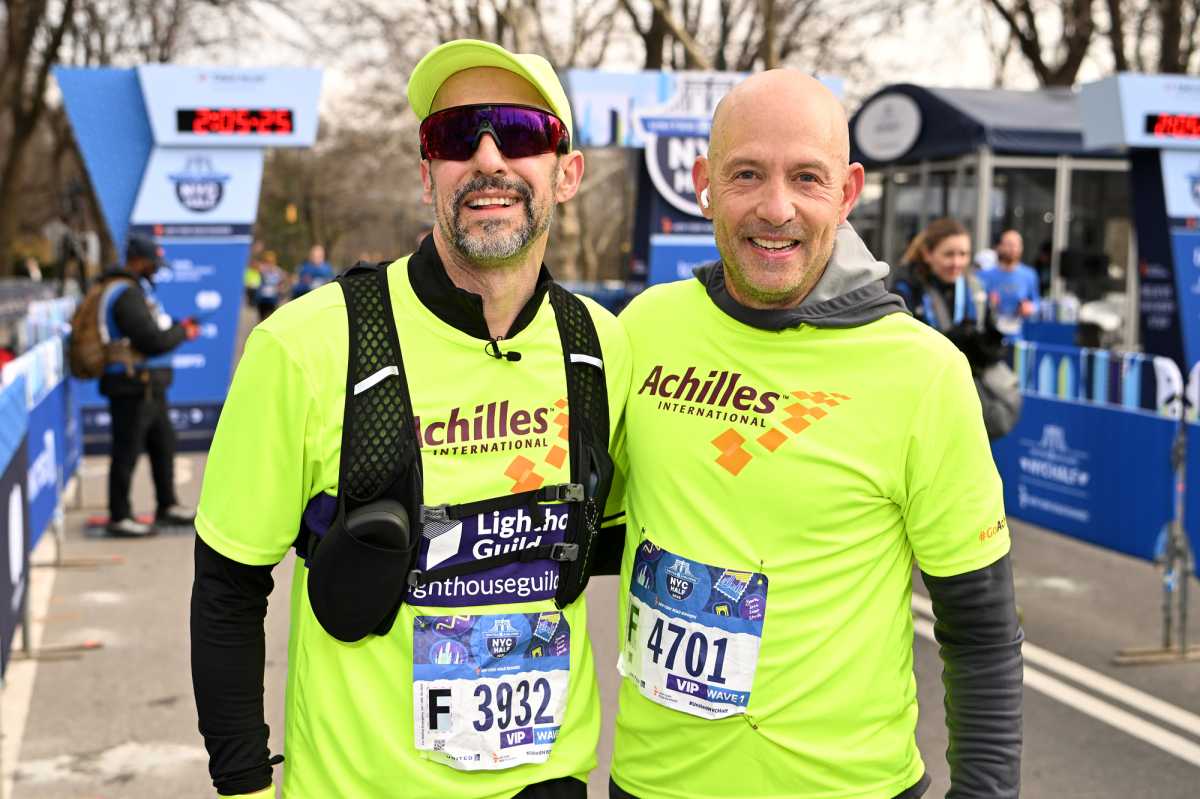
As Thomas Panek crossed the finish line of the 2026 New York City Half Marathon, it was more than just another race completed; it was the first time artificial intelligence helped to guide him through 13.1 miles of crowded city streets.
For Panek, president and CEO of Lighthouse Guild, the race marked more than a personal milestone. It represented a new world of possibilities for the blind and low vision community, demonstrating how technology can shape the future when used thoughtfully.
Panek noticed changes in his vision at a young age, when he realized that he couldn’t see as clearly as his peers. As he grew older, the problem worsened— and so did the consequences.
“I was doing things like everybody else does, riding a bike or running, and I’d break my arms, and bump into things,” Panek said. “People just thought I was clumsy, and what was really going on was that I was experiencing vision loss.”
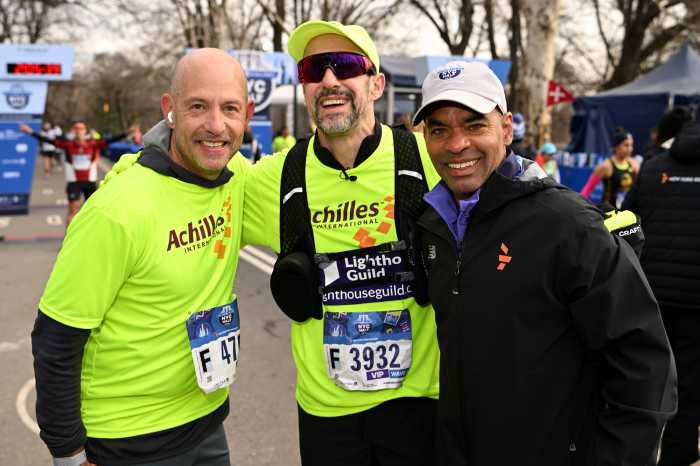 March 15, 2026: The 2026 United Airlines NYC Half Marathon is held in New York City. The course starts in Brooklyn and ends in Central Park in Manhattan. (Photo by Bryan Bedder for New York Road Runners.)
By his early 20s, Panek was legally blind. Accepting that reality was not easy.
“It’s really hard and difficult for people to go through that,” he said.
At 26, Panek made a decision that would change the course of his life: he sought help through Lighthouse Guild, a leading nonprofit organization that provides healthcare, rehabilitation, and technology services to people who are experiencing vision loss. There, he received his first cane, and soon after, a guide dog, tools that restored both his mobility and confidence.
“I like to tell the story that the very first day I received my guide dog, I was sort of out and about in the world, accepting the fact that I couldn’t see,” Panek said. “And with that a sort of confidence.”
This confidence reshaped his life. Panek went on to meet his wife, build a family, and establish a career rooted in service and advocacy.
“I live a very wonderful life,” he said. “When people ask me what is difficult about vision loss, I tell them that everyone has something.”
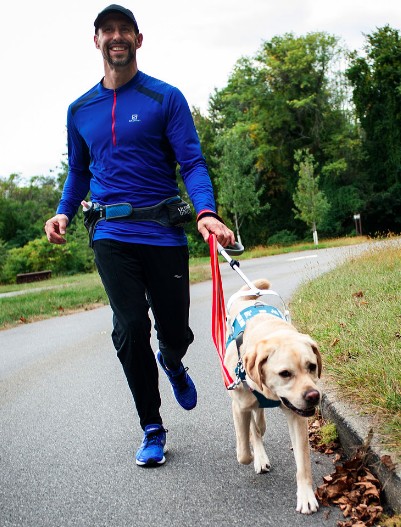 Panek and his guide dog, enjoying a run.Photo courtesy of Thomas Panek
Panek has made it his goal to challenge assumptions about disability. For him, running is not just an exercise, it’s proof that possibility is endless.
“The sky’s the limit, you can do anything,” he said. “That’s probably one of the primary reasons why I run: to improve myself, not only for health and wellness, but also to prove that there’s very few things that you can’t do with the right tools and support.”
Over time, Panek rose to become president and CEO of Lighthouse Guild, where he now leads efforts to support others of all ages experiencing vision loss.
This mission came full circle at this year’s NYC Half Marathon. Panek used Lighthouse Guild’s mobility glasses powered by artificial intelligence to cross the finish line. This is one of the many aids provided by the nonprofit’s fundraising.
“That was the first time AI had helped me be able to get through a marathon course,” he said. “I had a safety runner, Jed Oscowitz, who ran on behalf of Achilles, but at the end of the day, that was the first time I had run semi-independently since I was a boy.”
While some remain skeptical of the rising use of artificial intelligence, Panek sees its potential if used responsibly.
“Like any tool, it can be used for harm or for good,” he said. “But it’s incredibly helpful and could be a game-changer for people in many ways. We just need to be thoughtful about how we use it.”
Through Lighthouse Guild’s partnership with Meta to create a pair of glasses that can depict images for the visually impaired, Panek played a major part in the development of technology that can interpret the world around them in real time.
“You can take a picture of something, and it’ll tell you it’s a red or green pepper,” Panek explained. “ Or it’ll tell you if that is bus number 102 or 86.”
For Panek, technology is only a fragment of the larger message: you are in charge of the limitations of the world around you.
“We’re all gonna face some sort of challenge,” he said, “It’s so easy to give up on something you love. But if there’s something you love, and you’re finding yourself not able, or not thinking that you could do it, just rethink it, and you should get some help along the way.”