
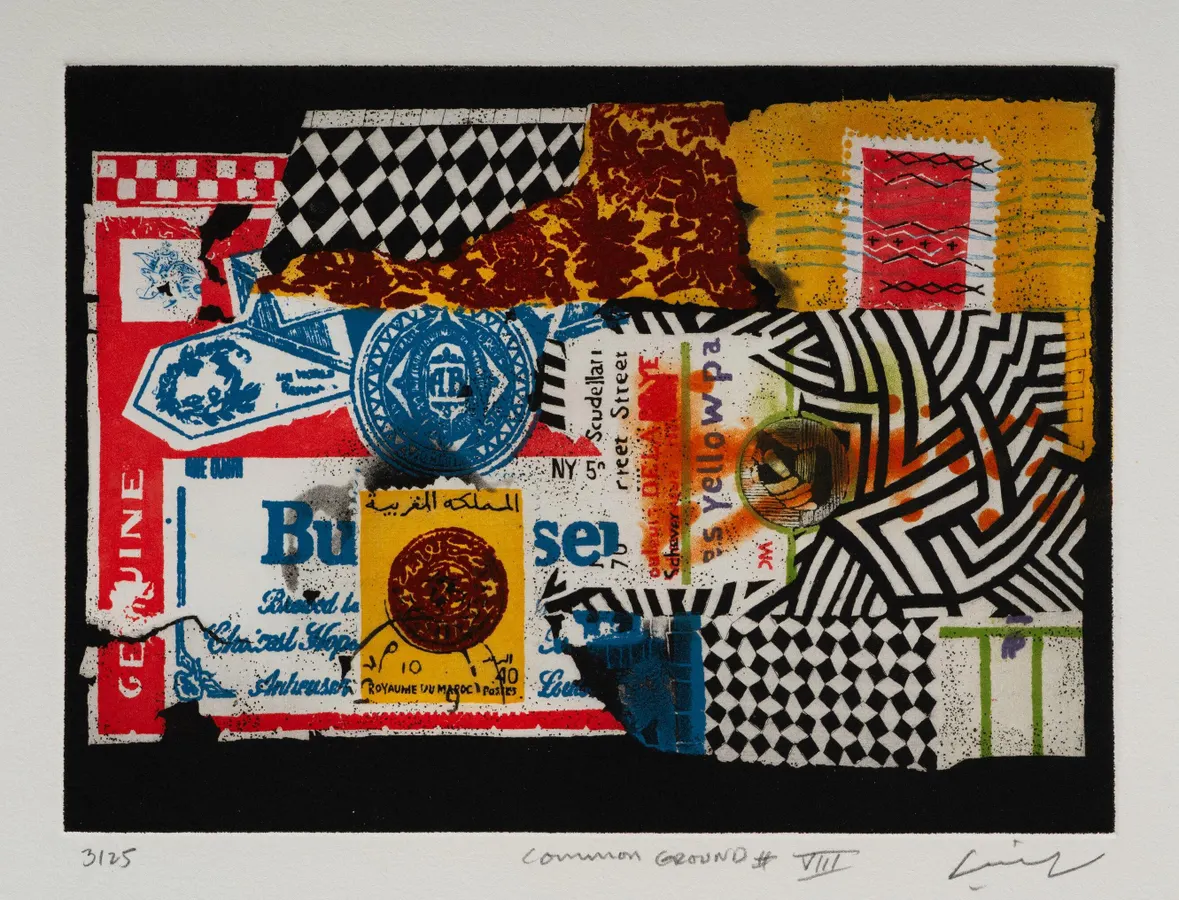
Mohammad Omer Khalil, ‘Common Ground VIII,’ C. 1985–1995. 15 x 20 in. Etching, photocopy transfer, etching, aquatint, sugarlift, spitbite 3/25
Courtesy of the artist
Artists are the most interesting people. Their creativity. Their curiosity. Their life experience and travels.
Mohammad Omer Khalil was born in Sudan in 1936, further educated in Italy, taught nearly 30 years in Morocco, and has lived in New York since 1967. The fascinating, fantastical, and heartbreaking places he’s been and people he’s met made their way onto paper over his six-decade career as the first major printmaker from the Arab world.
On view through May 31, 2026, “Mohammad Omer Khalil: Common Ground” surveys artworks by the master printmaker in partnership with the Robert Blackburn Printmaking Workshop. Blackburn was instrumental in the development of printmaking in America during the 20th century and provided Khalil an artistic home for years.
The multi-venue and multi-city exhibition unfolds across five partner sites including the Blackburn Study Center (New York), Twelve Gates Arts (Philadelphia), Arab American National Museum (Dearborn), Maqām Studio (Brooklyn), and Jay Seven Inc (Brooklyn), alongside a robust series of programs and workshops in partnership with The Africa Center, Anthology Film Archives, Pratt Institute, and the Queens Museum.
Khalil is known for his work fusing Sudanese visual traditions with European classical training. Influenced by a life lived between Morocco and New York, the artist leans on literary, art-historical, and pop-cultural references including Bob Dylan and legendary Egyptian singer Umm Kulthum.
Trained in Khartoum, Sudan and later in Florence, Italy in fresco and etching, Khalil translates this rigorous foundation into atmospheric, abstract compositions exploring the interplay of light and dark, color and pattern.
“Mohammad’s works reflect his unique life story: one that is African, Black, Arabaphone, New Yorker, immigrant, family man, a disciplined craft master, and artist with a curious spirit,” exhibition co-curator Jenna Hamed said in a press release.
Sudan
Mohammad Omer Khalil, ‘Suakin,’ 2015. 20 x 20 in. Oil, collage on canvas.
Courtesy of the artist
Khalil was born during a period of colonial rule in Sudan stretching from 1898 to 1956. The British and Egyptians jointly ruled the region. Prior to this, the Egyptians had brutally controlled the Sudan since 1820, employing an economic model most heavily dependent upon slavery.
Over the past 200 years, few places in the world have suffered like Sudan.
Post-colonization, rooted in colonization, Sudan has been wracked by near constant civil war. The country’s northern, Arab-identifying, Muslim population and its southern, African-descended, increasingly Christian, tribally related people have little in common aside from adjacent geography. The word “Sudan” references this tension. The name originates from the Arabic term “bilād as-sūdān,” meaning “Land of the Blacks;” Arab traders used it to describe the region south of the Sahara.
Even before Sudan had achieved independence, it began engaging in civil war, a conflict that would last from 1955 to 1972, claiming unknown hundreds of thousands of lives.
A second civil war began in the 1980s. It stretched through the 90s and into the 2000s. Millions perished.
South Sudan achieved independence in 2011.
Now, another civil war rages.
“I don’t know why Sudanese love Sudan, I don’t know,” Khalil told me, earnestly, during a video interview. “I don’t know why we love it. It’s the hottest country in the world, dusty, no color. Now people are killing each other. So, what is there to love? Tell me.”
American attempts at aide in the region have been ineffectual.
“Sudan was totally destroyed by the different (American) administrations. The aide wasn’t really aide,” Khalil explained. “They give you equipment, they give you advisors, they give you spies. There is nothing to spy on in Sudan, everything is open, but I met a few. They were teachers, but then not really teachers.”
He gives an example of how well-intentioned American aide made little impact on the ground.
“The equipment, there was boxes in the art school when I was a student, and I thought that somebody generous sent–I was thinking of a printing press to make a studio for etching,” Khalil remembers. “I see these boxes sitting for weeks, and the rain beat them up and the dust and everything. I asked the head of the school, ‘What are these boxes sitting here? Can I open them and see what’s there?’ I opened the box and I found agriculture equipment. I call the agricultural ministry and tell them that I have equipment here, sitting, (getting) dusty. They said they were looking for them. Why would the aide come to a school? I have no idea.”
Misdirected aide is better than missile strikes. That’s been the hallmark of American intervention in Sudan dating back to the Clinton Administration’s efforts to destroy a pharmaceutical factory in the country supposedly manufacturing chemical weapons for Osama bin Laden.
“Sudan is a forgotten country,” Khalil said.
He hasn’t forgotten, but he hasn’t returned since leaving at age 22.
New York
Mohammad Omer Khalil, ‘Harlem Portfolio 7.’
Courtesy of the artist
Growing up in Sudan, Khalil learned linocut because that’s what the British used in producing textiles. Continued study in Florence and travels across Italy introduced him to etching and other methods of printmaking. Italy changed Khalil’s life. He’d never seen any place so beautiful.
After arriving in New York in 1967 and establishing himself, the Robert Blackburn Printmaking Workshop emerged as a crucial artistic home at a time when there were few spaces in the city where non-white artists could exhibit their work. Upon meeting Blackburn in 1969, he joined the workshop and entered a community grounded in collaborative printmaking, mentorship, and mutual support—a context that would inspire Khalil to form his own studio in 1970.
From his studio, Khalil produced editions for legends including Mavis Pusey, Camille Billops, Emma Amos, Norman Lewis, Sean Scully, Jim Dine, among others, contributing significantly to the history of contemporary printmaking.
Who were his favorites?
“Louise Nevelson,” he said. “I loved Louise Nevelson. She knew exactly what she wanted to do, and she did it without any fuss.”
One more.
“Romare Bearden is one of the most magnificent people that I work with,” he added.
It was also Blackburn who invited Khalil to the Asilah Cultural Moussem in Morocco in 1978, a burgeoning residency program committed to democratizing art and networking non-Western artists.
For the next 50 years, Khalil continued to live between Asilah and New York, running the printshop for nearly three decades and working with artists from across the globe, reinforcing his commitment to collaboration, teaching, and printmaking as a shared language.
Morocco
When Khalil first arrived in Asilah, Morocco, the village 45 miles south of Tangier didn’t even amount to a dot on the map. It had a little outdoor dry fishing operation, but no running water. The lights came on about one hour a day, and the only phone was a pay phone.
“Most of the people went to Tangier, Casablanca, or Europe, and left their homes empty,” he remembers. “Three quarters of the village was kind of dead.”
Then the Asilah Cultural Moussem was established and later an arts festival.
“The biggest thing that happened in front of my eyes was Asilah. I never thought something so small like that would change people, change society, change everything, totally and completely,” Khalil said. “It became a town, with modernism, and they didn’t have anything, not even a business that would support them. Gradually, by having this (Moussem), 20,000 Moroccan came in, 20,000 when there were about 1,500 or 2,000 people living in the medina.”
All these years later, Asilah is now something of an off-the-beaten-path tourist destination. The festival carries on.
‘Common Ground’
Mohammad Omer Khalil. ‘Still life (Cafe Roma),’ 1964 2.75 x 4 in. 1/1.
Courtesy of the artist
“Common Ground” takes its title from Khalil’s series of 15 etchings produced between 1985 and 1995 that gather the light and color of coastal Asilah into dense, atmospheric abstractions. These works trace a passage through the formative sites and experiences that shape his art: the landscapes of Sudan that left an enduring imprint; the classical etching techniques he refined in Florence; the transnational camaraderie forged through Asilah; and New York, where he raised his family, built a life in art, and continues working today.
Across these locations, Khalil has not only been a practicing artist, but also an influential teacher and master printer—leading workshops in Asilah while, in New York, founding his own printmaking atelier, and teaching between 1973 and 2012 at Pratt Institute, The New School, Columbia University, and New York University.
Exhibition Sites:
Arab American National Museum | Through May 31
The Arab American National Museum in Dearborn, MI shows a selection of collage paintings and printed works inspired by Khalil’s travels between Sudan and Morocco. The installation includes a selection of historical ephemera on Khalil’s life and work alongside a soundscape of Khalil’s oral history and recording of Umm Kulthum’s album, both of which are sourced from the Museum’s archives.
Blackburn Study Center | Through May 31
The Blackburn Study Center in New York City presents Khalil’s earliest prints made in Italy alongside selections spanning his career, ranging in compositional formats and plate-making techniques; punctuated by a painting marking Khalil’s resonance with Umm Kulthum’s powerful vocals.
Jay Seven Inc. | Through May 31
Jay Seven Inc. in Brooklyn stages an interactive research archive featuring a curated selection of books, music, prints and ephemera that trace the influences and making of Khalil’s collage paintings and printed works.
Twelve Gates Arts | Through May 15
Twelve Gates Arts in Philadelphia exhibits Khalil’s work paying homage to Sudan, featuring a selection of collage paintings from the Suakin series alongside a portfolio of etchings based on Tayeb Salih’s novel, “Season of Migration to the North” (1966). The gallery invites the local community by providing reading materials and rare footage of Sudan, serving as a space for research.
Maqām Studio | April 26 Location provided upon RSVP
Maqām Studio in Brooklyn features a special presentation of a painting from Khalil’s Umm Kulthum series, accompanied by live performances from local musicians.
On View:
The New York Public Library | Through May 31
NYPL (476 5th Ave, New York, NY 10018 ) presents items from its collection including ephemera from Khalil’s Artist File, marking nearly 60 years of living and working in New York City. The display will also feature books he printed in collaboration with other artists along with a selection of historical and literary texts and media chosen by Khalil, drawing the many connections to literature, music, and travel present in his work.
The Metropolitan Museum of Art
At the Metropolitan Museum of Art, “Composition with Arabic Calligraphy” (1966) is currently on view in Gallery 450 of the Islamic Art wing, marking the occasion of the Museum’s recent acquisition of 32 prints by Khalil.
More From ForbesForbesMartin Wong’s ChinatownsBy Chadd ScottForbesGordon Parks: NationwideBy Chadd ScottForbesLauren Halsey’s Architectural Ode To ‘The Surge And Splurge Of South Central Los Angeles’By Chadd Scott