
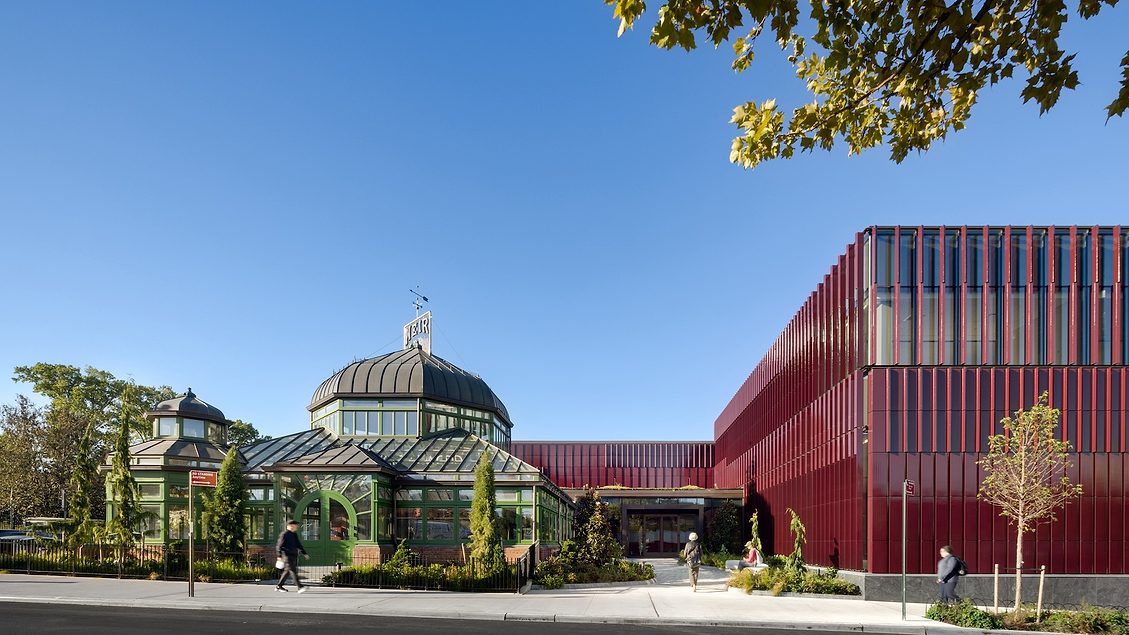
Brooklyn’s Green-Wood Cemetery is a curious place. After all, where else in New York City can you visit a dearly departed love and then immediately view an art installation in the catacombs or catch a modern dance performance staged amid centuries-old tombstones?
The notion of catering to the living just as much as the dead is embedded deep in the DNA of Green-Wood, which was established in 1838 as one of the first rural cemeteries in the United States just four years after Brooklyn was incorporated as an independent city. Spurred by 19th-century Romanticism, the rural cemetery movement served as a forebear to the concept of urban public parks: sprawling, stunningly landscaped tracts that served as both tranquil refuge and outdoor recreation destination for city dwellers. (Work on Central Park, which was heavily influenced by Green-Wood, didn’t kick off until nearly two decades after the cemetery’s debut.)
-Rafael-Gamo_11.jpg "Green-House at Green-Wood Cemetery")
Incorporating a landmarked Victorian greenhouse, the welcomes center is opposite 5th Avenue from the main cemetery gates. Photo © Rafael Gamo
Today, Green-Wood, designated as a National Historic Landmark in 1997, remains both a fully operational burial ground and a picturesque retreat popular with birders, wanderers, and those looking to escape to a pastoral, pre-Olmsted landscape—minus the crowds of New York’s big public parks. Further elevating its role as a vital civic institution, the 478-acre cemetery offers robust visual and performing arts programming that draws visitors from across the five boroughs and beyond. One thing Green-Wood has long lacked, however, is a proper visitors’ hub—a central venue for exhibitions, events, educational initiatives, and more. There now is such a place with this past weekend’s opening of the Green-House, a new “front door” to the cemetery located on the corner of 25th Street and 5th Avenue opposite architect Richard Upjohn’s double-arched Gothic Revival main gates. Designed by Brooklyn-based Architecture Research Office (ARO) with landscaping by Michael van Valkenburgh Associates (MVVA), the 17,000-square-foot, L-shaped building gently wraps a historic 1895 greenhouse that once housed a florist owned by James Weir, a member of a family that had long been active in local horticulture, and who, not surprisingly, is interred across the street.
-Rafael-Gamo_1.jpg)
1
-Rafael-Gamo_7.jpg)
2
Exterior restoration work began on the prominently positioned greenhouse (1) prior to the interior (2), which now serves as a flexible, multipurpose venue. Photos © Rafael Gamo
Topped by a copper-clad octagonal roof, the old Weir greenhouse—a designated New York City landmark and the only surviving Victorian commercial greenhouse in the city—was purchased by Green-Wood in 2012 in a vacant and dilapidated state. The cemetery was intent on saving the leaking, heavily vandalized structure from ruin, restoring it to its original appearance, and eventually, opening it to public use. As the Victorian greenhouse was stabilized and steadily resuscitated, construction on ARO’s $43 million “addition” commenced in May 2023.
“It was really important for the welcome center not to be inside the cemetery, but slightly outside of it to greet visitors,” explained Lisa Alpert, Green-Wood’s senior vice president of development and programming, on a recent tour. Alpert emphasized that since much of the cemetery’s educational and cultural programming is held outdoors, the Green-House helps to extend these offerings into the winter months with indoor options.
-Rafael-Gamo_6.jpg "Green-House at Green-Wood Cemetery")
The lobby is located in a low-slung volume connected to the historic greenhouse. Photo © Rafael Gamo
-Maike-Schulz.jpg "Green-House at Green-Wood Cemetery")
A collections gallery, with exhibition design by C&G Partners, displays just some of the cemetery’s sizable holdings. Photo © Maike-Schulz
-Rafael-Gamo_3.jpg "Green-House at Green-Wood Cemetery")
The lobby’s landscaped rooftop provides a visual connection to the cemetery grounds across the street. Photo © Rafael Gamo
The all-electric building features two ground-floor galleries: a larger exhibition hall for displaying the cemetery’s sizable collection of artifacts and a more intimate “focus” gallery with rotating artworks (on view now is Celadon Landscape, an installation by Jean Shin). There is also a classroom for school groups and community use, a dedicated research facility, climate-controlled archives tucked below-grade, and other visitor amenities including restrooms and ample seating. Plans for burial look-up kiosks and, potentially, food and beverage service are in the works. Accessible through the new building’s welcome hall, the rebuilt 1,600-square-foot greenhouse is now a versatile, light-drenched multipurpose space. “We spent a significant amount of time talking about the programmatic composition of the building and how the greenhouse would be best utilized in a multipurpose fashion, not as an entry point, but as a point that you arrive to after you come in,” explained ARO principal Kim Yao.
Upstairs in the two-story wing of the new building, administrative offices bring together much of the once-scattered Green-Wood staff in a bright open space. A conference room looks out over a lush rooftop landscape that blankets the one-story entrance hall and lobby below. The view extends across the street and up a hill to the cemetery gates, a visual connection that was critical to the design team.
-Rafael-Gamo_14.jpg "Green-House at Green-Wood Cemetery")
Facade detail. Photo © Rafael Gamo
From the street, ARO’s building is inviting and impossible-to-miss, and not too out of scale in this historically blue-collar, architecturally eclectic pocket of Brooklyn’s Sunset Park neighborhood that was once home to a thriving business ecosystem—complete with funeral homes, monument-makers, and florists—centered around the cemetery. Oriented in obvious deference to the historic greenhouse, the new structure is clad in vertical terra-cotta blades, custom glazed in a rich burgundy that accentuates the older building, which itself is done-up in a fresh coat of bright-green believed to be a close match to the original hue used in the late 1800s. The earthy coloring of the new building also references Upjohn’s soaring brownstone cemetery gates. This colorful meeting of the brand-new and newly reborn is bold, with the Green-House proclaiming I’m Alive—but not too loudly as to not offend what Green-Wood calls its “permanent residents” across the street.
“There’s a lot of notable architecture throughout Green-Wood,” said Stephen Cassell, principal at ARO alongside Yao and Adam Yarinsky. “We wanted to have some relationship with it, but also clearly be a modern building.”
-Rafael-Gamo_12.jpg "Green-House at Green-Wood Cemetery")
Photo © Rafael Gamo
The new construction element of the Green-House checks off all the boxes for a modern visitors’ center, and it does so quite nicely. But the star remains the old Weir greenhouse, a beloved neighborhood landmark that, ironically, evaded death thanks to the neighboring cemetery. ARO, in partnership with exterior restoration architect Walter B. Melvin, painstakingly reconstructed the steel-and-glass structure, an effort that included new glazing, framing, and HVAC systems. “It was literally taken apart and put back together again,” said Yao. (ARO’s team focused on the careful insertion of MEP infrastructure that would allow the greenhouse to be utilized.) Set into the brick flooring is a large tile map of the Green-Wood based on a cemetery map from the 1880s. Outside, capping the rehabbed cupola is replica “Weir” signage and a weathervane. The potential uses for the glass-enclosed space are myriad, including private parties and banquets, after-dark film screenings, and art installations, with the acknowledgement that it will always be a touch warmer in the heat of summer and colder in the winter compared to the new building that it now adjoins.
-Rafael-Gamo_10.jpg "Green-House at Green-Wood Cemetery")
Photo © Rafael Gamo
“This building is important because we did not want to add any interventions telling our story within the cemetery grounds, because Green-Wood is not a museum and we wanted to keep the original landscape looking like it is,” said Alpert. “But we wanted to be able to provide a space where the public can come and get the context that will help inform their visits.”
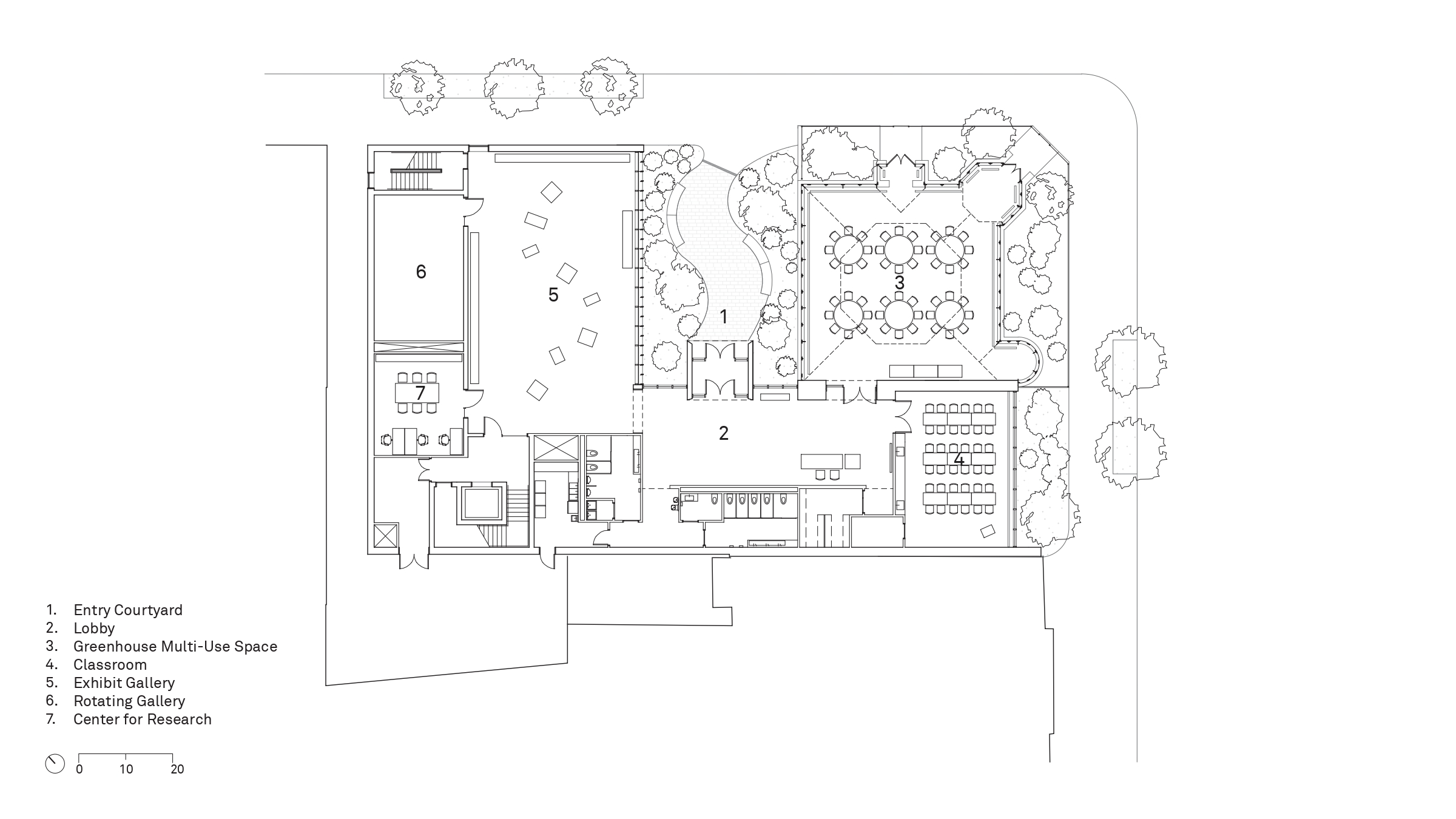
First-floor plan courtesy ARO
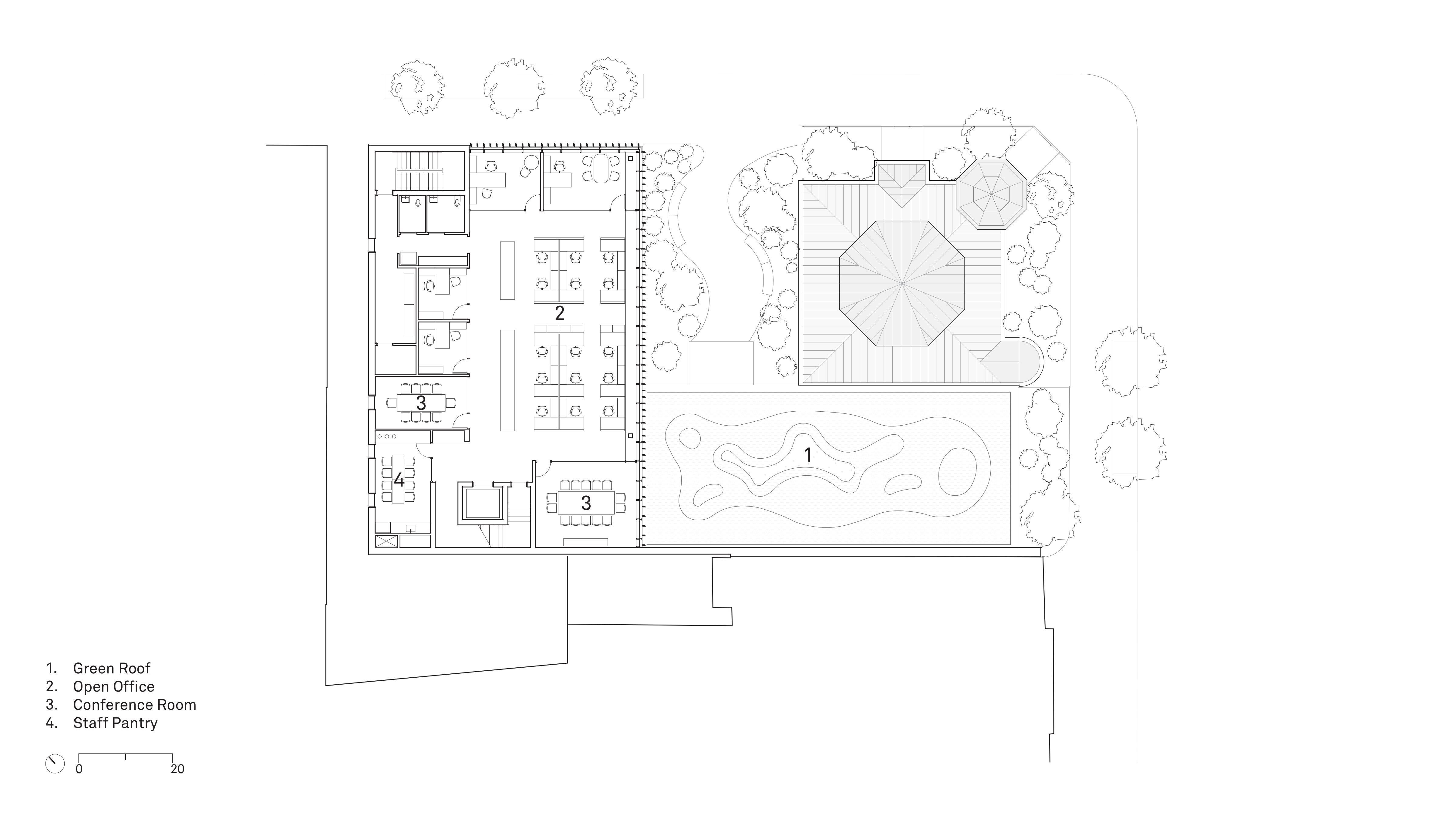
Second-floor plan courtesy ARO