
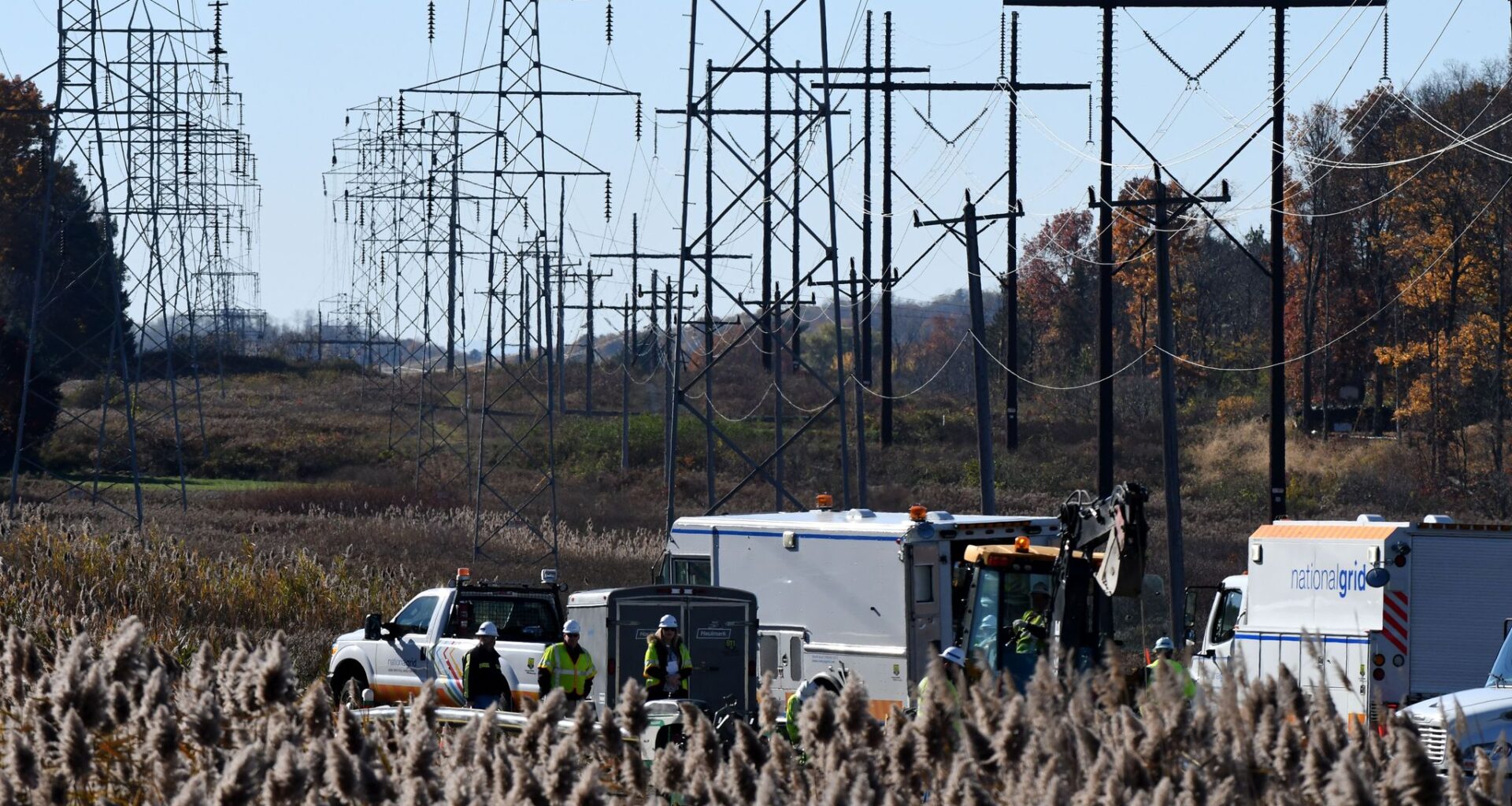
National Grid workers install a replacement gas pipe along North Greenbush Road near a corridor of power lines on Nov. 7, 2016, in North Greenbush.
Will Waldron/Albany Times Union
Electricity powers nearly every part of daily life, from homes to industry, but, because much of it is generated from fossil fuels, it also carries environmental costs. Ahead of Earth Day, new federal data shows which states consume the most and how New York stacks up.

According to the most recent data available from the U.S. Energy Information Administration, New York had the fourth-lowest total electricity use per person in January, at about 651 kWh, coming in behind California, Hawaii and Rhode Island. Total electricity use includes residential, commercial, industrial, transportation and other sectors.
Article continues below this ad
In total electricity consumption over the month, New York ranks ninth among the states, in part because it is the fourth most populous. Texas consumed the most electricity of any state, at 41,531 MWh, more than twice that of California, which ranked second.
By contrast, although North Dakota is among the lowest third of states in total electricity consumption, it has the highest per-person electricity use in the nation at 3,570 kWh, nearly 5.5 times that of New York. The high per-person consumption is driven largely by the state’s small population, energy-intensive industries such as oil and gas extraction and mining, high vehicle miles traveled per person, and its cold climate.
In New York, 39% of electricity use was residential; 59% was consumed by businesses, including commercial and industrial use. (The last 2% was transportation.) The residential sector includes homes and apartments; the commercial sector includes offices, stores, schools, hospitals, restaurants and hotels; and the industrial sector includes facilities used for manufacturing, agriculture, mining and construction.
Article continues below this ad
Make the Times Union a Preferred Source on Google to see more of our journalism when you search.
Add Preferred Source
Related: New Yorkers are paying for a generational grid makeover. What will it deliver?
In New York homes, each resident used an average of 254 kWh of electricity in January, the third-lowest in the country. The state’s housing patterns may help explain this, especially in New York City, where many residents live in multi-unit buildings that use energy more efficiently and, combined with the large population, lower the per-person average. According to the EIA, households in buildings with five or more units use about half as much energy as other homes.
New York is also among the states with the highest average retail electricity prices at 28.66 cents per kWh in January, according to the New York State Energy Research and Development Authority. That’s about $73 per month for someone using 254 kWh, which may also lead people to use less electricity.
Article continues below this ad
Although New York’s per-person use is relatively low, the state still accounts for about 3.5% of the nation’s residential electricity use, ranking among the top states. Compared with other populous states — Texas at 9.6% and Florida at 7.2% — the Empire State uses significantly less residential electricity.
Beyond residential use, business use often accounts for a large share of electricity consumption. New York has the ninth-lowest electricity use per business location, including all establishments with active operations.
Since New York has a heavily service-based economy, with more than 85% of jobs in industries such as health care, education, finance and professional services, 83% of its business electricity use comes from the commercial sector, including heating, ventilation, air conditioning and lighting.
Article continues below this ad
In states with more manufacturing-based economies, such as Iowa, Arkansas and Louisiana, a larger share of electricity use comes from the industrial sector rather than the commercial sector, driven by industries like chemicals, machinery and agricultural production.
As National Grid and other utilities invest more than $4 billion to modernize New York’s grid for upcoming renewable energy projects, manufacturing plants and AI data centers, those costs could raise utility bills by an additional $32 to $64 per household per month by 2030, once the projects are completed.