
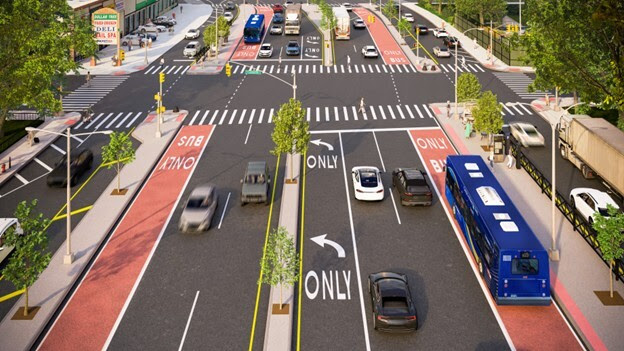
Brooklyn’s Linden Boulevard, one of the borough’s most dangerous corridors, is slated to receive major safety upgrades and new bus lanes by next year, Mayor Zohran Mamdani’s administration announced on Tuesday.
The city Department of Transportation (DOT) will begin installing safety features and center-running bus lanes along the thoroughfare between Fountain and Conduit Avenues in East New York later this year.
The changes are aimed at reducing traffic deaths and injuries along the corridor, where DOT recorded one fatality and 443 injuries between 2021 and 2025. Those dangers come with the road’s current design, which allows drivers to frequently speed, forces pedestrians to cross several lanes of traffic to get from one side to another, and often leaves buses stuck behind double-parked cars.
The DOT classifies Linden Boulevard as a Vision Zero Priority Corridor. That means the road is among those with the highest recorded traffic deaths and injuries in Brooklyn
The overhaul is also intended to boost bus speeds on Linden Boulevard — where they have been recorded moving as slow as 4 miles per hour.
“Redesigning this historically dangerous corridor will make it safer for everyone who has to cross it,” the mayor said. “When we make our buses faster and our streets safer, we’re making a clear choice about the kind of city we want to be: one that puts people first.”
Bus boarding islands, new signals on Linden Boulevard
The safety enhancements coming to Linden Boulevard include eight concrete bus boarding islands, which also function as pedestrian refuges and shortens their crossing distance; new signalized intersections at Pine and Emerald Streets, and five newly closed slip lanes.
DOT Commissioner Mike Flynn framed the redesign as key to Mamdani’s broader goal of speeding up buses citywide — one of the mayor’s central campaign promises.
“Mayor Mamdani has tasked us with delivering fast buses for New Yorkers and our redesign of Linden Boulevard will help deliver on this promise for so many residents in East New York, where these buses are a lifeline to connect to jobs, healthcare appointments and so much more,” Flynn said in a statement. “With the nearest subway a far walk away, residents here must cross 10 lanes of vehicle traffic just to board buses that end up stuck in traffic, behind double-parked cars — that is going to change under the Mamdani administration.”
The agency says its redesign will boost bus speeds on six routes: the B13, B14, B15, B20, BM5 and Q8. It would also better connect riders to six nearby subway lines — the A, C, J, Z, L, and 3 trains — which are all at least a half-mile away, and often farther.
Faster bus service is especially vital along the portion of Linden Boulevard being redesigned, according to DOT, because 54% of residents living around the stretch commute by public transit. At the same time, 57% of nearby households lack access to a private vehicle.
Transit advocates quickly lauded their long-sought overhaul of Linden Boulevard.
Danny Pearlstein, policy and communications director the group Riders Alliance, said in a statement that faster buses could not come to Linden soon enough.
“Linden Boulevard has long failed Brooklynites, combining the dangers of a major highway with slow and unreliable public transit service,” he said. “Starting this year, bus lanes, boarding islands and pedestrian refuges will make the street work better for 60,000 daily bus riders, saving people time and money, increasing safety, and knitting the surrounding communities together.