
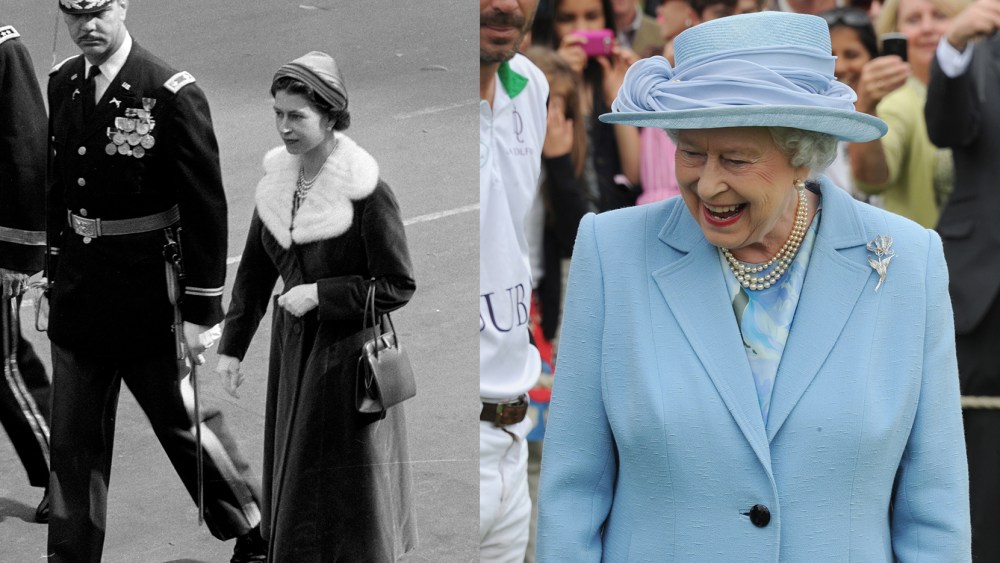
Queen Elizabeth II‘s wardrobe was never considered avant-garde, but it achieved something far more enduring — continuity. Her meticulously curated head-to-toe ensembles, inclusive of her favorite colors, were shaped by four Londoners, who played a key role in crafting her early public persona. Known to fashion, Sir Norman Hartnell, Sir Hardy Amies, shoemaker, Sir Edward Rayne, and milliner Kate Day established the timeless elegance and grace, long associated with British royal fashion, despite any controversies. While the Queen did not live to see her 100th birthday, she and the designers she depended upon left behind a fashion legacy that remains an inspiration.
From her earliest public appearances in the 1930s, Elizabeth II’s fashion choices faced unrelenting media attention. Women’s Wear Daily chronicled her evolution, from budding trendsetter to global icon of modern royal fashion. As a young princess, she made headlines by wearing “grown-up” stockings and a diamond bracelet gifted to her on her 13th birthday. At her mother’s coronation in 1937, she and her sister Princess Margaret captivated audiences in elegant lace dresses.

Norman Norell with model Petrusa Rood, 1965 and Queen Elizabeth II’s Norman Norell wedding dress, WWD, 1947. Getty/Fairchild Archive
By the late 1940s, Elizabeth began adopting contemporary styles, including Christian Dior’s “New Look,” but would ultimately champion British designers. Significant moments in WWD’s timeline highlight her honey-gold engagement ensemble and her wedding dress — which made the cover of the daily in 1948 — both created by London couturier Hartnell. Her ascension to the throne in 1952 brought even greater focus to her wardrobe, often described by WWD as “smart dress.” These refined choices elevated British design and the Queen’s designers to international prominence, setting a lasting standard for royal fashion.
Key milestones in the Queen’s day-to-day life showcased her evolving style. At her 1953 coronation, the intricate fabrics of her gown toured the U.S., symbolizing British craftsmanship to a curious audience. Her 1957 inaugural visit to the U.S. and Canada, as well as state visits in 1974 and 1984, highlighted how her wardrobe served as an extension of her royal duties and landed her on the paper’s best dressed list amongst other celebrities in 1958.
Paying close attention to her designers’ contributions, in 1957, WWD highlighted them in an article titled “They Designed the Royal Wardrobe.”
“They Designed The Royal Wardrobe,” WWD, Oct. 16, 1957. Fairchild Archive/WWD
Hartnell, an enduring favorite, played a pivotal role in transitioning Elizabeth II from the soft “pale pink and powder blue” of her youth to the regal sophistication that defined her reign. His designs also dressed other royals, including the Queen Mother and Princess Margaret.
Amies, another cornerstone of the Queen’s style evolution, began designing for her in 1951 while she was still Princess Elizabeth. A Savile Row tailor, Amies and the house bearing his namesake masterfully redefined the Queen’s daytime and eveningwear into the early 2000s.
Hardy Amies, photographed for DNR, 1985 (left) and Queen Elizabeth II in a gown by Hardy Amies attends her silver jubilee gala, London, 1977. Fairchild Archive/WWD
Rayne, her trusted shoemaker, gained acclaim for the comfortable footwear that became fixtures in her wardrobe before her aging adult years. Mayfair milliner Day, known as the “Queen’s milliner,” earned recognition for designing iconic hats, including the more kitsch ones worn during her 1957 North American tour.
For their contributions, Hartnell, Amies and Rayne were later knighted by Queen Elizabeth II in recognition for their significant impact on royal fashion and London’s rise as an international fashion hub. Day was the only milliner to receive a royal warrant in the first years of the queen’s reign. For each of these designers, keeping the queen’s iconic style in the forefront kept their legacies inseparable from royal elegance.
Throughout her 70-year reign, from her 1953 coronation to her final appearances, Queen Elizabeth II’s wardrobe reflected her role as monarch while pioneering the definition of royal style. Her deliberate fashion choices served to bridge tradition and modernity, making her an enduring, yet unexpected style icon. As documented by WWD through the decades, Queen Elizabeth II’s fashion choices paid tribute to British design while shaping perceptions of royal elegance, honoring history and individuality with authenticity and grace.