
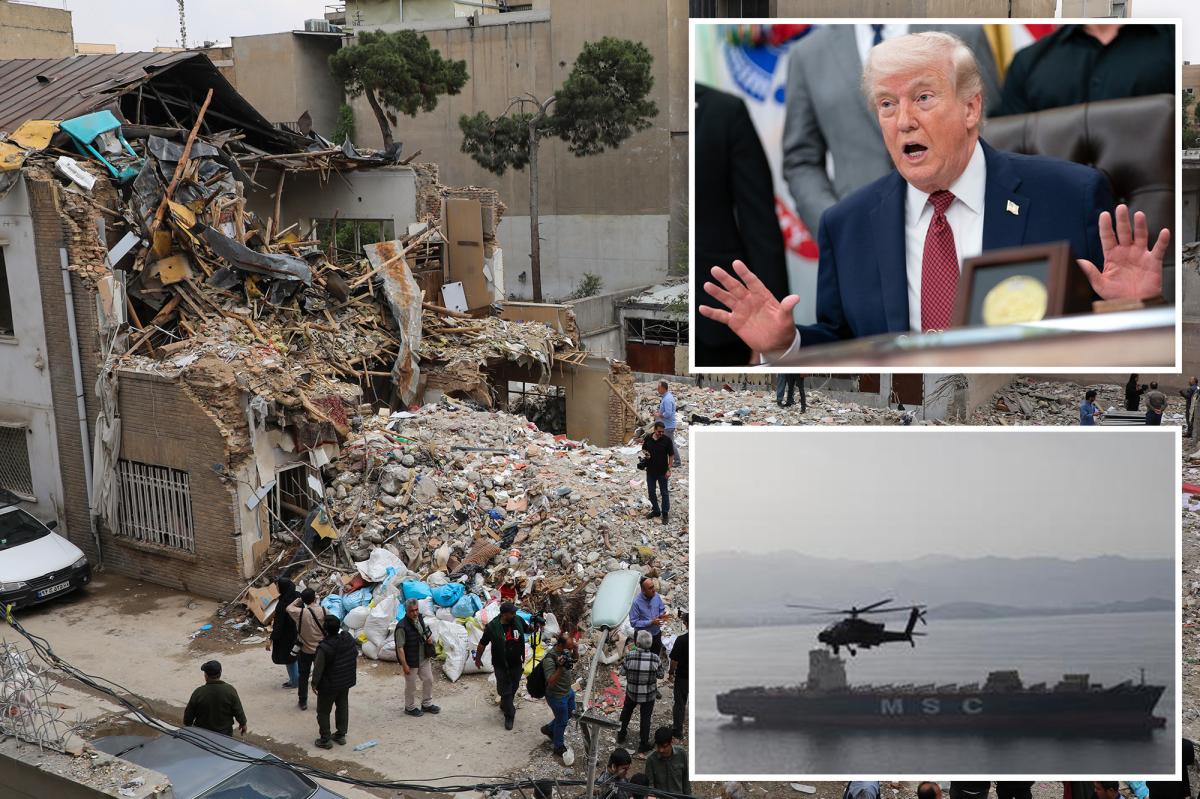
WASHINGTON — President Trump extended his cease-fire with Iran Tuesday afternoon — after an American negotiating team led by Vice President JD Vance delayed plans to travel to Pakistan for a second round of peace talks.
“Based on the fact that the Government of Iran is seriously fractured, not unexpectedly so and, upon the request of Field Marshal Asim Munir, and Prime Minister Shehbaz Sharif, of Pakistan, we have been asked to hold our Attack on the Country of Iran until such time as their leaders and representatives can come up with a unified proposal,” Trump wrote on Truth Social.
“I have therefore directed our Military to continue the Blockade and, in all other respects, remain ready and able, and will therefore extend the Ceasefire until such time as their proposal is submitted, and discussions are concluded, one way or the other.”
President Trump extended his cease-fire with Iran Tuesday afternoon. MediaPunch / BACKGRID
The open-ended cease-fire extension followed heavy speculation about whether fighting would resume when the truce’s original two-week duration lapsed Wednesday.
Vance arrived at the White House shortly before 1 p.m. Tuesday as doubts grew that he would travel as planned to Islamabad for negotiations. It’s now unclear when he might make the 17-hour flight.
Special envoy Steve Witkoff and Trump son-in-law Jared Kushner also were expected in the Pakistani capital, but instead traveled from Miami to the White House for afternoon meetings.
Iran had not told mediators if it would send representatives, a Pakistani source told The Post, stalling the US delegation’s trip.
Iran’s government is believed to be divided between hardliners associated with the Islamic Revolutionary Guard Corps, which is closely associated with the ruling Khamenei family, and more moderate leaders, such as President Masoud Pezeshkian.
Negotiators ultimately are accountable to the supreme leader, though his whereabouts are unknown and US officials believe reaching him directly by phone is out of the question, adding further complexity to detailed discussions.
Mahdi Mohammadi, an adviser to Iran’s parliament speaker and negotiator Mohammad Bagher Ghalibaf, ripped Trump’s announcement on X and suggested attacks could begin regardless.
“Trump’s ceasefire extension means nothing. The losing side cannot dictate terms,” Mohammadi wrote.
“The continuation of the siege is no different from bombardment and must be met with a military response. Moreover, Trump’s ceasefire extension is certainly a ploy to buy time for a surprise strike. The time for Iran to take the initiative has come.”
Iran’s permanent representative to the United Nations, Amir-Saeid Iravani, told journalists Tuesday, ahead of the cease-fire extension, that the regime’s team is ready to meet if Trump ends his blockade of Iranian ports.
The cease-fire extension followed a day of heavy speculation about whether the war would resume when the truce expired Wednesday. Getty Images
“As soon as they block this blockade, I think that the next round of the negotiation will take place in Islamabad,” Iravani said in footage posted to X by AlAraby TV journalist Nabil Abi Saab.
“If they want to sit [at a] table and discuss and find [a] political solution, they will find us ready. If they want to go to the war, in this case also, Iran is ready,” he added.
Vance, Witkoff and Kushner previously held about 21 hours of talks with Iranian officials in Islamabad on April 10-11, but went home without a deal.
Following those talks, Trump blockaded Iranian ports in an attempt to strong-arm the other side into agreeing to his core demands — topped by ending nuclear enrichment and relinquishing near-weapons-grade uranium.
Start your day with all you need to know
Morning Report delivers the latest news, videos, photos and more.
Thanks for signing up!
Trump claimed last week that Iran had agreed to stop enriching uranium and to hand over an estimated 1,000 pounds of deeply buried “nuclear dust.”
Iran publicly denied making those concessions — leading to speculation that Iranian negotiators over-promised or that communications were relayed imprecisely by Pakistani mediators.
The US military on Sunday attacked and seized the Iranian cargo ship Tosca for violating Trump’s blockade, adding additional uncertainty to diplomatic efforts.
Negotiations have been beset by doubts about whether Iranian diplomats are able to speak with authority for their nation’s leadership. The concern existed too before joint US-Israeli airstrikes began on Feb. 28.
Trump said in a Tuesday morning interview with CNBC that he plans to resume bombing if there’s no deal by the time the cease-fire ends Wednesday. EyePress News/Shutterstock
Supreme Leader Mojtaba Khamenei has not been directly seen or heard from since succeeding his father and the powerful Islamic Revolutionary Guard Corps is believed to oppose the perception of caving to US demands.
Iran was repped in the first round of talks in Pakistan by Foreign Minister Abbas Araghchi and Ghalibaf.
“Blockading Iranian ports is an act of war and thus a violation of the ceasefire,” Araghchi tweeted Tuesday. “Striking a commercial vessel and taking its crew hostage is an even greater violation. Iran knows how to neutralize restrictions, how to defend its interests, and how to resist bullying.”
Trump kept the cease-fire in place despite saying in a Tuesday morning interview with CNBC that he planned to resume bombing if there was no deal by Wednesday.
“I expect to be bombing because I think that’s a better attitude to go in with,” Trump told the financial network’s “Squawk Box” program. “We’re ready to go. The military is raring to go.”
The conflict has lasted for 53 days and the War Powers Resolution of 1973 says congressional approval is needed within 60 days. The White House argues that the law is unconstitutional, but it could nonetheless underpin legislative debates about war funding.