
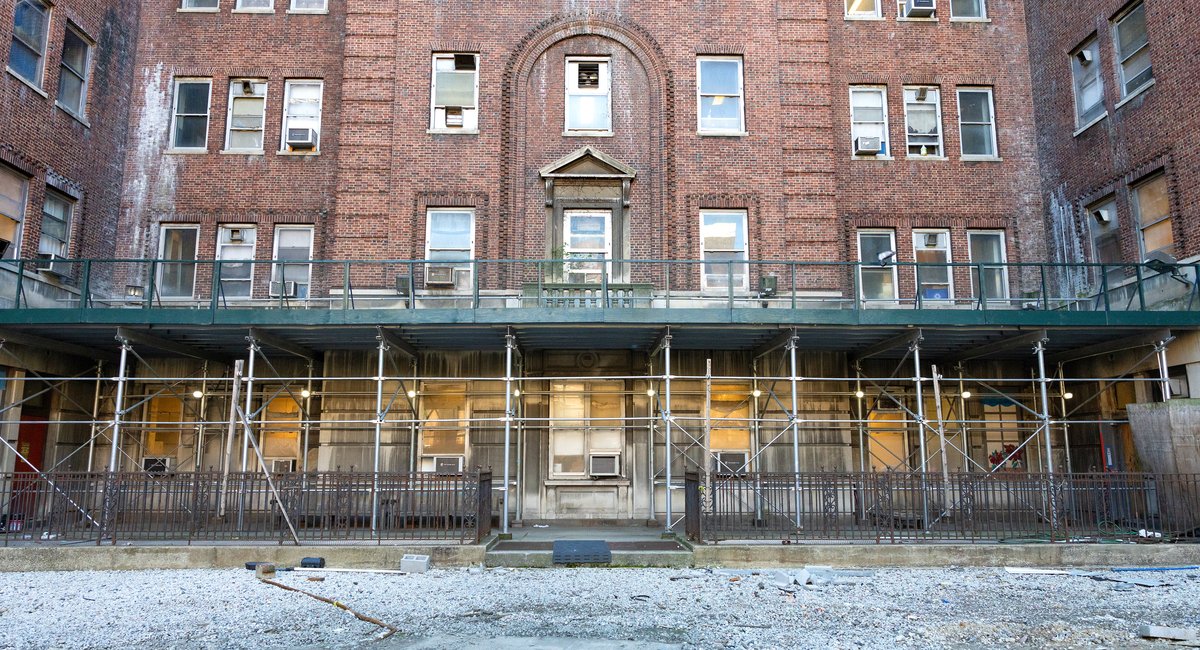
In the underbelly of the nearly 100-year-old men’s homeless shelter in Midtown set to shutter next month, chunks of plaster are missing from the walls, columns and beams are so corroded they’re filled with holes, and parts of the floor are sinking.
“This didn’t happen overnight. This is over decades,” said Joseph Piwowarski, associate commissioner at the city’s Department of Design and Construction.
City officials gave Gothamist a rare look inside the massive facility on 30th Street known as Bellevue, allowing a reporter and photographer inside several floors of the decrepit structure that once sheltered as many as 850 men and for decades served as the first stop for homeless New Yorkers needing a place to sleep.
Pigeons rest in the abandoned auditorium at the recently closed Bellevue Men’s Shelter.
Aristide Economopoulos for Gothamist
The nine-story brick fortress was built in 1931 and used to be Bellevue’s psychiatric hospital.
Mayor Zohran Mamdani said the building, which spans a whole city block, is falling apart and no longer structurally sound. The closure is part of the city’s broader plan to create better living conditions for the city’s homeless residents and move away from larger, institutional facilities that can dissuade New Yorkers sleeping on the street from coming inside.
A dorm room on the 7th floor.
Aristide Economopoulos for Gothamist
The shelter is empty. About 250 homeless men have already been moved to other sites in Brooklyn. The city’s intake services for men will relocate to 8 East Third St. and families without children will go to 333 Bowery starting May 1.
The original lobby of the Bellevue Psychiatric Hospital.
Aristide Economopoulos for Gothamist
What used to be the psychiatric ward’s entrance, but is now where intake services take place, still has its original terrazzo floors. City officials believe there may be murals that were painted over before the building was retrofitted into a shelter, and are seeking to preserve those murals.
The solarium’s celling is falling.
Aristide Economopoulos for Gothamist
Inside the 400,000-square-foot building, whole sections that aren’t structurally sound are cordoned off to keep people safe.
An old, abandoned auditorium has been unused for years, though pigeons have made a home inside.
The hospital’s former solarium is also not in use, with exposed wiring and pipes and large portions missing from the ceiling.
”There are a number of these spaces where they were not usable to begin with,” Piwowarski said.
Metal supports help support the celling on the ground floor.
Aristide Economopoulos for Gothamist
Piwowarski said more than a quarter of the building has long been abandoned and is unused, including floors that were closed to residents due to safety concerns.
The building’s steam and plumbing systems are past their lifespans and often leak. And given the building is nearly 100 years old, there’s likely asbestos and lead throughout, Piwowarski said.
Former mayors have tried to shutter Bellevue. The Bloomberg administration proposed turning the site into a luxury hotel and conference center, but abandoned those plans after pushback from advocates. In the late 1990s, then-Mayor Rudy Giuliani tried to convert the site into an upscale assisted living facility.
The hallway outside dorm rooms on the 7th floor.
Aristide Economopoulos for Gothamist
Piwowarski said city officials have determined the building is unsafe and should be vacated. He said the scope of the building’s instability is too widespread to be repaired while people are still living in the upper floors.
Bellevue is notorious among homeless New Yorkers, who often complained about violence and drug use at the large facility. It was also among the reasons why so many were scared to return to the shelter system: All men needing a bed stayed at Bellevue temporarily until they were assigned to another shelter.
The shelter is located at the old Bellevue Psychiatric Hospital on First Ave. between E. 30th and E. 29th Streets.
Aristide Economopoulos for Gothamist
On the seventh floor, where up to 89 men slept in the northeast wing of the building, anywhere from one to 12 people were assigned to each room. The hallways are clean and there’s no peeling plaster or crumbling floors or ceilings.
City officials said though the building’s infrastructure is decaying — with part of the building on timber piles — spaces for the residents have remained safe. If they’re not, they’ve been closed off, officials said.
The building lacks cooking facilities, only ovens to warm meals that are delivered. There are few common areas aside from tables where residents can eat.
A mural outside by the front courtyard.
Aristide Economopoulos for Gothamist
Visible from the windows is black netting along the exterior that holds parts of the building’s facade from crumbling and falling.
“It’s essentially keeping the walls of the corners of the ninth floor from splaying out open into the street,” said Piwowarski.
City officials say Bellevue will be redeveloped, but it’s unclear what the site will become or whether it will eventually reopen for homeless residents.
The city is hoping to build an intake facility that is better designed to meet the needs of homeless New Yorkers. It recently opened a brand-new intake shelter for single women that includes a computer lab, lactation room, art therapy room, gardening area and full-service kitchen.