
In the whirlwind of housing court, it’s not uncommon for tenants without a lawyer to come out of a hearing in confusion about what just happened in their case.
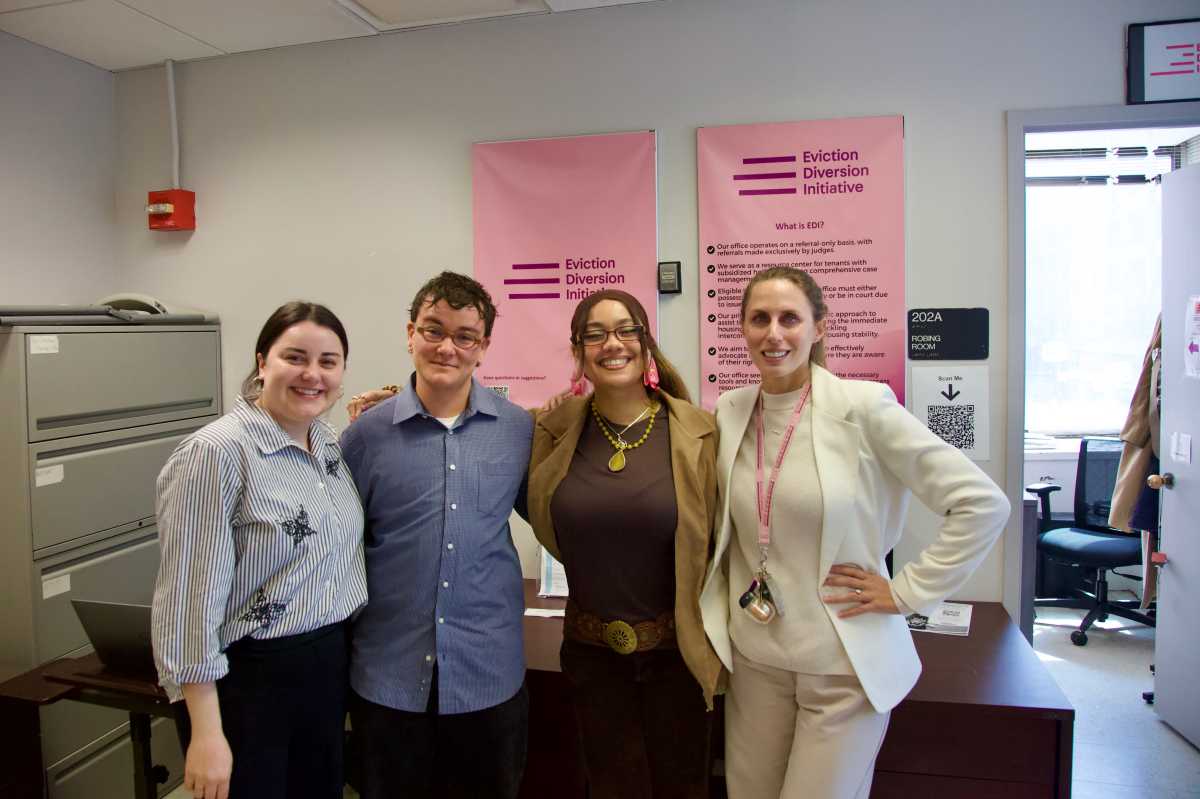
Enter the Eviction Diversion Initiative, a shoebox-sized office nestled in the corner of the chaotic waiting area of Brooklyn’s Housing Court, where any tenant navigating rent subsidies can get away, have a snack and debrief. There, a program advocate will hear them out and try to diagnose the root cause of their issue.
“EDI has kind of been the fairy godmother in housing court,” said Priscila Auffant, the program’s deputy director.
Its purpose is to help tenants avoid evictions that are the result of administrative errors that cause rent subsidies to underpay, lapse or be delayed — all issues that can prompt a landlord to seek remedy in housing court.
As a result, EDI’s operations provide a window into what is not working underneath the surface of the city’s housing programs.
“Shockingly we ended up with the majority of our cases being folks with CityFHEPS,” said Viviana Gordon, Director of Housing Justice Initiatives.”
Advocates look to be voice for voiceless tenants
 Auffant sits at her desk inside EDI’s Brooklyn office.Photo by Max Parrott
The initiative sits at the intersection of housing policy issues. Though they mainly work with low-income or income-restricted tenants, fewer than 20% of their clients actually have a housing attorney through the citywide right-to-counsel program that guarantees them one.
Of the approximately 300 tenants that participated in EDI in Brooklyn, around 60% were CityFHEPS recipients, and a majority of participants ended up in the program after they have already seen a judge and entered a settlement or received a judgment.
But when the payment issues are rooted in lapsed subsidies, a tenant’s problems straddle the court system and municipal government. The small team behind the program helps to escalate cases within the relevant agency to flag what went wrong and what needs to be paid to keep them in their home.
“We’re that facilitator… that is bridging the gaps that people aren’t aware are there,” Auffant said. “The tenant is frustrated because they don’t know how to navigate all these systems — housing court, CityFHEPS. The landlord’s attorneys are frustrated because they’re having to come to court.”
The Center for Justice Innovation, the state court system’s nonprofit community programming, recently announced that it’s expanding the initiative from its pilot in Brooklyn Housing Court and Suffolk County District Courts to the Bronx, Manhattan, and Queens, as well as upstate to Rochester and Syracuse.
That means that the three new borough-based will get offices like that in Brooklyn, focused on troubleshooting subsidies like CityFHEPS.
An ‘overwhelming’ battle for vouchers
Kerry, a Brooklyn resident who asked to be identified by first name only, had come to EDI after she didn’t receive paperwork in the mail to renew her CityFHEPS application, and her payments lapsed. She said her landlord was used to getting delayed payments in batches, so it wasn’t immediately clear that her case had been closed.
By the time she found herself in court, she had rental arrears for over a year. She appealed to the city’s office of Human Resources Administration, the agency that oversees CityFHEPS, but said an administrator simply told her that her subsidy had been discontinued and that her case would be dismissed.
“It was overwhelming,” she said.
Auffant helped Kerry assemble her paperwork and create a timeline of the arrears that they needed to be paid through the subsidy. By the end of the process, she said that Kerry was taking the lead in talks with her landlord’s attorney to resolve her case, and even advocate for repairs that needed to be made in her apartment.
“Knowing that you’re not alone in the process makes a difference, and it gives you that additional confidence,” Kerry said.
Unlike the Section 8 subsidy, which had its own housing court section, there’s no automatic process of notifying a judge when a tenant is receiving a voucher so it often comes up later on in court proceedings. It’s then up to the judge to refer the tenant to EDI.
The ever-expanding CityFHEPS program now covers more than 67,000 households, a more than 200% growth since its launch, and the Mamdani administration is facing a difficult fiscal position of whether it can abide by a City Council mandate to expand the program’s eligibility criteria.
But as the program has grown so has administrative scrutiny. A state comptroller’s audit found that payment and other administrative delays troubled the program. In EDI’s experience, the majority of arrears from CityFHEPS tenants continue to stem from administrative issues and errors, including unprocessed or incorrectly processed renewals or modifications.
Neha Sharma, a spokesperson for the Department of Social Services, said the administrative errors were “anomalies” in a landscape where a majority of households relied on CityFHEPS over other rental subsidies to move out of a housing shelter.
“The agency has implemented numerous policy, process, and technological enhancements over the last several years, and the results of these efforts are clear,” Sharma said. “Today, the agency is administering CityFHEPS for more than 150,000 New Yorkers who continue to stay stably housed which is a testament to the effectiveness of our wide-ranging efforts.”
Gordon said that the court doesn’t track the number of CityFHEPS recipients that end up in housing court, so they have no way of knowing what fraction of the total number have used their services. One thing she hopes EDI can accomplish through “good casework” is to help HRA understand where the administrative breakdowns are happening. As the program expands to more borough, it’s sure to continue mapping gaps in the city’s administrative processes.
“I love doing it here in Brooklyn, and I’m going to cause some good trouble in the other housing courts,” Auffant said.