
New York City Council Speaker Julie Menin warned Wednesday morning that if Mayor Zohran Mamdani vetoes the council’s legislation intended to regulate protests at religious and educational sites, the city will face “more divisiveness,” calling the decision a critical test for the mayor.
The bills, which include measures to create standard NYPD policy for deploying buffer zones during protests at educational and religious facilities, face a potential veto as Mamdani has repeatedly declined to take a stand on the issue. He has acknowledged concerns against the legislation from left-wing activists and civil rights groups who have targeted synagogues and yeshivas with anti-Israel demonstrations, and has until the end of this week to veto the bills or they become law automatically.
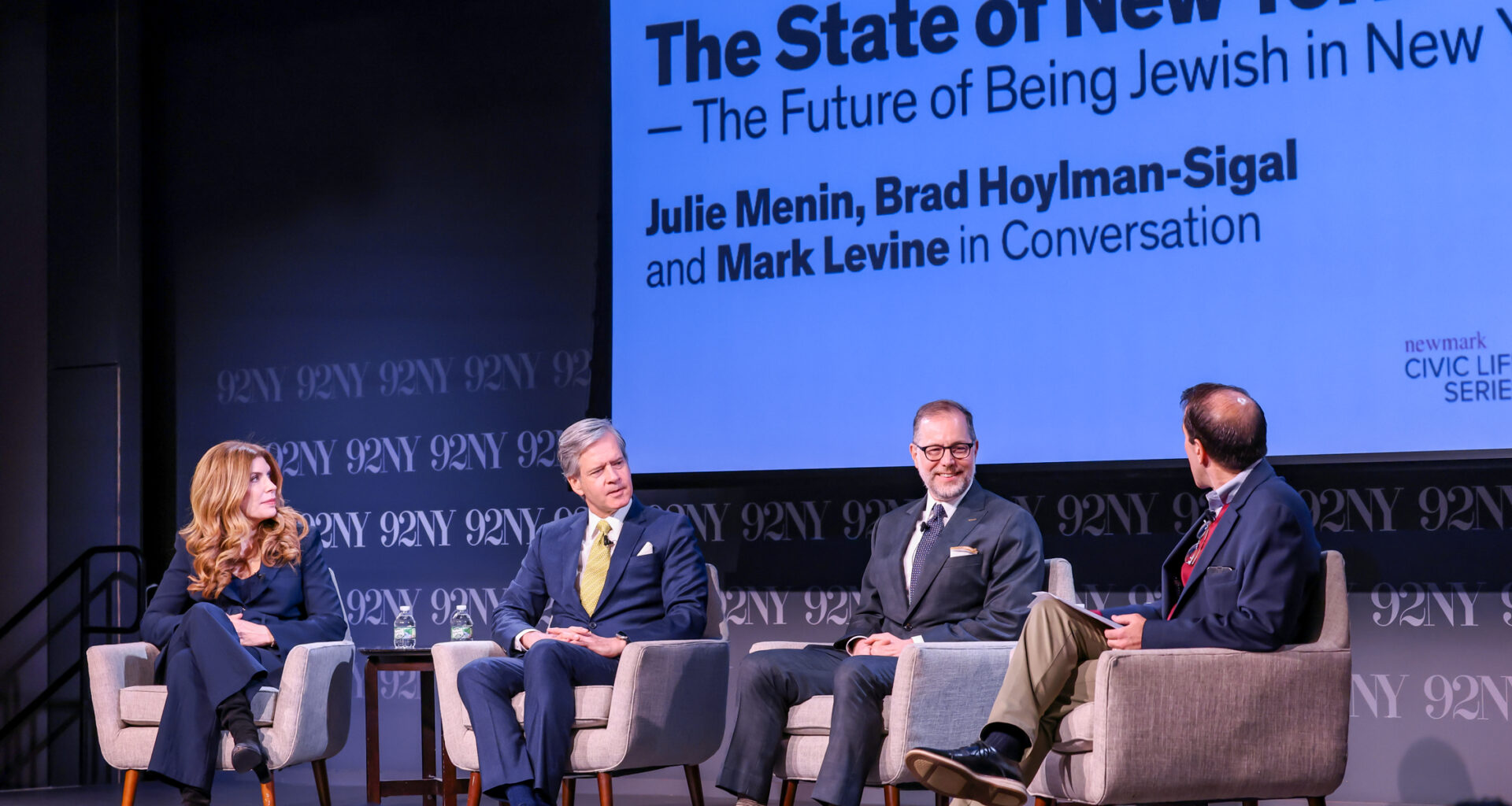
“We need less divisiveness. I really hope — and I’ve said this to the mayor — that there is not a veto of the package of bills. That’s necessary. It will create much more division,” Menin said during a panel discussion at 92NY on “the future of being Jewish in New York,” featuring the city’s most senior Jewish elected officials: Menin, who is the first Jewish council speaker, Comptroller Mark Levine and Manhattan Borough President Brad Hoylman-Sigal.
The panel, moderated by 92NY CEO Seth Pinsky, comes as the city has experienced historic levels of antisemitism in the wake of the Oct. 7, 2023, terrorist attacks — and as Jews navigate a tense relationship with a mayor who has held hostile views towards several key communal issues. New York City has the largest population of Jews outside of Israel.
Asked by Pinsky what advice each would give to Mamdani to try to reassure the roughly 70% of the Jewish New York City electorate that did not vote for him, Hoylman-Sigal called on Mamdani to “follow the tradition of every mayor preceding him [since 1951] and visit Israel.”
He added that Mamdani already has some “really good Jewish advisors,” including Phylisa Wisdom, a progressive Jewish leader Mamdani tapped in February to run the Mayor’s Office to Combat Antisemitism. A range of Jewish Democratic politicians and advocates had lauded Wisdom’s selection, though she has alienated some Orthodox and Hasidic Jewish leaders over her work criticizing the secular education taught at yeshivas in the past.
Hoylman-Sigal’s assertion that the mayor’s heart “is in the right place” when it comes to the Jewish community was met with a chorus of “boos” from the audience.
Addressing the city’s long-standing Israel bonds investments, which Mamdani has called to end in a key source of tension for him and Levine, Levine said the investments “are not political [and] shouldn’t be political.”
“Israel bonds have never missed a payment in 70 years,” said Levine. “And by the way, we’ve had no protests about our investments in Saudi Arabia, our investments in Pakistan or China.”
All three Jewish leaders echoed the sentiment that despite a turbulent past few years, the New York City Jewish community remains resilient, and urged New Yorkers not give into the rising calls to decamp to Florida.
“Absolutely stay in New York,” said Menin. “This is not a time to lose hope. Hopefully the three of us here can embody the future of the commitment to fighting antisemitism, the commitment to supporting the Jewish community. This is a time to lean into it as opposed to shy away from it. New York is a city that has been a beacon of inclusion and tolerance; we need to make sure that it stays that way.”
“I believe the Jewish community in New York City is stronger than it’s ever been,” said Levine, who praised Mamdani’s decision to retain former Mayor Eric Adams’ NYPD commissioner, Jessica Tisch, who is Jewish and openly identifies as Zionist.
“In many synagogues, attendance is way up. Jewish New Yorkers are active in ways they haven’t been. We’ve seen new coalitions come together … This engagement gives me real hope for the future,” continued Levine.
“My wish looking forward to the next 25 years is that we see a community that fought — that didn’t move to Miami with its bad bagels — and that we kept this story going of what is really one of the most glorious Jewish communities.”