
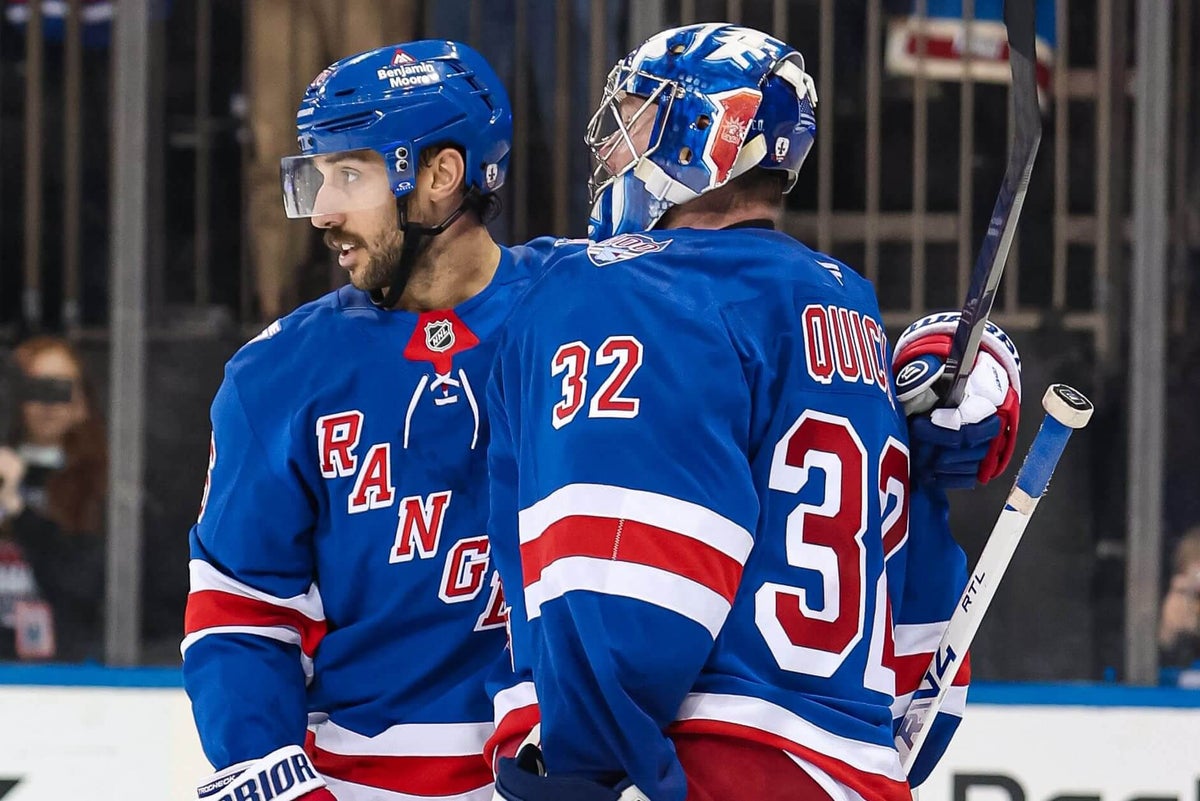
Though the NHL playoffs are just getting underway, the New York Rangers have already headed home for their second straight long summer.
The offseason will be filled with questions for a team that plans to “retool,” not rebuild, as Rangers president Chris Drury told fans in his Jan. 16 letter. Exactly how he plans to do that is less clear. At the very least, he’ll have ample room to maneuver. Our most recent salary-cap projection had New York with around $27.5 million in available space, with factors in play that could push that number well over $30 million.
How will Drury use it? That’s to be determined in the coming months, but these 10 questions will shape the future of a downtrodden roster:
1. What happens to Vincent Trocheck?
All of our reporting suggests he’s the most likely Blueshirt to be traded, which Trocheck seemed well aware of at breakup day. Many reporters said the same thing leading up to the trade deadline (us included), but the Rangers made a calculated gamble they’ll have a better chance of getting what they want during the offseason — namely a young, NHL-ready player with upside as the centerpiece of the deal. Even the usually tight-lipped Drury hinted at that Friday, noting deadline offers were restricted by “limited buyers (and) limited cap space.” He believes the market will expand this summer, at which point he’ll again try to use the 32-year-old center — whose 12-team no-trade list will shift to 10 on July 1 — as his primary trade chip to move the retool along. — Vincent Z. Mercogliano
2. Who else could get traded?
Braden Schneider is another name we’ll be monitoring closely. The Rangers talked to multiple teams about the 24-year-old defenseman before the deadline and will enter the summer with a good idea of where his market stands. He’s valued within the organization for his defense-first mindset and high character, but with so few movable assets, there’s recognition they should at least consider capitalizing on other teams’ thirst for big young right-shot D. Drury is believed to be seeking a scoring forward, according to two league sources, with the San Jose Sharks among the forward-rich, defense-needy teams to watch.
Another option could be keeping Schneider and trading fellow right-handed defenseman Will Borgen, whose no-trade clause will change to a 15-team no-trade list July 1. But Borgen, who’s five years older than Schneider, would likely net a lesser return.
Alexis Lafrenière’s strong finish should increase his chances of sticking around — the Rangers need to add top-six forwards, not subtract them — but it could also renew interest around the league. If a top target becomes available, I wouldn’t rule the 24-year-old winger out as part of a bigger trade.
Other than that, Drury doesn’t have many appealing players without trade protection to dangle. I could see him offloading one of his young, bottom-sixers to clear room on the roster — maybe Brett Berard or Adam Edström, who both seemed to fall out of favor this season — but there’s not a whole lot to work with outside of Trocheck, Schneider and possibly Lafrenière. — Mercogliano
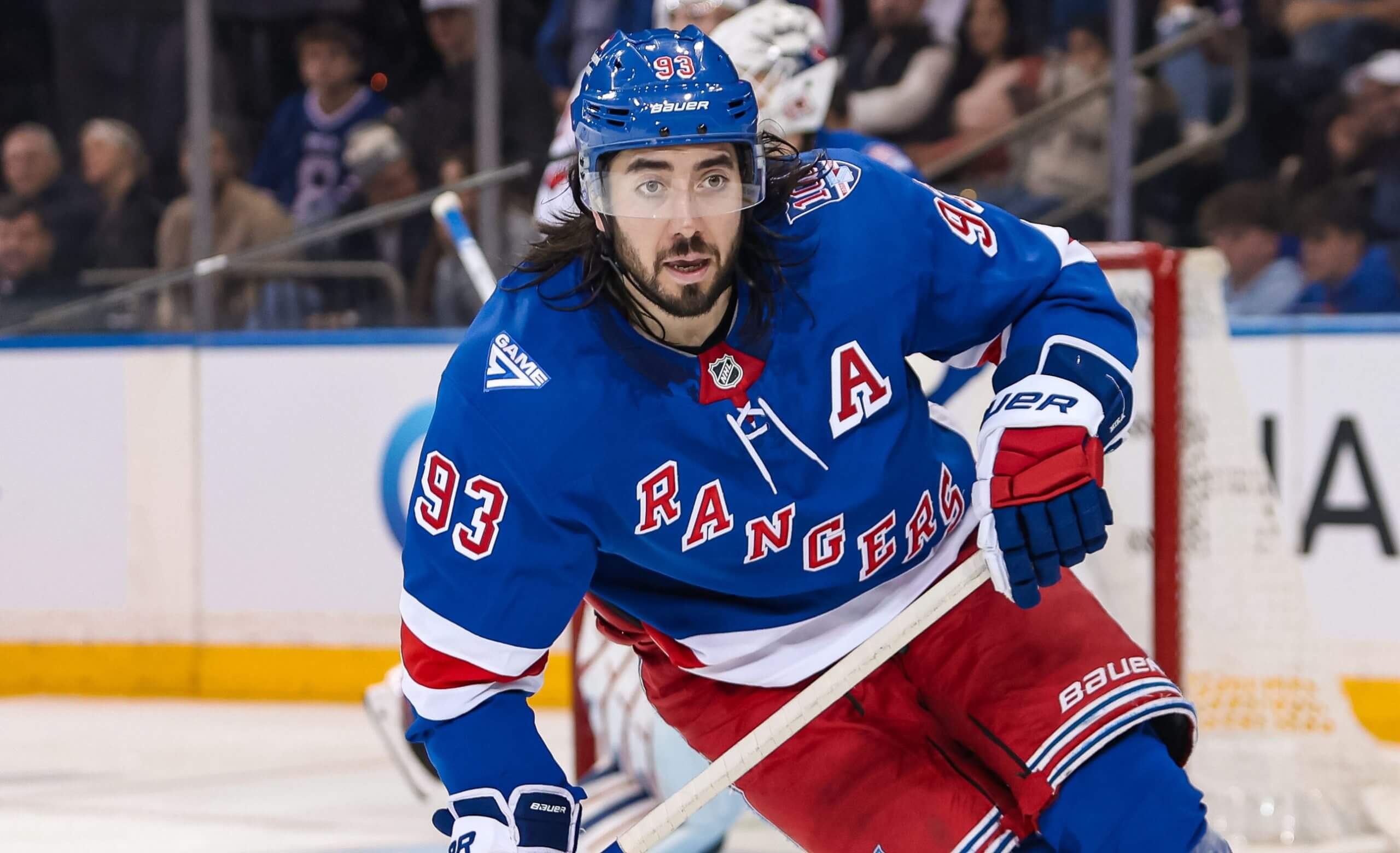
Though many Rangers are heading into the summer with uncertain futures, center Mika Zibanejad made it clear he wants to be part of the team’s future. (Danny Wild / Imagn Images)
3. Is anyone untouchable?
Some Rangers players can choose whether they are untouchable. Igor Shesterkin, Mika Zibanejad, Adam Fox, J.T. Miller and Vladislav Gavrikov all have no-movement clauses. Zibanejad expressed a firm commitment on breakup day — “I want to be here to turn this around,” he said — and Adam Fox seemed encouraged by “promising signs” to end the season. Chances are all five no-movement clause players are back, especially considering the Rangers are aiming for a retool and not a rebuild.
Gavrikov, signed last summer to a seven-year deal, watched the Rangers trade his close friend Artemi Panarin, and he conceded earlier this year the team’s direction has been different from what he expected. All of that has perhaps made his transition a little rockier than he’d have liked, but there are too many complications for a move to be likely. He’d have full say over his destination with the no-movement clause, and why would the Rangers want to trade their No. 2 defenseman if they’re trying to turn things around quickly?
Gabe Perreault is likely the most untouchable of the non-no-movement clause players. New York desperately needs young skill, and he is its top prospect. It’s also hard to see New York moving its top-five pick in this coming draft, given the state of its prospect pool. The team also has other young forwards such as Will Cuylle and Noah Laba, whom it would likely move only if absolutely needed to trade for a superstar. — Peter Baugh
4. How aggressive will Chris Drury be in adding players?
He wants to be, but what’s realistic? Because of extensions around the league (Connor McDavid, Kirill Kaprizov, Jack Eichel, Martin Nečas), the free-agent market has thinned from star-studded to one highlighted by Darren Raddysh, Alex Tuch and Anthony Mantha. Tuch, who turns 30 next month, fits Drury’s hard-to-play-against vision — he’s 6 feet 4, has scored 30-plus goals in three of the past four years and plays with an edge — but Buffalo could still work out an extension with him.
The trade market is the other route for aggressiveness. The Rangers would presumably love for a star player such as Auston Matthews or Brady Tkachuk to become available. But even if someone of that ilk does, would New York have the assets to trump other teams’ packages? Tkachuk and Matthews, who have no-movement clauses, are under contract through 2027-28, so the Ottawa Senators and Toronto Maple Leafs have plenty of leverage, at least this summer. Of pending restricted free agents, the Dallas Stars’ Jason Robertson and Vegas Golden Knights’ Pavel Dorofeyev could be attractive trade targets given their teams’ tight cap situations. It’s hard, though, to see Dallas letting Robertson go unless it absolutely can’t make anything work. The Stars will probably have to move contracts to make room for his raise.
In short, aggressive moves will be complicated for Drury to pull off, especially via trade. First, a star will have to become available, and second, the Rangers must outbid other potential suitors that could have richer prospect pools. Supplementary moves might end up being the route Drury has to go. — Baugh
5. Is top six or bottom six a bigger priority?
According to Drury and coach Mike Sullivan, it’s surprisingly the latter.
“I think there might be some opportunities to improve our bottom six at the forward position, where players might be able to play certain roles that could allow us to take some of our core players out of situations,” Sullivan said Friday.
Finding ways to preserve veterans such as Miller and Zibanejad, who both turned 33 this year, isn’t a bad idea, but the best way to ease their burden would be by infusing the lineup with much-needed play drivers. Panarin has been traded to the Los Angeles Kings, and Trocheck is likely on his way out, as well, leaving two gaping holes in a top six that already had one or two.
The Rangers are flush with bottom-six options. Could they upgrade a couple of those spots? Sure, but moving the retool needle will require forwards who can score at a high rate and go head-to-head with the best players in the league.
Of course, as Peter detailed, finding true top-six talent will be easier said than done. That might explain why Drury and Sullivan are hedging, rather than creating expectations for a big move they might not be able to follow through on. — Mercogliano
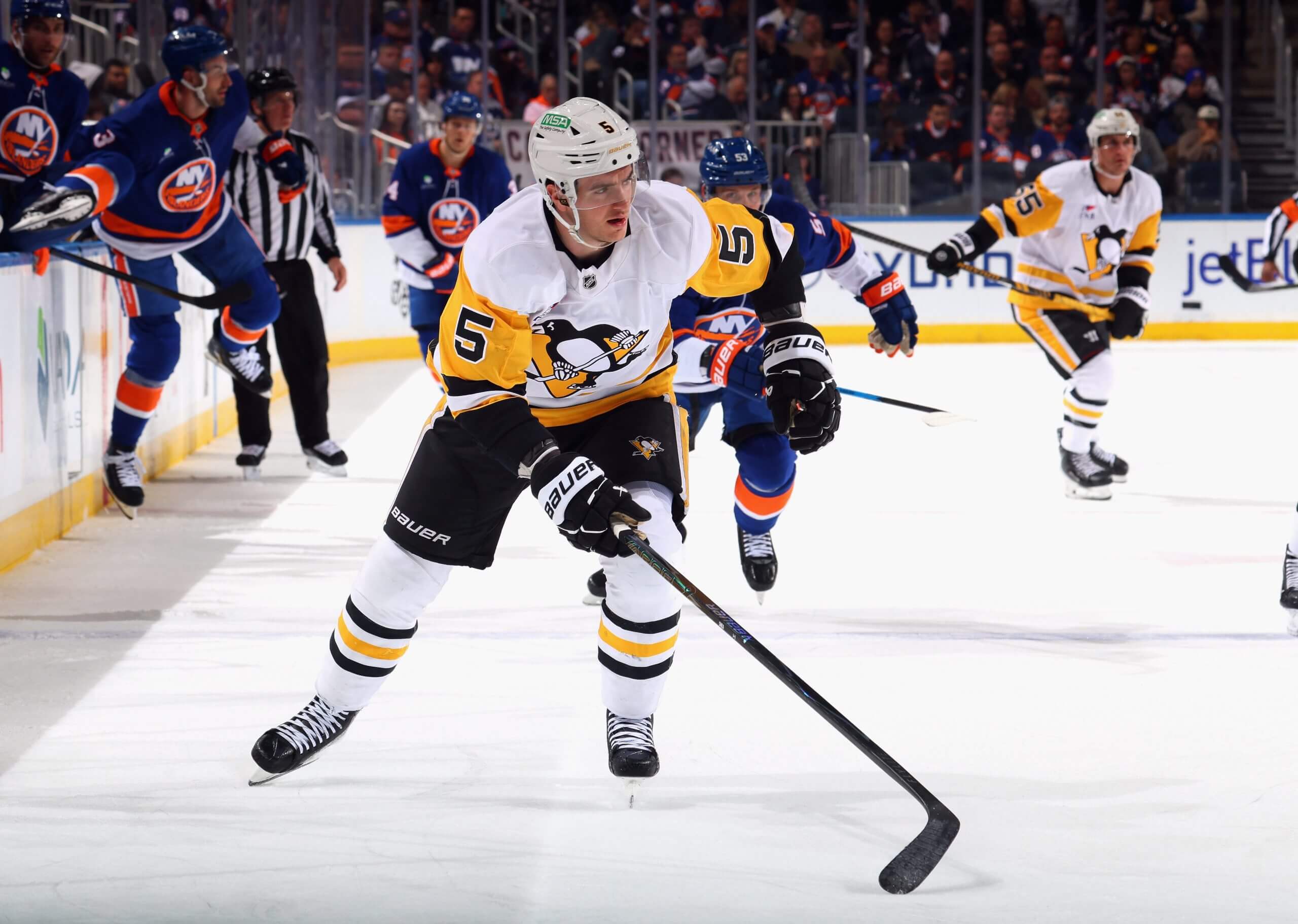
Ryan Shea will be an unrestricted free agent and could be a good fit for the Rangers’ retool. (Bruce Bennett / Getty Images)
6. Which ‘puck-moving’ defensemen might they target?
Along with depth forwards, Sullivan mentioned adding “puck-moving ability on our blue line” as a priority for the Rangers. As currently constructed, the Rangers have a bigger need on their left side, though if they move Schneider or Borgen, a hole could open on their right, too.
The highest-scoring defensemen who are pending unrestricted free agents are the Tampa Bay Lightning’s Raddysh, Anaheim’s John Carlson and Vegas’ Rasmus Andersson. The Anaheim Ducks and Golden Knights paid big prices to acquire Carlson and Andersson in in-season trades, so they presumably will try to work out extensions before July 1. Raddysh is coming off a 22-goal, 70-point season. Because of it, New York would have to pay a high price to get him, which might not be the wisest allocation of resources with Fox already slotted in on the top power-play unit.
Among lower-priced UFAs, Ryan Shea could be a fit. The 29-year-old had 35 points with Pittsburgh this season and played under Mike Sullivan the two seasons prior. Nick Blankenburg is the No. 7 defenseman on the Colorado Avalanche. He’s small — listed at only 5 feet 9 — but could bring puck-moving in a third-pair role.
The Rangers could seek to fill this role via trade. A player such as the Buffalo Sabres’ Michael Kesselring could use a fresh start after a difficult first season. He’s not a pure puck-mover but showed he can chip in some offense while with the Utah/Arizona organization. Anaheim’s Pavel Mintyukov was a healthy scratch at points earlier this season. The 22-year-old, who went No. 10 in 2022, is the type of player New York should target, but he ended up getting more playing time as the Ducks’ season went on. They might not be looking to trade him.
Drury could also ask for a puck-moving defenseman as part of a potential Trocheck return. — Baugh
7. Who will replace Jonathan Quick as backup goalie?
Dylan Garand made his case for the role in his first three NHL starts, going 2-0-1 with a .948 save percentage. The 23-year-old would give the Rangers a young homegrown No. 2 behind Igor Shesterkin. He made it clear speaking to reporters at the end of the season his goal is to remain in the NHL and not return to AHL Hartford.
Garand would require waivers to go back to the AHL in the fall. The Rangers will either have to give him the nod as the No. 2 to start next year, trade him or risk losing him for nothing.
If Drury doesn’t yet trust Garand, he could look to the free-agent market. Some free agents make no sense. Sergei Bobrovsky, for example, presumably isn’t going to sign somewhere to be the No. 2. Others, though, would likely sign without expectation of a starting role. Cam Talbot (Detroit Red Wings), Vítek Vaněček (Utah Mammoth), David Rittich (New York Islanders) and Eric Comrie (Winnipeg Jets) fit that mold.
Drury could also bring in a lower-end free agent — someone such as Matt Murray (Seattle Kraken) or James Reimer (Ottawa) — essentially as insurance in case Garand has a rocky camp. Garand could enter the fall as the presumed No. 2 but still know he has to earn it through his preseason play.
Spencer Martin, who played six games for the Rangers this year, also offers some organizational depth at the goalie position. — Baugh
8. Which prospects should we be watching for their top-five pick?
We won’t know exactly where the Rangers pick until the May 5 lottery — they hold the third-best odds (11.5 percent) for No. 1 — but they’re guaranteed a place in the top five. We can begin to consider scenarios for the most important pick the franchise has had since selecting Lafrenière at No. 1 in 2020.
If New York picks in the top two, chances are it will be one of the consensus best forwards available: Penn State’s Gavin McKenna or Sweden’s Ivar Stenberg. But if the selection lands in the Nos. 3-5 range, the conversation will get interesting.
Many experts, including our own Corey Pronman and Scott Wheeler, rank Soo Greyhounds’ Chase Reid at the head of a talented defenseman class. Carson Carels (WHL Prince George), Alberts Smits (Liiga, Jukurit) and Keaton Verhoeff (University of North Dakota) would also be in the best-player-available debate, but would the Rangers pass on D in favor of filling their prospect pool’s biggest need at center?
There’s a trio of pivots who would merit consideration: Viggo Björck (SHL Djurgårdens), Tynan Lawrence (Boston University) and Caleb Malhotra (OHL Brantford). Malhotra, who’s also committed to BU, is the son of New York’s 1998 first-round pick, Manny Malhotra, and has been picking up steam lately. — Mercogliano
9. What are the chances they keep their second first-round pick?
The Rangers have the better of the Carolina Hurricanes’ or Dallas’ first-round picks, which they acquired in the K’Andre Miller trade. The Hurricanes and Stars are Stanley Cup contenders, so the pick will be late in the first round.
Whether Drury moves the pick will come down to how much of an opportunity he has to be aggressive on the trade market. If he’s trying to add a high-end player, he’d likely have to part with a first. The Rangers will have to decide whether there is anyone available worth doing that for. Using the pick could help them further restock their prospect pool. — Baugh
10. Which prospects should be on the NHL radar?
Perreault finished with 27 points (12 goals and 15 assists) in 49 games as a rookie and has graduated as the organization’s No. 1 prospect, with whoever is selected with New York’s top-five pick sure to slide into that spot. But in terms of players we know will play professionally next season, Liam Greentree is next in line.
The centerpiece of the Panarin trade registered 74 points (38 goals and 36 assists) in 52 games this season as the captain of the Windsor Spitfires, who have advanced to the conference final in the OHL playoffs. The 20-year-old winger will likely start with AHL Hartford, but he has an NHL-ready body (6-3, 216 pounds) and could earn an in-season call-up.
A few other forward prospects will be entering their first full pro seasons: Nathan Aspinall, Jacob Battaglia and Brody Lamb. Aspinall might be the most intriguing after exploding to finish second in the OHL with 94 points (33 goals and 61 assists) for the Flint Firebirds this season. They’ll each require development time with Hartford, but more seasoned prospects such as Jaroslav Chmelař and Adam Sýkora should vie for bottom-six spots during training camp.
There’s less coming on the defensive side, but Drew Fortescue jumped straight from Boston College to the NHL for a nine-game taste at the end of the season and will factor into the camp competition on the left side. — Mercogliano