
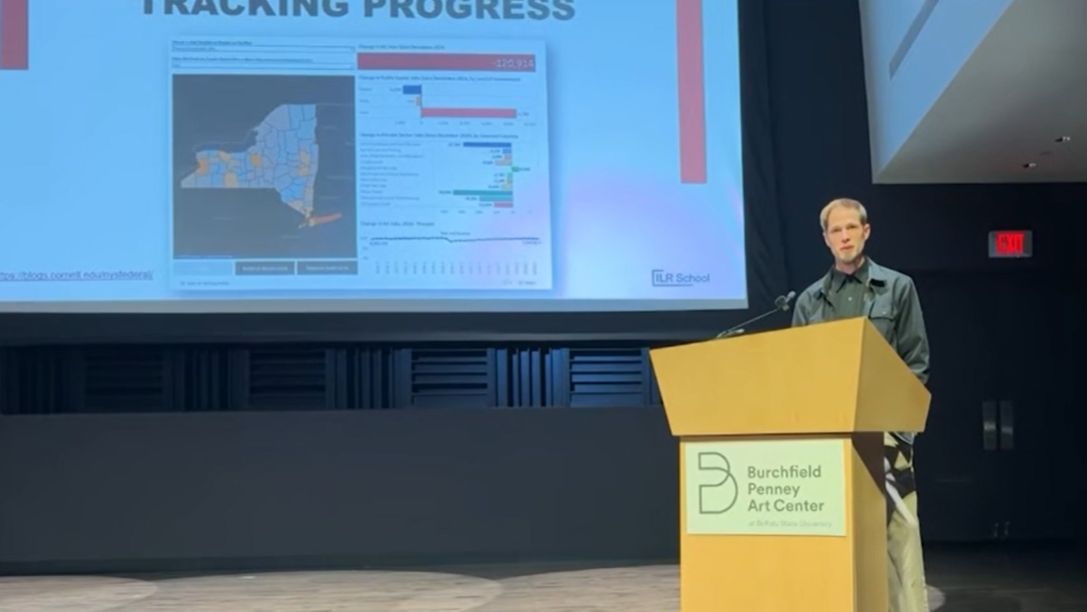
President Donald Trump has been adamant that waste and abuse in the federal government must end. But a new mapping tool out of Cornell University shows efforts to make the government work better has instead had some adverse effects.
What You Need To Know
An interactive map out of Cornell shows the effect of federal cuts on New York state
It’s Phase 1 of the mapping tool, which needs more data
The government shutdown may slow the release of that additional data
Trump administration policy changes are reshaping the United States economy.
“We see sweeping tariffs in an effort to bring manufacturing back to domestic production, we see a lot of government efficiency efforts, or efforts in the name of government efficiencies, such as downsizing, federal layoffs, budget cuts,” Russel Weaver explained.
Weaver is director of research for Cornell’s ILR Buffalo Co-Lab, which created the map. He said the map shows how all the federal changes are directly impacting New Yorkers.
“We’ve charted a relative history, a 10-year history of data on jobs in New York state by quarter, and then we’re pinging that with a series of monitors on the right hand side over here that just look at how changes are taking shape after the implementation of, of this new economic agenda,” Weaver explained.
Cornell officials describe the preliminary results as sobering.
From Dec. 24 to March 24, New York state as a whole saw a decrease of nearly 121,000 jobs, a $7.5 billion loss in federal assistance funding and a more than $8 billion loss in federal contract spending.
The numbers can be broken down further by focusing on specific counties, levels of government and impacted industries and enterprises.
That lack of funding impacts places like the Homeless Alliance of Western New York, which relies on the government to be able to provide permanent, supportive housing to the area’s unhoused individuals.
“We’re talking about peoples’ lives here,” said Daniella Gallego, a supervisor with the Alliance. “These are families with children, these are individuals living with disabilities, chronic illness and trauma, who have finally found stability and now they are at risk of losing everything again.”
This is phase one of the map. As more data becomes available, it will be updated to reflect the changes. One problem: that data is shutdown-dependent.
“The big problem right now is that we are in a shutdown, and so these data are not being published anymore,” Weaver said. “The next release is set to happen for Q2 of 2025 on Dec. 3, and unless the shutdown is resolved by that point, we just won’t get the data.”
In the meantime, Weaver says even this preliminary map gives a good idea of what’s to come, so New Yorkers can prepare accordingly.
The Trump administration has said it remains committed to funding programs that are in line with the administration’s priorities.