
by Michelle Mullen
An inaugural film festival at Manhattan University expanded a classroom project into an international platform for emerging filmmakers, attracting submissions from amateur and working creatives alike.
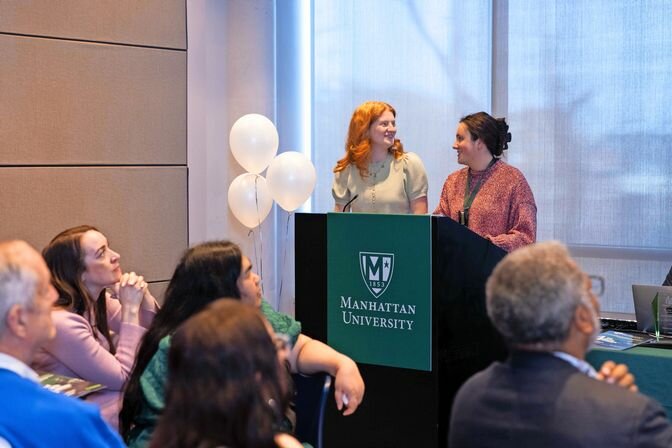
Launched this spring, the Sixth Borough Film Festival unfolded over a weekend of screenings, filmmaker Q&As and a closing awards ceremony — all organized and run by students. The event grew out of an experiential learning course led by Michael Grabowski, who said the goal was to give students direct experience building a film festival rather than studying one.
“We didn’t want this to stay theoretical,” Grabowski said. “We wanted students to actually build something, make decisions and see what it takes to run a festival in real time.”
The 26 students enrolled in the course sifted through more than 100 submissions, shaping a final program that reached well beyond campus. A number of entries came from outside the United States — Brazil, Poland and Indonesia were just a few of the places represented.
In selecting films, the teens used a judging process that emphasized storytelling, originality and technical execution, standards that Grabowski and his students said distinguished stronger entries from what they described as “AI slop,” or submissions that relied heavily on artificial intelligence.
The festival’s director of operations, senior Max Bennett, said the project gained traction after he returned from studying abroad in Rome, where he took part in an Italian film festival. Throughout his travels, he and his professor stayed in touch.
“I would email Grabowski every so often and tell him about it, and he was talking to me about his ideas for doing a film festival,” the student recalled. “He had already been thinking about it.”
After Bennett’s return to campus, the two continued to discuss the potential for putting on a similar event at the university, not thinking much would come of it.
“We talked about it so much that eventually, it became a question of why not actually do it,” Grabowski explained.
As part of the professor’s experiential learning class, students analyzed existing film festivals and connected with organizers to learn what it takes to bring such an event to fruition. The students took on roles across the event’s operations, managing programming, outreach and logistics while working under faculty guidance.
As the festival approached, that work intensified, with students balancing creative decisions and practical demands. For Sam Wofford, a senior who floated between social media, press and logistics, the moment the festival became tangible came just weeks before it opened.
“I got back from spring break and saw the banners up, and I was like, ‘this is happening,” Wofford said. “Then we saw that our trailer was getting all these views, and it really hit that people outside the school were watching this.”
Wofford also screened his own film, “Sharks of Montauk,” a mockumentary he crafted with classmates Dylan Woolcott and Billy Walker. The film, a comedic take on a nature documentary, was like a last hurrah for the team of seniors.
Like many other student films screened, the project was made with limited resources, relying on borrowed equipment, small crews and a willingness to improvise. Those same conditions defined the festival itself, as students worked to keep the operation moving.
“Communication was the biggest challenge, not because people weren’t responding, but because there were so many moving pieces,” he said. “There were many different avenues that we never really discussed, so we had to figure out how to stay on the same page.”
Behind the scenes, students such as Mary Haley, the festival’s director of awards, worked to ensure filmmakers were recognized for their contributions. Haley and her team reviewed top-scoring student films and helped determine award recipients, culminating in the closing gala.
“It was a once in a lifetime opportunity,” Haley said. “It’s so different when you’re watching a project and you’re watching art with the people that make it. It puts in perspective that these are real, lifelong, passionate projects.”
Despite budget constraints, including the inability to provide travel stipends or large-scale amenities, the festival drew more than 20 filmmakers to campus, some traveling internationally to attend.
“I’m really proud of what the students built,” Grabowski said. “They took ownership of it, and that showed in the final product.”
Keywords
Manhattan University,
Sixth Borough Film Festival,
student film festival,
emerging filmmakers,
international film submissions,
experiential learning