
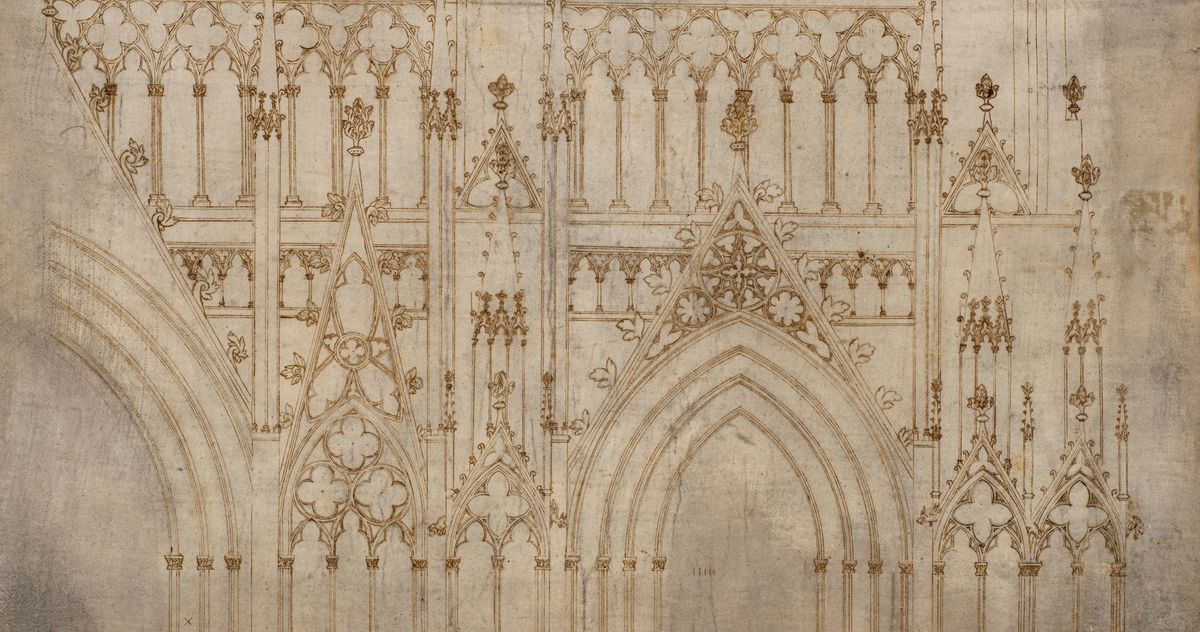
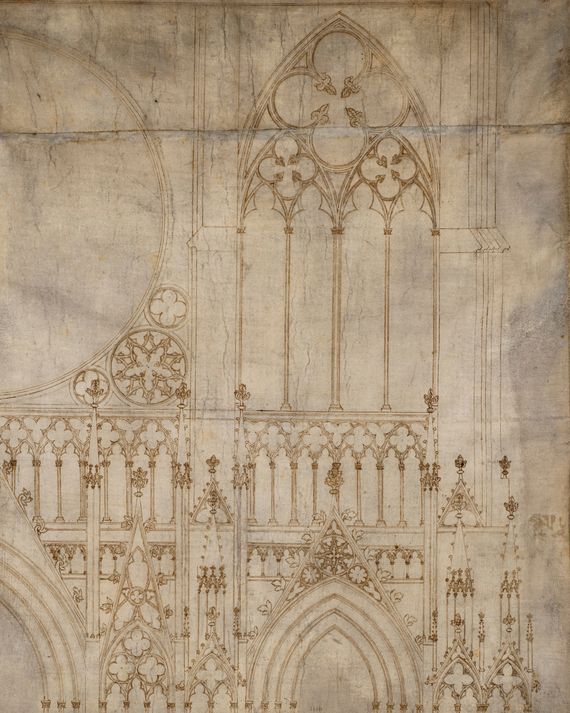
The oldest surviving architectural drawings are of Strasbourg Cathedral, which was begun around 1250, but this façade elevation from about a decade later is so visually sophisticated that it suggests a long preexisting practice.
Photo: Courtesy of The Met
If all that remained of architecture from the 12th to the 16th centuries were the astonishing diagrams now on view in “Gothic by Design” at the Met Museum, you might suppose you were looking at wild fantasies. How could such finespun lacework stand up at all, let alone stretch hundreds of feet toward the heavens? The show helps you see clearly what the buildings themselves only suggest: Gothic cathedrals are drawings delicately alchemized into solid, nearly indestructible forms. Line by line, mark by mark, medieval builders figured out how to shape stone and pour light, conjuring complete buildings on parchment before the first rock was hewn. Confident that limestone wouldn’t crack or beams split, they diagrammed vaults, traced the arcs of graceful buttresses, and drew spires encrusted with statuary. These structures look unreal in two dimensions, as if they were made mostly of air.
At the Met, I wandered in awe through an architectural world where complexity was the norm and extreme engineering a starting point. The great cathedrals of Europe are exhilarating not just because they’re light and tall and bejeweled with stained glass, but because every carved curl and iron hinge is linked in a harmonic chain of relationships to joints, vaults, towers, and the sky beyond. Ornaments are no more dispensable than foundations. Today, we might think of those patterns as fractal; medieval architects saw them as holy. And where the spirit was concerned, detail mattered, because you couldn’t just value-engineer the presence of God.
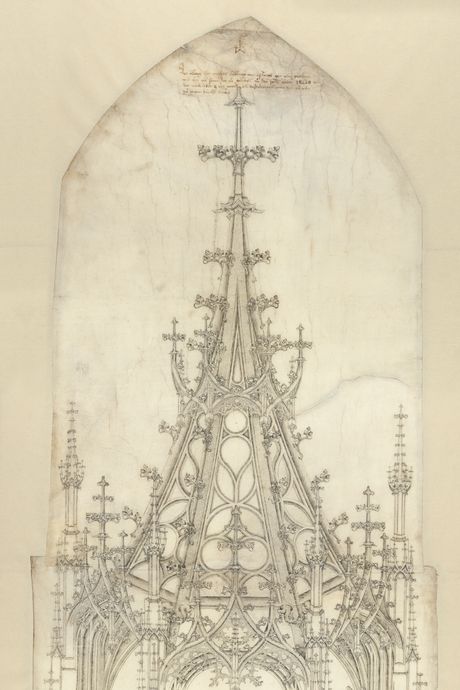
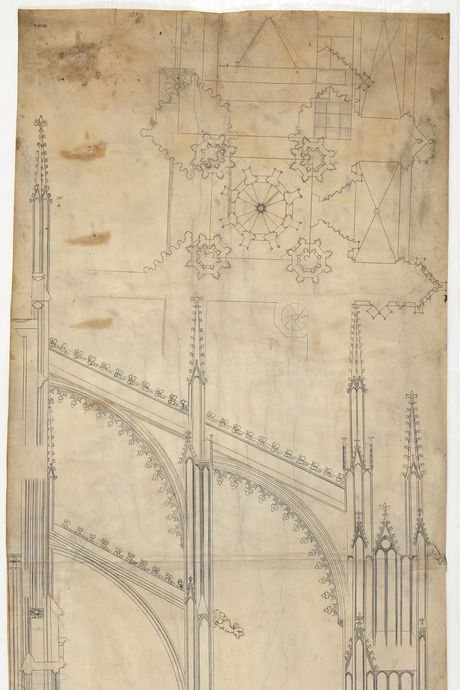
From left: Matthäus Böblinger (German, ca. 1450–1505): Design for a Mount of Olives Monument for the City of Ulm, 1474. Photo: Courtesy of The MetPeter Parler (German, ca. 1330–1399): Cross Section of the Northern Half of the Choir and Flying Buttresses of the Cathedral of Saint Vitus (Veitsdom), Prague, ca. 1360. Photo: Courtesy of The Met
From top: Matthäus Böblinger (German, ca. 1450–1505): Design for a Mount of Olives Monument for the City of Ulm, 1474. Photo: Courtesy of The MetPeter… more
From top: Matthäus Böblinger (German, ca. 1450–1505): Design for a Mount of Olives Monument for the City of Ulm, 1474. Photo: Courtesy of The MetPeter Parler (German, ca. 1330–1399): Cross Section of the Northern Half of the Choir and Flying Buttresses of the Cathedral of Saint Vitus (Veitsdom), Prague, ca. 1360. Photo: Courtesy of The Met
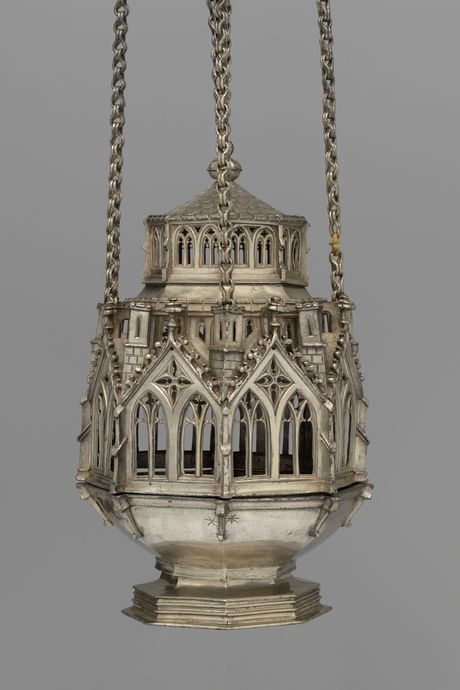
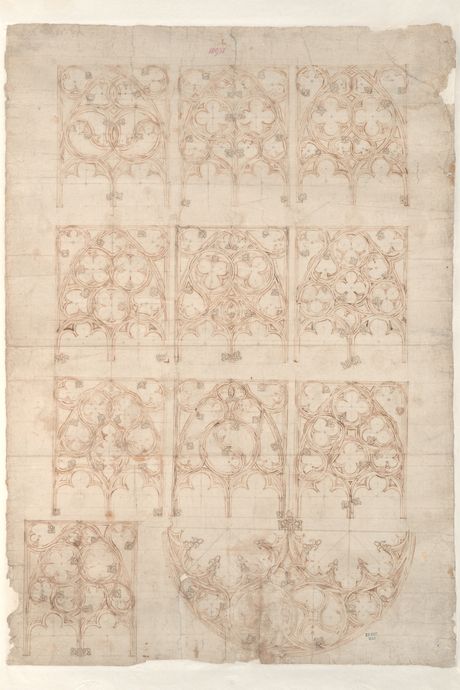
From left: Unidentified Swiss artist (active Basel, 15th century): Censer Before 1477. Photo: Courtesy of The MetAttributed to Madern Gerthener (German, ca. 1360–1430): Studies of Tracery Variations ca. 1410–15. Photo: Courtesy of The Met
From top: Unidentified Swiss artist (active Basel, 15th century): Censer Before 1477. Photo: Courtesy of The MetAttributed to Madern Gerthener (German… more
From top: Unidentified Swiss artist (active Basel, 15th century): Censer Before 1477. Photo: Courtesy of The MetAttributed to Madern Gerthener (German, ca. 1360–1430): Studies of Tracery Variations ca. 1410–15. Photo: Courtesy of The Met
Then as now, drawing was a way to bridge vastly different scales, because in two dimensions you couldn’t distinguish between, say, an immense edifice and a little casket. Goldsmiths worked from the same templates as masons did, producing tabletop churches and pocket chapels. The Met includes examples of such exquisitely miniaturized architecture, like the late 15th-century design for a censer by the anonymous Netherlandish engraver known as Master W with Key. But the most spectacular works are the 10- and 11-foot lengths of parchment that dramatize the way medieval architects conceived their spiritual ladders to heaven. Lorenz Lechler’s 1502 drawing of a monumental (but unbuilt) sacrament house rises from a stepped pedestal via columns as skinny as flowers’ stalks, before blooming into a filigree of delicate stonework and then climbing ever higher to a needle’s point. The tower is supremely unpragmatic: It contains nothing but statues and breeze, and you’d need binoculars to make out its uppermost carvings from street level. But then, its target audience was all-seeing and far above.
This towering sacrament house was never built, but Lorenz Lechler’s pen-and-ink drawing, which stretches over nearly 11 feet of parchment, is monumental enough that the eye can’t take in the whole thing at once. In two dimensions, viewers have the option of starting from the tapering spire …
… letting the eye drift down to the Last Supper taking place practically in midair …
… and continuing along the filigreed openwork to the slender base.
Courtesy of The Metropolitan Museum of Art, New York, Purchase, The Cloisters Collection, Lila Acheson Wallace Gift, and Harry G. Sperling Fund, 2022/https://creativecommons.org/publicdomain/zero/1.0/
The earliest work here is a drawing from around 1260, showing part of the façade of Strasbourg Cathedral, but it is so precise and vivid, so assured in its technique, that it must surely have emerged from a long tradition. What was new in Strasbourg in the 13th century was not the practice but the recordkeeping. Even so, scholars can rarely be sure who designed what when, or whether a given drawing was made as a preliminary sketch, an assembly manual for construction workers, or a record after the fact. Every Gothic cathedral is the product of ideas that altered over generations, ambitions abandoned or superseded, compromises with ballooning budgets, labor shortages, or bottlenecks in the supply chain from quarries and forests and mines. The drawings, too, evolved, passing from hand to hand.
Many appear so mysteriously complex that it’s hard to imagine how anyone ever translated them into physical existence. Some plans were never built, but they could have been, as a pair of short videos in the exhibition helps explain. Two researchers, Zoltan Bereczki and Robert Bork, took Lechler’s Sacrament House drawing literally and used 3-D software to translate the artistic rendering into a detailed digital model. Another researcher, Stéphane Potier, tackled Ulrich von Ensingen’s early-15th-century ground plan of an octagonal tower at Strasbourg. As the video demonstrates, von Ensingen’s drawing (not in the show, alas) collapses all the levels, complete with stairs, setbacks, vaults, and columns, onto a single plane. Potier decodes that practically illegible document and creates a 3-D realization that grows from a fantastically complex swirl of interlocking geometries.
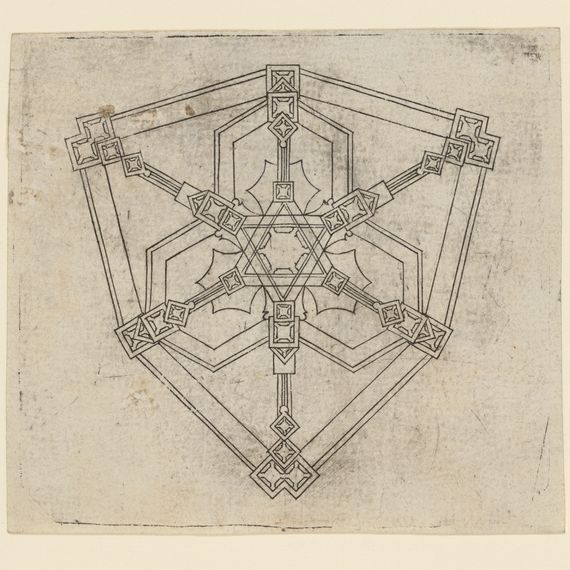
Circle of Erwin von Steinbach (German, born Upper Rhineregion, died 1318): Elevation for the Tower of Freiburg Minster, ca. 1300.
Photo: Courtesy of The Met
When the roof of Notre-Dame de Paris collapsed in flames seven years ago, the French government was flooded with proposals to update and transform it. Instead, it returned to the immense cache of drawings by the 19th-century architect Eugène Viollet-le-Duc and produced a 21st-century re-creation of an industrial-era gloss on a 13th-century original. An exhibition curated by Barry Bergdoll and Martin Bressani at the Bard Graduate Center links those three eras, giving a central place to Viollet-le-Duc’s lifelong fascination with moody renderings, exploded perspectives, meticulous elevations, and analytical diagrams. They demonstrate that, for centuries and long after the Gothic era, putting pencil to paper remained the principal way to study, teach, and propagate architectural ideas.
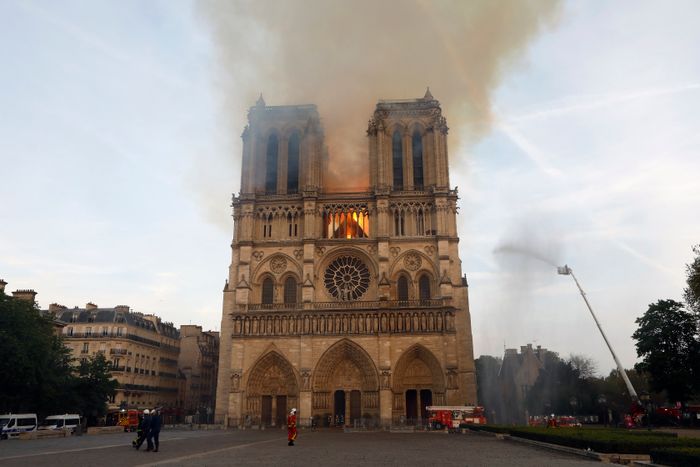
A fire that broke out on April 19, 2019, destroyed the roof and Viollet-le-Duc’s spire, though not the statues, which had been removed the day before for restoration.
Photo: Antoine Gyori/Corbis/Getty Images
Viollet-le-Duc’s flabbergasting virtuosity with that tradition helped him and his partner Jean-Baptiste-Antoine Lassus win a government-sponsored competition to restore the cathedral. By 1843, Notre-Dame had been deconsecrated, abused, and neglected. In luminous drawings that had the texture of authenticity, they imagined the resurrection of a Gothic carcass: eroded limestone made new, blurred lines re-etched, vanished finials replaced, the accretions of the 18th century carted away. In breathtaking detail, we see how the partners conceived the renewal of Notre-Dame as a practical demonstration of France’s unique genius.
Some earlier practitioners, like Piranesi, had elevated drawing into highly theatrical art. But Viollet-le-Duc gave it a lasting political charge. Lassus died in 1857, leaving the completion of Notre-Dame to his talented collaborator, who was also an avowed nationalist, glorifier of colonialism, and committed racist who saw French superiority manifested in everything from the shape of his countrymen’s brows to the nobility of Mont Blanc’s glaciers. The most graphically striking representation of his country’s spirit was the Gothic vault, which he dissected in his multivolume Dictionary of French Architecture From the 11th to the 16th Centuries. Though the book’s approach was historical, its message was timely: Anticlerical rampages during the Revolution had left the landscape studded with religious ruins, structures that represented the complete and perfect fusion of scientific rigor and aesthetic fervor. Those churches, he insisted, deserved to be lovingly, patriotically renovated. He made his arguments in images that showed how every piece fit together in a tour de force of unity.
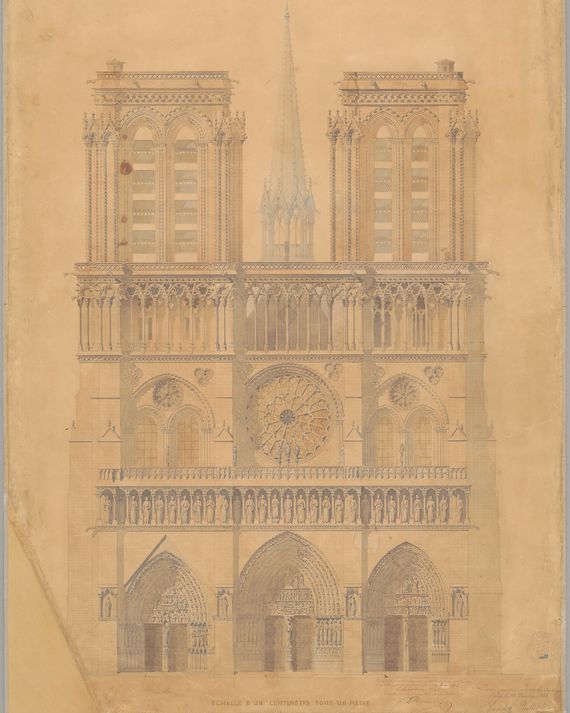
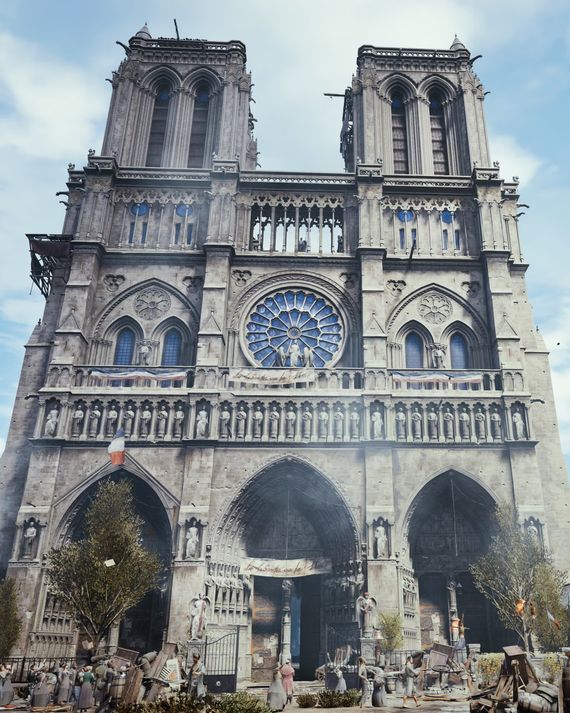
From left: Eugène-Emmanuel Viollet-le-Duc (French, 1814–79); Jean-Baptiste-Antoine Lassus (French, 1807–57): West elevation of Notre-Dame de Paris, competition drawing, 1843. Photo: Courtesy of Bard Graduate CenterBefore the fire, the video-game company Ubisoft had devoted 5,000 hours of research to producing a detailed digital reconstruction of Notre-Dame for the game Assassin’s Creed. Although the game designers strove for medieval period accuracy, they bent chronology and replaced the original spire with Viollet-le-Duc’s taller, more dramatic version. Photo: Ubisoft
From top: Eugène-Emmanuel Viollet-le-Duc (French, 1814–79); Jean-Baptiste-Antoine Lassus (French, 1807–57): West elevation of Notre-Dame de Paris, com… more
From top: Eugène-Emmanuel Viollet-le-Duc (French, 1814–79); Jean-Baptiste-Antoine Lassus (French, 1807–57): West elevation of Notre-Dame de Paris, competition drawing, 1843. Photo: Courtesy of Bard Graduate CenterBefore the fire, the video-game company Ubisoft had devoted 5,000 hours of research to producing a detailed digital reconstruction of Notre-Dame for the game Assassin’s Creed. Although the game designers strove for medieval period accuracy, they bent chronology and replaced the original spire with Viollet-le-Duc’s taller, more dramatic version. Photo: Ubisoft
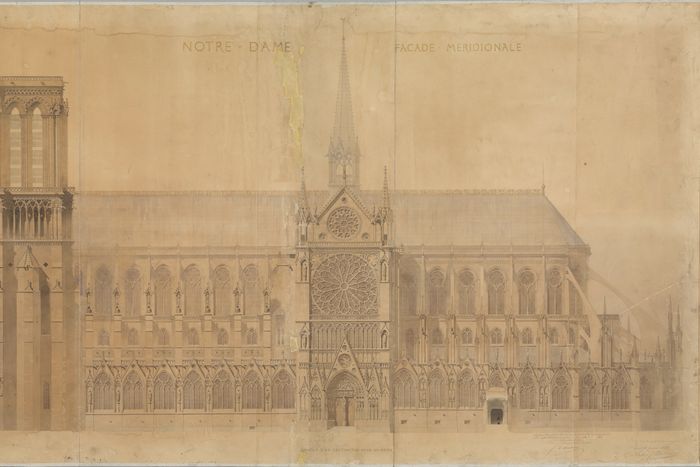
Eugène-Emmanuel Viollet-le-Duc; Jean-Baptiste-Antoine Lassus: South elevation of Notre-Dame de Paris, competition drawing, 1843.
Photo: Courtesy of Bard Graduate Center
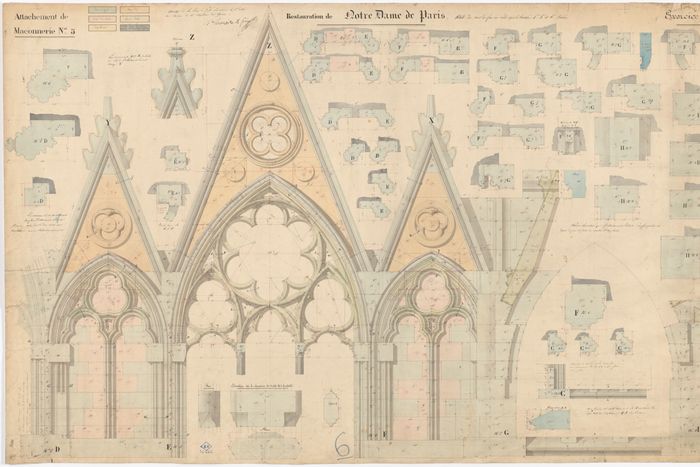
Jean-Baptiste-Antoine Lassus; Eugène-Emmanuel Viollet-le-Duc; and Émile Boeswillwald, Janvier; Lemaire et frères (contractors): Southern choir aisle of Notre-Dame de Paris, shop drawing of the gables of the fourth, fifth, and sixth bays after the transept, 1847.
Photo: Courtesy of Bard Graduate Center
Viollet-le-Duc’s concepts of renovation were radical then and would be alarming now, because they combined meticulous restoration with anachronistic additions — notably a new spire, which rose 60 feet higher than the 13th-century original so that it would continue to dominate the 19th-century city just as it had the medieval one. The extra height matched his sense of responsibility. “Any architectural element that stands out against the sky requires … an exquisite sense of form, for nothing is insignificant in such a situation,” he wrote — an admonition that today’s designers of high-rises should internalize.
Sign Up for the Curbed Newsletter
A daily mix of stories about cities, city life, and our always evolving neighborhoods and skylines.
Vox Media, LLC Terms and Privacy Notice
Related