
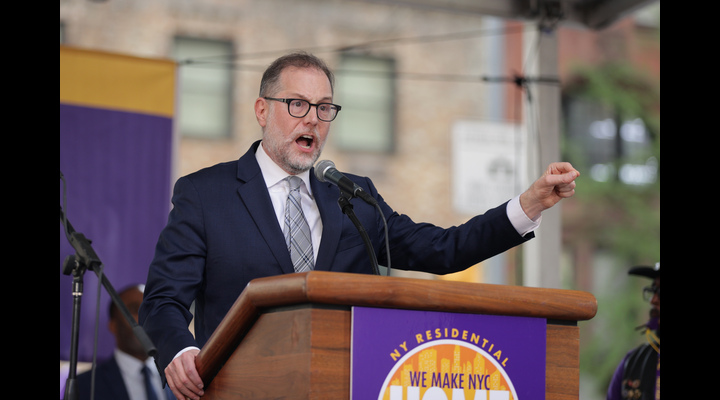
New York City Comptroller Mark Levine speaking on April 15, 2026. Photo: Luiz Rampelotto/EuropaNewswire/Sipa USA via Reuters Connect
New York City’s top financial official defended the city’s ongoing investment in Israel bonds as the administration of Mayor Zohran Mamdani faced growing criticism over its refusal to adopt a formal definition of antisemitism and continued hostile posture toward the Jewish state, paving the way for a showdown over how New York should address hate crimes and foreign investment policy.
Comptroller Mark Levine said on Wednesday that bonds issued by the Israeli government remained a safe, long-standing investment for city pension funds, insisting that financial decisions must be separated from political pressure. Levine pointed to the bonds’ decades-long record of repayment and argued his office’s responsibility was to maximize returns for retirees, not respond to shifting political campaigns.
“This is not political. It shouldn’t be political,” said Levine, a Democrat. “Israel bonds have never missed a payment in 70 years, ever, not once.”
The comptroller noted that the city has investments in other foreign countries but only faces protests for its association with Israel.
“And by the way, we’ve had no protesting about our investments in Saudi Arabia, our investments in Pakistan or China — only this one little, tiny sliver,” Levine said.
His comments came as the Mamdani administration faced continued scrutiny over its approach to Israel and antisemitism policy. Mamdani, a far-left democratic socialist who has made anti-Israel activism a cornerstone of his political career, has urged Levine to end city investments in Israel bonds.
Mamdani has long been an outspoken supporter of the boycott, divestment, and sanctions (BDS) movement, which seeks to isolate Israel on the international stage as the first step toward its elimination. Leaders of the movement have repeatedly stated their goal is to destroy the world’s only Jewish state.
In New York City specifically, records show that Israel bonds, historically yielding approximately 5 percent annually, have outperformed many alternatives.
Meanwhile, Israeli firms pour billions of dollars and tens of thousands of jobs into the local economy, and business experts have warned that a push for divestment could lead Israeli-associated and Jewish-owned companies to leave.
A study released by the United States-Israel Business Alliance in October revealed that, based on 2024 data, 590 Israeli-founded companies directly created 27,471 jobs in New York City that year and indirectly created over 50,000 jobs when accounting for related factors, such as buying and shipping local products.
These firms generated $8.1 billion in total earnings, adding an estimated $12.4 billion in value to the city’s economy and $17.9 billion in total gross economic output.
As for the entire state, the report, titled the “2025 New York – Israel Economic Impact Report,” found that 648 Israeli-founded companies generated $8.6 billion in total earnings and $19.5 billion in gross economic output, contributing a striking $13.3 billion in added value to the economy. These businesses also directly created 28,524 jobs and a total of 57,145 when accounting for related factors.
From financial tech leaders like Fireblocks to cybersecurity powerhouse Wiz, Israeli entrepreneurs have become indispensable to the innovation ecosystem. The number of Israeli-founded “unicorns,” privately held companies with a valuation of at least $1 billion, operating in New York City has quadrupled since 2019, increasing from five to 20.
Beyond its finances, New York City will not use a codified definition of antisemitism in evaluating complaints or incidents, according to administration officials. Instead, the Mayor’s Office to Combat Antisemitism, led by Phylisa Wisdom, will assess cases individually without relying on a fixed legal or policy definition.
“The first thing I’ll say is that across city government, there is not a definition codified for any form of hate at all,” Wisdom said on Wednesday while presiding over the City Council’s Task Force to Combat Antisemitism
The decision marks a departure from previous city policy, which had incorporated the International Holocaust Remembrance Alliance (IHRA) definition of antisemitism. The Mamdani administration revoked that standard when he entered office, arguing that rigid definitions can risk conflating criticism of Israel with antisemitism and may complicate the handling of politically sensitive speech.
IHRA — an intergovernmental organization comprising dozens of countries including the US and Israel — adopted the “working definition” of antisemitism in 2016. Since then, the definition has been widely accepted by Jewish groups and lawmakers across the political spectrum, and it is now used by hundreds of governing institutions, including the US State Department, European Union, and United Nations. Law enforcement also uses it as a tool for matters such as hate-crime investigations and sentencing.
According to the definition, antisemitism “is a certain perception of Jews, which may be expressed as hatred toward Jews. Rhetorical and physical manifestations of antisemitism are directed toward Jewish or non-Jewish individuals and/or their property, toward Jewish community institutions and religious facilities.” It provides 11 specific, contemporary examples of antisemitism in public life, the media, schools, the workplace, and in the religious sphere. Beyond classic antisemitic behavior associated with the likes of the medieval period and Nazi Germany, the examples include denial of the Holocaust and newer forms of antisemitism targeting Israel such as demonizing the Jewish state, denying its right to exist, and holding it to standards not expected of any other democratic state.
Critics say the absence of a clear definition could weaken enforcement and create inconsistency in how incidents are classified. Some lawmakers have pointed to recent public exchanges in which officials were unable or unwilling to clearly articulate what constitutes antisemitism under the city’s current framework.
The debate has intensified against the backdrop of a broader surge in antisemitic hate crimes in New York City. Advocacy groups and elected officials have raised concerns that the policy shift could make it harder to respond effectively at a time of heightened tension and increased reported incidents.
The majority of all hate crimes in New York City over the first three months of this year have targeted Jews, according to data released by the New York Police Department (NYPD).
“Confirmed hate crimes increased nearly 12 percent this quarter citywide. We continue to see that the vast majority of our hate crimes are antisemitic in nature,” NYPD Commissioner Jessica Tisch said earlier this month. “In fact, in the first quarter of 2026, more than half of all confirmed hate crimes, or 55 percent, were antisemitic, despite Jews only making up approximately 10 percent of the population of New York City.”
Mamdani took office on Jan. 1.
However, the surge in anti-Jewish hate crimes predated Mamdani.
Jews were targeted in the majority (54 percent) of all hate crimes perpetrated in New York City in 2024, according to data issued by the NYPD. A recent report released in December by the Mayor’s Office to Combat Antisemitism noted that figure rose to a staggering 62 percent in the first quarter of 2025, despite Jewish New Yorkers comprising a small minority of the city’s population.