
EAST RUTHERFORD, N.J. — After months of waiting and speculation, the first night of the NFL Draft always passes in a blink.
But this year, after trading Dexter Lawrence to the Cincinnati Bengals, the New York Giants held two top-10 picks, making the evening speed by. Rather than trading back and acquiring more draft capital, the Giants stuck with their selections and added two players they hope will transform both sides of the ball: linebacker Arvell Reese at No. 5 and offensive lineman Francis Mauigoa at No. 10. That Reese was still available to the Giants surprised even general manager Joe Schoen and coach John Harbaugh, but he’ll start off at inside linebacker and be used in creative ways to add to a formidable pass rush. Mauigoa fulfills the Giants’ massive need at right guard.
So, where does that leave the Giants as they head into Day 2? There’s still a big hole at defensive tackle that needs patching, along with more potential playmakers for quarterback Jaxson Dart.
Check out our updated big board on the best available prospects the Giants can turn to when they kick off Day 2 with the No. 37 pick. To compile our list, we turned to a variety of The Athletic’s indispensable draft resources, including Dane Brugler’s top 300 and “The Beast,” to compile this 40-prospect list.
Notes: The number on the left indicates where they rank in Brugler’s top 300. An asterisk means they completed a pre-draft visit with the Giants.
Day 2
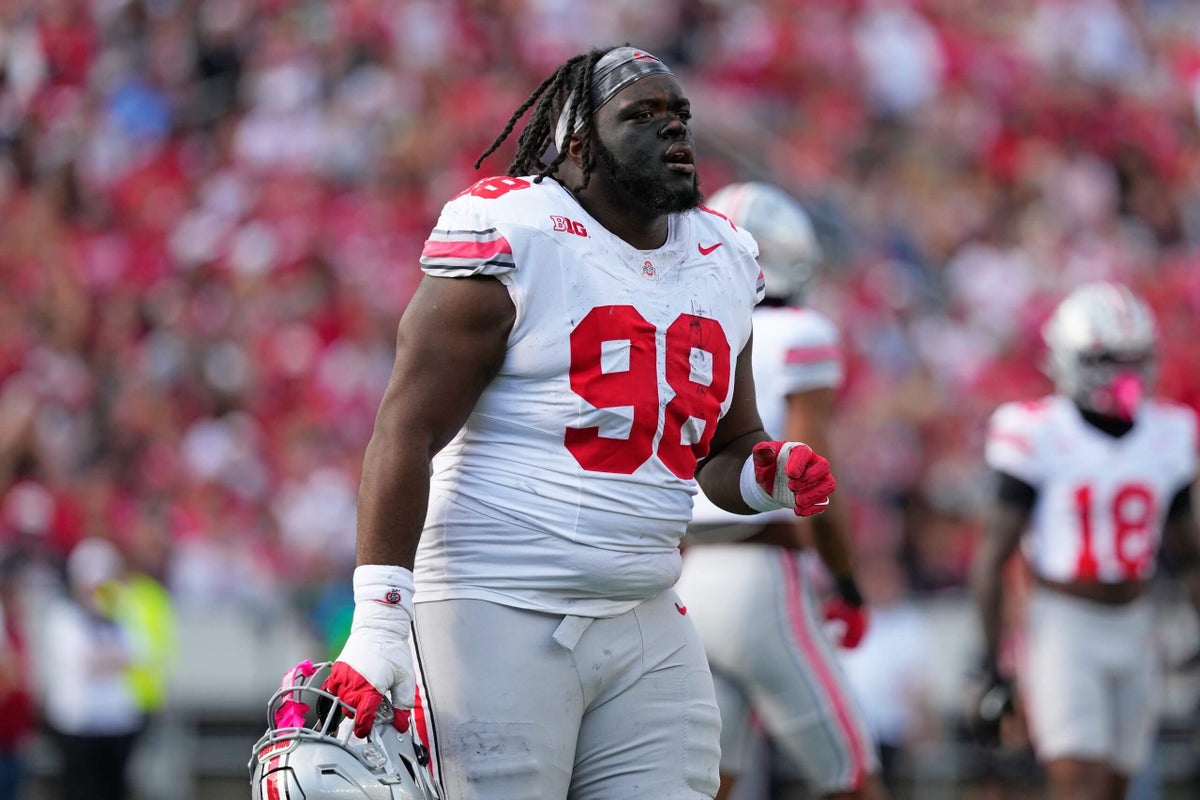
32. Kayden McDonald, DT, Ohio State (6-foot-2, 326 pounds)
McDonald is Brugler’s top-ranked defensive tackle and the Giants are going to have to address the defensive tackle position; it was already a necessity before the Lawrence trade. Now it is even more of a must.
34. Chase Bisontis*, G, Texas A&M (6-5, 315 pounds)
Sense a theme? Bisontis projects as an “eventual NFL starter and has traits that will speak to both zone and power schemes,” per Brugler. Plus, he’s a hometown prospect who went to New Jersey’s Don Bosco Prep, so what’s not to love?
40. Jacob Rodriguez, LB, Texas Tech (6-1, 231 pounds)
A former quarterback, Rodriguez gave up a scholarship and walked on at Texas Tech as a transfer, transitioning to linebacker. The move paid off and he won plenty of awards (Chuck Bednarik Award, Lombardi Award, Bronko Nagurski Trophy, Butkus Award) last year during an All-American season, while also finishing fifth in Heisman voting. While Rodriguez is average-sized, Brugler notes his “athletic versatility has made him a more instinctive linebacker and helps him play decisively.” That should help him compete immediately for a starting role, and he could carve out a spot as a leader for the defense.
41. Germie Bernard, WR, Alabama (6-1, 206 pounds)
Bernard led the Crimson Tide in receptions the last two seasons. As Brugler notes, it will be more of a challenge for Bernard to create separation versus NFL corners, but he “competes with the toughness to play through contact.”
43. Christen Miller*, DT, Georgia (6-4, 321 pounds)
Miller played multiple positions on the interior D-line during his two seasons as a starter at Georgia, but those fronts were heavily rotated, so he averaged only 31.2 snaps per game in 2025. Even with the versatility, Miller projects best as a one-gapping nose in a four-man front, per Brugler. The good news is that Miller is a rock-solid run defender, which the Giants desperately need as they look to boost their run defense.
57. Emmanuel Pregnon, G, Oregon (6-4, 314 pounds)
Pregnon was a four-year starter, playing his sixth and final season at Oregon. While Pregnon checks all the NFL boxes of a starting guard, Brugler notes his comfort level is clearly on the left side. Current left guard Jon Runyan will be a free agent next year if the Giants are looking to the future. Pregnon is an older prospect who will be 25 years old as a rookie.
71. Gennings Dunker, G, Iowa (6-5, 319 pounds)
As a Midwesterner who loves Culver’s, am I including Dunker solely for our shared love of the frozen custard spot? No, but does it add to the legend, as well as Dunker’s appeal as a “Paul Bunyan-like folk hero” (Brugler’s words, not mine!). On the field, Dunker projects as a guard with starting potential and tackle flexibility. His old-school toughness would be appealing for a new coach trying to build around physicality.
72. Ted Hurst*, WR, Georgia State (6-4, 206 pounds)
Hurst was the first player in school history to make Feldman’s “Freaks List,” and in two seasons at Georgia State, he combined for 127 catches, 1,965 yards and 15 touchdowns. Brugler notes he faces a steep learning curve, but his traits and ball-tracking skills are exciting. The question is: Do the Giants need a receiver who’s more ready to start this season rather than a developmental one?
79. Travis Burke*, OT, Memphis (6-9, 325 pounds)
With eye-popping size, Burke has “tools worth drafting in the mid-rounds, to be a swing tackle and potential starter,” per Brugler. Again, right now the Giants are set at tackle. But if they do manage to trade back from the No. 37 spot and/or pick up a third-rounder, do they want to take a shot on a prospect with intriguing potential and, as Brugler notes, a “nasty” disposition?
Day 3
99. Deion Burks, WR, Oklahoma (5-10, 180 pounds)
While he has size limitations, Burks also has “dynamic athleticism and the tracking skills to snatch and secure,” per Brugler. He’s got the “juice and contact balance to be a big-play creator,” but he wasn’t used as a downfield threat much during his two years as a starter at Oklahoma. Should the Giants go receiver to start off Day 3 (assuming Burks is around), the receiver could start off as a “gadget role player” with the potential to become something more.
107. Chris McClellan*, DT, Missouri (6-4, 313 pounds)
McClellan has the physical characteristics of an NFL player. Per Brugler, he responds well to double teams and holds the point against the run, which would benefit the Giants. He projects as a rotational interior lineman who can “give teams quality snaps as a zero-/one-technique,” which, given Lawrence’s departure, is important.
110. Bryce Boettcher, LB, Oregon (6-1, 230 pounds)
Originally a baseball player at Oregon — he was drafted by the Houston Astros in the 13th round of the 2024 MLB draft — Boettcher walked on to the football team in 2022. Choosing to go forward with football only in his final year, he was the first Oregon player to surpass 135 tackles in a season since the 1970s. While Brugler notes he needs the right situation to be a starter, Boettcher can become an immediate and impactful special teamer. With Harbaugh’s special-teams background, that could make Boettcher particularly appealing.
115. Kaytron Allen, RB, Penn State (5-11, 216 pounds)
The Giants may still want to add a young running back to their room to pair with Cam Skattebo, Tyrone Tracy and fullback Patrick Ricard. Allen could be an option as someone with a good feel for the position and who “maximizes carries with his vision, physicality and body control,” as Brugler notes. He projects as a durable backup (important to consider given Skattebo’s physicality) or a low-end starter. One thing to monitor: He doesn’t project to have much of a special-teams role, which, as we get into Day 3 and with a coach like Harbaugh, could be detrimental.
117. Febechi Nwaiwu*, G, Oklahoma (6-4, 316 pounds)
Nwaiwu could be a perfect developmental fit for an offense that needs help in the trenches. Not only does he have primarily right guard experience, he also has two games at center under his belt and projects as a valuable backup with guard/center flexibility. Looking ahead at who is signed inside beyond 2026 makes drafting interior linemen vital. Nwaiwu was flagged just once in 13 games in 2025.
119. Tacario Davis*, CB, Washington (6-4, 194 pounds)
Davis had the largest wingspan among all defensive backs at the NFL combine. While his measurables might work against him at times, his “size-speed traits and ball skills are worth the gamble,” per Brugler. Davis did miss six games during his final season, including the final three with a severe hamstring pull.
127. Gracen Halton, DL, Oklahoma (6-3, 293 pounds)
If the Giants are looking to take a DT-by-committee approach — or for rotational depth — Halton could be their guy. Brugler notes that a “part-time role that keeps his battery charged will be his best NFL fit.” It’s similar to what he did at Oklahoma, where he played multiple alignments on a lower snap count.
128. Marlin Klein, TE, Michigan (6-6, 248 pounds)
We’ve not included a tight end up until this point given the Giants’ investment in this room during free agency, adding Isaiah Likely on a three-year deal. But even with Likely and Theo Johnson, along with depth pieces Chris Manhertz, Thomas Fidone II and Tanner Conner, perhaps Harbaugh has sights on a late-round development prospect of his own. Who better than Klein, who played for Harbaugh’s brother Jim at Michigan? As Brugler notes, Klein is a “good-sized athlete with toughness worth developing as a blocker.”
148. Rayshaun Benny, DT, Michigan (6-3, 298 pounds)
Benny has a power profile and an active play style, though the results might not be immediate. But, as Brugler notes, he has the talent to see the field early while NFL coaches work on the rest. He’s someone who piqued the interest of NFL teams with his flashes. Were the Giants one of those teams?
149. Malik Benson, WR, Oregon (6-0, 189 pounds)
Benson’s production improved with each season, and he performed his best during his final stop, leading Oregon in receiving yards. As Brugler notes, his quick-game and intermediate-area skills are underdeveloped, but for those looking for a pure vertical receiver on the perimeter, he has value. A good note from Brugler for a mid-round receiver: He can be used to return punts.
160. Nick Barrett, DT, South Carolina (6-3, 312 pounds)
Barrett only has one season under his belt as a full-time player, with fewer than 1,000 career snaps over five years. But Barrett has shown promise in his pass-rush effort and is stout against the run — which can’t be highlighted enough given recent run-defense struggles in New York.
183. Anez Cooper, G, Miami (6-6, 342)
The Giants obviously watched a lot of Mauigoa’s tape. That’s lucky for Cooper, Mauigoa’s partner inside for the last three seasons at Miami, forming one of the better right sides of an offensive line in college football. Cooper has experience: He’s tallied more than 3,000 offensive snaps in college and earned All-ACC honors each of the last three years. He’s physical and projects best in a gap scheme and can find the field in the right situation.
190. Jager Burton, C, Kentucky (6-4, 312 pounds)
I’m not sure I’ve ever done a big board with this many trench prospects, but another potential name to add to the list is Burton, who offers guard/center flexibility after taking all his snaps last year at center. While he’s played a lot of football, only one season produced NFL-worthy tape. He offers some intriguing Day-3 value.
196. Thaddeus Dixon*, CB, North Carolina (6-1, 195 pounds)
Dixon won’t likely fill the role of a starting outside corner for the Giants, but he could provide depth and grow into a role that isn’t scheme-dependent. As Brugler notes, Dixon is “solid across the board and has the size, coverage agility and toughness that will give him a chance to make a 53-man roster.”
207. TJ Hall, CB, Iowa (6-1, 188 pounds)
Hall is another corner who could add depth rather than be a full-time starter. As Brugler notes, Hall’s competitiveness will translate well in both coverage and run defense. He has a reputation as someone who likes to be coached hard.
224. Kaden Wetjen, WR, Iowa (5-9, 193 pounds)
Wetjen was the only FBS player in 2025 with both a kick return and punt return touchdown, so he’s on this list purely for special-teams value. Wetjen’s pass-catching skills are a bit more unproven, but he’s dynamic as a special teamer. With Gunner Olszewski on the roster through this year, the Giants could look to the future of their return game with Wetjen.
229. Louis Moore, S, Indiana (5-11, 190 pounds)
Moore is already 25 years old and has had quite the journey through the college game, with stops at Navarro College, Indiana, Ole Miss and then one final year at Indiana. Would he compete with Holland and Nubin for a starting spot? Unlikely, as he projects as a back-of-the-roster safety or nickel, per Brugler, but Moore’s skills give him a chance to carve out an NFL career. And he’s played a variety of secondary spots and has special-teams experience, which is valuable for a pick at this stage.
231. Haynes King, QB, Georgia (6-2, 212 pounds)
For the first time in a while, the Giants quarterback question seems answered. That doesn’t mean the position should be left untouched, as backup quarterback Jameis Winston is only signed through this upcoming season. Drafting a late-round quarterback and developing him into a backup wouldn’t be the worst plan. In fact, Harbaugh’s Ravens did that in 2019 (the year after drafting QB Lamar Jackson) when they went with Trace McSorley in the sixth round.
233. Andre Fuller, CB, Toledo (6-1, 200 pounds)
A one-year starter, Fuller got on the NFL’s radar during his final season after making the switch to corner. While he missed that 2024 season with an injury, he returned in 2025 to show off smooth transitions and confidence to make plays on the ball in coverage. Again, at this point of the draft, special-teams ability will be important.
237. J.C. Davis*, OT, Illinois (6-4, 322 pounds)
One more for the trenches? Davis started two seasons at Illinois, allowing a sack in just three of his 25 starts for the program. With tweaks to his game, he offers quality depth at guard or tackle, per Brugler. Looking for a developmental prospect who can add O-line depth is never a bad idea at this point of the draft.